
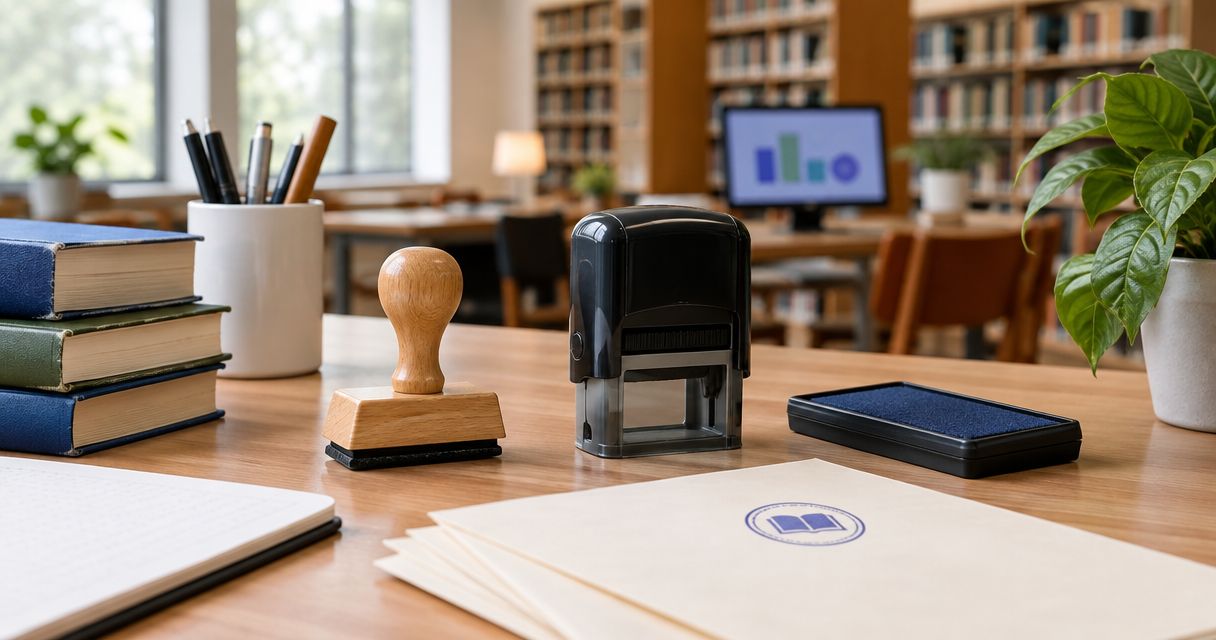
Custom stamps for librarians standardize ownership marking, due-date tracking and item processing so every branch handles materials the same way, whether that's a single reading room or a multi-branch public library system across Toronto and the GTA.
- Custom stamps for librarians cover ownership marks, due-date rotators and processing stamps in one order.
- Self-inking stamps suit high-traffic circulation desks; pre-inked stamps suit lighter, detailed work.
- Print Fast produces self-inking, pre-inked and traditional rubber stamps for GTA libraries with rush turnaround.
- Test ink colour and imprint on your actual card stock before ordering stamps for every branch.
Why custom stamps matter for libraries
A library runs on the same kind of paperwork any organization does, and a stamp is a practical tool for making that paperwork consistent. The Toronto Public Library 2025 annual report recorded 31.2 million circulation transactions, including 13.3 million physical loans, across 100 branches. At that scale, a clear return-by date and a consistent ownership mark help staff process materials the same way at every desk.
Custom stamps for librarians also standardize donor bookplates, mark items pulled for weeding before a book sale, and route interlibrary loans back to the right branch. Print Fast prints everything from ownership marks to self-inking stamps built for notaries that libraries adapt for daily circulation use. None of this needs software — it needs a stamp built for the job and used the same way at every desk.
How to choose and order custom stamps for your library
Define what each stamp needs to do
Before ordering anything, list every task a stamp currently handles by hand or could replace a handwritten note. Most libraries need several stamp designs, not one universal stamp.
- Ownership or property marking on the title page, edge, or inside cover
- Due-date or return-by rotating stamp for circulation
- "Withdrawn" or "Discard" stamp for weeded items headed to sale or recycling
- Donor bookplate or gift acknowledgment stamp
- Interlibrary loan routing or "Return to [branch]" stamp
- Processing stamp confirming cataloguing or accession
Decide which jobs actually need a stamp
Not every workflow needs a physical stamp. A printed label or a handwritten note works fine for low-volume, one-off tasks — save the stamp budget for anything staff do dozens of times a week.
- High-frequency tasks like daily check-in and check-out justify a dedicated stamp
- One-time tasks, like a donor plaque for a single collection, often don't
- Anything read by multiple staff with different handwriting is a stamp candidate
- Anything touching archival or rare materials needs review before any ink touches the page; the Canadian Conservation Institute's paper-care guidance recommends minimizing unnecessary handling and avoiding actions that can damage paper objects
Match the stamp type to the job
Once you know what needs stamping, pick the mechanism. A high-traffic circulation desk and a rare-books room need different tools.
- Self-inking: internal cartridge re-inks with every strike, the standard choice for busy front desks
- Pre-inked: finer imprint lines, better for detailed logos or small text
- Traditional rubber stamp with a separate pad: cheapest per unit, slower per use, easiest to swap ink colour
- Date-band or rotating stamps: built specifically for due-date and processing workflows
- For budget-conscious branches, the same compact ordering approach used for small business invoicing stamps keeps a small stamp set affordable without sacrificing quality
Design the imprint text and layout
Staff and patrons read the imprint at odd angles, on uneven paper, often in low light. Keep it legible at a glance.
- Library or branch name, short enough to scan in a second
- A due-date line with room for legible handwriting or a rotating date band
- Address or barcode reference only if the workflow actually requires it
- Skip fine serif fonts under 8pt — they blur on porous paper
- Test the layout on the actual stock (hardcover title page, paperback, library card) before finalizing
When a branch needs several small custom designs in one batch — a branch logo, a donor mark, a discard mark — the same kind of set that artists and makers order for marking their work covers the same ground for a library at a similar scale.

Choose ink colour for visibility and archival stability
Ink colour affects both legibility and the condition of older or rare materials.
- Black or dark blue for permanent ownership and processing marks — highest contrast, least fading over time
- Red for "Withdrawn," "Discard," or attention-flagging stamps
- Avoid oil-based or solvent inks on anything heading into long-term archival storage
- Test on a scrap page from the actual collection, not a blank sheet, before committing to a full order
Set sizes and quantities per desk and branch
A single-branch library needs a different order than a five-branch system.
- One stamp per active circulation desk at minimum — sharing one stamp across desks slows every transaction
- A backup stamp per desk for the two highest-use designs: ownership and due-date
- Match stamp size to the smallest surface it hits — a library card needs a compact stamp, not a full-page design built for a title page
- Order extra ink pads or refills before the current one runs dry, not after
Test before rollout
Run a small batch across every material type the library handles before ordering for every branch in 2026.
- Hardcover title pages
- Paperback covers
- Library cards or spine labels
- DVD or media cases if the collection includes non-print items
- Confirm the imprint reads clearly on both the darkest and lightest cover stock in the collection
Stamp types compared for library use
| Option | Best for | Key limitation |
|---|---|---|
| Self-inking stamp | High-traffic circulation desks, daily use | Internal ink cartridge needs replacement; colour can't be swapped instantly |
| Pre-inked stamp | Fine detail, small logos, precise text | Lower impression count before drying out under heavy daily use |
| Traditional rubber stamp + pad | Low-budget or low-volume branches | Slower per stamp; ink pad dries and needs separate replacement |
| Rotating date-band stamp | Due-date and processing workflows | Limited to date or short-code use, not a general-purpose ownership stamp |
A busy circulation desk wins with a self-inking stamp; a rare-books room or low-volume branch does fine with a traditional pad-and-stamp setup.
Common mistakes libraries make with custom stamps
- Using the wrong ink on archival or rare materials. A permanent, oil-based ink meant for cardstock can bleed or fade unpredictably on older paper — test on scrap from the actual collection first.
- Ordering one stamp for every job. A single do-everything stamp reads worse on every surface than three purpose-built stamps sized for their specific task.
- No backup stamp at high-traffic desks. When the only due-date stamp jams or dries out mid-shift, the desk falls back to handwriting and consistency drops for the rest of the day.
- Skipping the test print. Ordering a full multi-branch set before confirming the imprint reads clearly on the library's actual card stock and cover types wastes the whole order.
- Not standardizing placement across branches. If one branch stamps the title page and another stamps the inside cover, recovery and audits get harder, not easier.
Ready to order library stamps?
Rush and same-day stamp printing for Toronto and GTA libraries.
FAQ
What's the best custom stamp type for a busy library circulation desk?
A self-inking stamp is the best fit for a busy circulation desk because it re-inks with every strike and needs no separate pad. Pre-inked stamps work better for finer logo detail but wear out faster under heavy daily use.
Is a self-inking stamp better than a pre-inked stamp for library use?
For high-volume daily stamping, yes — self-inking stamps hold up better under repeated use. For detailed small text or fine logos used less often, a pre-inked stamp gives a cleaner imprint.
Can custom stamps be used safely on rare or archival books?
Only after testing the specific ink on a scrap page from the collection. Oil-based or solvent inks can bleed or fade unpredictably on older paper, so archival items need a separate review before any stamp touches them.
How many stamps does a library actually need?
Most libraries need at least one stamp per active circulation desk, plus a backup for the two highest-use designs: ownership and due-date. A five-branch system needs a set per branch, not one shared stamp.
What ink colour should a library use for withdrawn or discard stamps?
Red is standard for withdrawn or discard stamps because it flags the item clearly against black or blue ownership and processing marks already on the page.
Do library stamps need to match across branches?
Yes. Standardized placement and design across branches makes recovery, audits and staff training faster than each branch improvising its own stamp location.
How fast can a library order custom stamps in Toronto?
Print Fast offers same-day and rush turnaround on custom stamp orders for Toronto and GTA organizations, which covers a library needing a replacement stamp before a busy circulation week.
What's the difference between a due-date stamp and a processing stamp?
A due-date stamp tracks when an item is due back and usually uses a rotating date band. A processing stamp confirms an item has been catalogued or accessioned and doesn't need a changing date.
One last thing
Order a spare self-inking stamp for every high-traffic desk before the busiest season of 2026, not after the current one dries out. Circulation volume spikes around school terms and summer reading programs, and that's exactly when a dead pad forces staff back to handwriting and consistency breaks down across the desk.


