
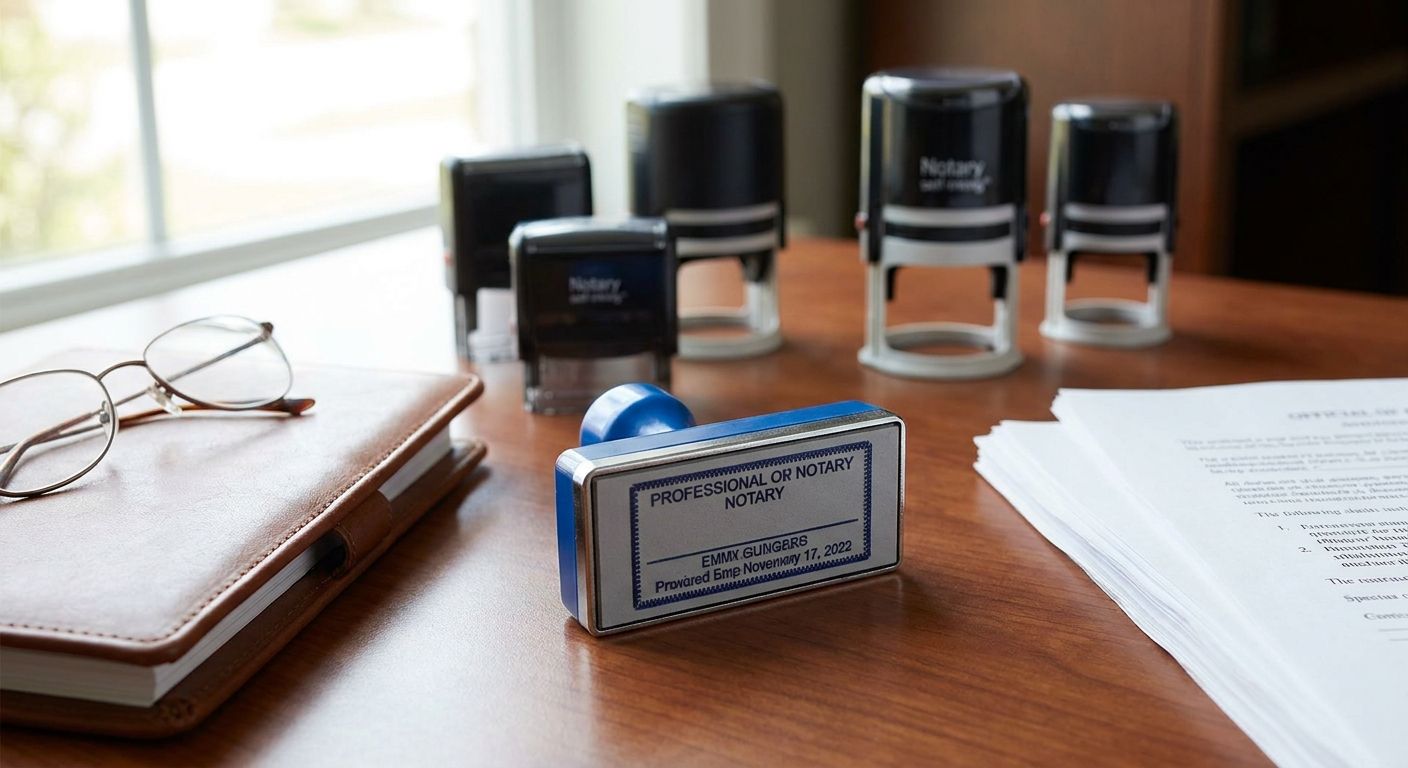
Notary self inking stamps are pre-inked rubber stamps built into a self-inking mount, designed to let a commissioned notary apply a compliant, repeatable impression on hundreds of documents without a separate ink pad. Notaries need a different stamp than a general office user: the wording, size and ink colour on the stamp often have to match provincial commission rules exactly, and a rejected or illegible stamp can hold up a closing, an affidavit or a certified copy.
- Notary self inking stamps in a 1-5/8 x 2-1/2 inch format (the Trodat 4913 size) cover most Canadian provincial wording requirements in 2026.
- Confirm your province's exact stamp wording before ordering — a reorder costs more time than getting it right once.
- Self-inking stamps beat pre-inked and traditional rubber stamps for notaries doing 10+ signings a week.
- Print Fast handles rush and same-day custom quotes for notary stamps and supporting print materials in the GTA.
- Order a backup stamp with your first one — a lost or dried-out stamp shouldn't stop your practice.
Why notary stamps matter for your practice
A notary's stamp is the visible proof that a document was executed under their commission. Documents rejected for a smudged, faded or incorrectly worded stamp usually mean a client has to come back, which is worse for a small or solo notary practice than for a large firm with backup staff. Print Fast works with Toronto-area professionals who need rush turnaround on the print materials that support a notary practice — presentation folders, business cards and signage — and the same logic applies to stamps: order early, order compliant, and keep a spare.
Self-inking stamps matter specifically because notaries repeat the same action dozens of times a week. A stamp built for occasional home-office use won't survive that pace; the ink pad inside dries out faster than a stamp designed for high-volume professional use, and a faint impression on a certified true copy can get flagged by a bank, court clerk or land registry office in 2026 just as easily as it would have a decade ago.
How to choose and order notary self inking stamps
Confirm your province's stamp requirements
Every Canadian province regulates who can notarize and what a notary stamp has to show. Don't guess — check before you design anything.
- Contact your provincial law society, notary regulator or the ministry that issued your commission
- Note the exact required wording (full legal name, title, province)
- Check whether a commission number or expiry date must appear on the stamp
- Confirm the required ink colour — many provinces specify black for notarial acts
- Ask whether an embosser or raised seal is required in addition to the ink stamp
Pick the right stamp format
Three formats cover almost every notary use case, and each fits a different signing volume.
- Self-inking stamp: built-in ink pad, fastest repeated use, best for daily signings
- Pre-inked stamp: sharper, cleaner impression, better for documents that get scanned or photocopied often
- Traditional rubber stamp with separate pad: lowest volume tolerance, needs a stamp pad kept nearby
- Pocket or travel stamp: smaller footprint for notaries who sign off-site or at client locations
Draft your exact stamp text
Get the wording right on paper before it goes into a die. This is the step that prevents a reorder.
- Spell your full legal name exactly as it appears on your commission certificate
- Include your title ("Notary Public") and province as required
- Add a commission number or expiry date only if your regulator requires it
- Leave the layout uncluttered — three or four lines maximum for legibility
- Double-check spacing and capitalization against your regulator's sample, if one is provided
Choose a durable stamp size
Size affects both legibility and how well the stamp reads after a document is scanned or faxed.
- A common self-inking notary stamp size is 1-5/8 x 2-1/2 inches (the Trodat 4913 format), which fits most provincial wording without crowding
- Round stamps are common where an embosser-style layout is preferred
- Test font size at the smallest legible point before finalizing the die
- Leave a margin around the text so ink doesn't bleed to the edge on repeated use
Order through a fast-turnaround print shop
Once your wording and size are locked, ordering speed matters if your commission start date or a client closing is close. Print Fast takes custom quotes on stamps alongside the business cards and presentation folders notaries and legal professionals order together, with next-day business card printing as an example of the rush turnaround built into the same order process.
- Confirm rush options (1Hr, Same Day, 24Hr) if your first signing is imminent
- Ask for a custom quote that bundles your stamp with business cards or folders
- Use local delivery in the GTA instead of waiting on shipping
- Get live support to confirm wording before the die is cut, not after
Test the impression before your first notarization
A quick test run catches problems before they show up on a client's document.
- Stamp on the actual paper stock you'll notarize most often
- Check for smudging or ink bleed at the edges of letters
- Compare the impression against your regulator's sample wording if one exists
- Confirm the ink dries fast enough for immediate scanning or photocopying
Maintain and re-ink your stamp
A self-inking stamp isn't maintenance-free. Plan for it the same way you'd plan for a printer running low on toner.
- Re-ink only with the colour your province requires
- Clean the stamp face periodically with a stamp-safe cleaner, not water alone
- Replace the stamp once impressions stay faint after re-inking
- Store the stamp away from direct heat, which dries the internal pad faster
Keep a backup stamp on hand
A lost, stolen or dried-out stamp is a bigger problem for a solo notary than for a large office with shared equipment.
- Order two identical stamps at the same time to save a second setup fee
- Store the backup separately from your desk stamp
- Update both stamps together when your commission renews with a new expiry date
- Travel with the backup if you notarize documents off-site
“If the ink pad fades before your commission does, you bought a stamp built for occasional use, not for a daily notary practice.”
Comparing notary stamp options
| Option | Best for | Starting price | Key limitation |
|---|---|---|---|
| Self-inking stamp | High-volume, daily signings | Custom quote | Ink pad dries out and needs periodic re-inking |
| Pre-inked stamp | Documents that get scanned or photocopied often | Custom quote | Can bleed on paper if over-pressed |
| Traditional rubber stamp + pad | Occasional or low-volume notarizing | Custom quote | Slower per use; needs a separate ink pad |
| Notary embosser/seal | Provinces requiring a raised seal | Custom quote | Doesn't photocopy or scan; needs an ink stamp alongside it |
A self-inking stamp is the right default for any notary signing more than a handful of documents a week; the embosser only makes sense as an add-on where your province requires a raised seal.
Get a custom quote on notary stamps
Rush and same-day options available for Toronto and GTA notaries.
Common mistakes notaries make with stamps
- Ordering before confirming wording — a stamp that's missing a required commission number gets rejected and has to be reordered, at your cost and your client's expense of time.
- Using the wrong ink colour — some provinces require black ink specifically for notarial acts; a stamp inked in blue or purple can be flagged on a certified copy.
- Waiting until the commission is issued to order — the gap between commission approval and stamp delivery shouldn't be your first client's problem.
- Skipping the backup stamp — a single point of failure is a bad plan for a service you can't perform without the right tool.
- Choosing a size too small to stay legible after scanning — text that reads fine on paper can blur into an unreadable smear after a bank or court scans the document.
FAQ
What's the best self-inking stamp for notaries in 2026?
A self-inking stamp sized around 1-5/8 x 2-1/2 inches, in the ink colour your province requires, covers most Canadian notary needs in 2026. Confirm exact wording with your provincial regulator before ordering.
Do notary stamps need to say "Notary Public" in Ontario?
Ontario notary stamps generally need to show the notary's full legal name and title as commissioned. Check the current wording requirement with the ministry that issued your commission before finalizing your stamp design.
Is a self-inking stamp better than a pre-inked stamp for notaries?
Self-inking stamps are faster for high-volume daily signings because the ink pad is built in. Pre-inked stamps give a sharper impression, which matters more if your documents are scanned or photocopied often.
How much does a notary stamp cost in Canada?
Pricing depends on size, format and customization, so request a custom quote rather than assume a flat rate. Bundling a stamp order with business cards or presentation folders can simplify the process.
Can I use any ink colour on a notary stamp?
No. Many provinces require a specific ink colour, often black, for notarial acts. Verify the requirement with your provincial regulator before ordering ink or re-inking an existing stamp.
Do notaries need both a stamp and an embosser?
Only if your province requires a raised seal in addition to the ink stamp. An embosser alone won't photocopy or scan, so most notaries still need an ink stamp for document copies.
How fast can I get a notary stamp made in Toronto?
Rush print shops in the GTA offer same-day and 24-hour turnaround on custom stamps when wording is confirmed in advance. Same-day options depend on order timing and design approval.
How often do I need to replace a self-inking stamp?
Replace it once impressions stay faint after re-inking with the correct colour. High-volume notaries typically re-ink more often than occasional users before a full replacement is needed.
One last thing
The detail that trips up more new notaries than any pricing question: the stamp wording has to match the commission certificate exactly, down to middle initials and title format. Draft the wording, get it confirmed by your regulator or a colleague who's been through the process, then order — reordering because of a typo costs more time in 2026 than the few extra minutes of proofreading ever will.