Custom stickers for ice cream shops and dessert brands need to survive cold, condensation, and constant handling while still selling the product on sight. A dessert business has different sticker demands than a dry-goods brand: labels go on pint lids that sweat, cups that get scooped from a freezer case, and bags that customers photograph before they open. Getting the material and shape wrong means peeling edges and smeared ink within a day.
- Waterproof vinyl or BOPP stock is the only safe choice for custom stickers for ice cream shops in 2026 — paper labels fail in freezer condensation.
- Kiss-cut sheets work for retail hand-outs; roll labels are faster for high-volume pint and cup runs.
- Order a physical proof before any run over 250 units — screen color rarely matches printed color on clear stock.
- PrintFast prints custom stickers with same-day and rush options for Toronto/GTA dessert brands scaling for markets and pop-ups.
Why custom stickers matter for ice cream shops and dessert brands
A sticker on a pint lid or a bakery box is often the only branding a customer sees before they decide to follow you online or come back next week. Dessert businesses sell on impulse and repeat visits more than almost any other food category, and packaging is doing marketing work that a menu board can't.
Most ice cream and dessert brands are also seasonal or event-driven — farmers markets in summer, holiday gift boxes in December, a new flavor drop that needs new stickers fast. That means the print partner matters as much as the sticker itself: a shop that needs 500 pint labels before a Saturday market can't wait a week for proofs and a print run.
Custom stickers for ice cream shops work best on waterproof vinyl or BOPP stock with a matte or gloss laminate — paper-based labels are the wrong call for anything that touches a freezer or a wet cup. That's the one line worth remembering before you order anything.
Choose your sticker material for freezer and moisture conditions
The material decision comes before design, size, or shape. Get this wrong and every other choice is wasted.
- Use waterproof vinyl for pint containers, tubs, and anything stored below freezing
- Use BOPP (biaxially-oriented polypropylene) for a lower-cost waterproof option on flat surfaces like bags and boxes
- Avoid uncoated paper stock entirely for anything that contacts ice, condensation, or a cooler
- Choose a matte laminate if the sticker sits under store lighting that causes glare on gloss
- Choose gloss if the goal is shelf pop for a retail or grocery placement
Match the sticker shape to your packaging
A circle sticker on a square lid wastes space and looks like an afterthought. Shape follows container, not the other way around.
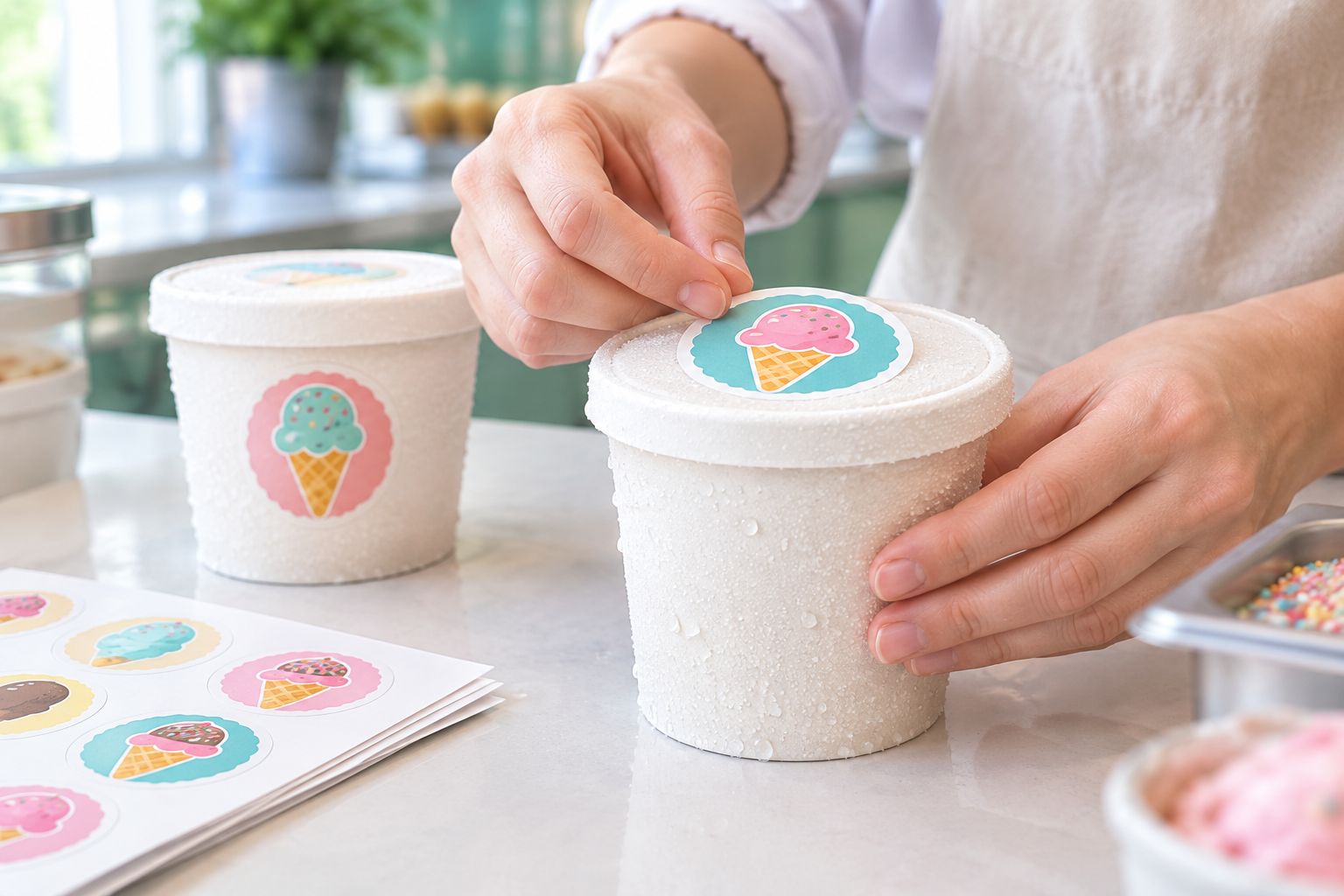
- Die-cut circles for pint and quart lids
- Die-cut ovals or custom shapes for cup sleeves and cone wrappers
- Rectangle labels for bakery boxes and take-out bags
- Custom die-cut shapes (a scoop, a cone, a slice) for brand recognition on merchandise and packaging
Design for shelf and freezer visibility
Stickers on frozen goods sit in low light behind fogged glass more often than they sit under retail spotlights. Design has to survive that.
- Use high-contrast color combinations — dark backgrounds with white or bright text read through frost
- Keep the flavour name and allergen information legible from arm's length, and follow the Canadian Food Inspection Agency's allergen labelling requirements for packaged products
- Avoid thin script fonts under 8pt; they blur once condensation forms
- Test the label under a phone flashlight in a dim room before finalizing artwork
Pick a size that fits your smallest container
A label designed for a pint often gets forced onto a 4oz sample cup later. Size the design system, not just one SKU.
- Start with your smallest container size and design the label to that footprint
- Scale up for larger containers rather than shrinking a detailed design down
- Leave a minimum 2mm bleed on all die-cut shapes to avoid white edges after cutting
- Confirm the label diameter doesn't overlap the container's seam or lid edge
Decide between roll labels and kiss-cut sheets
How you order the sticker changes how fast you can apply it at the counter or on the packing line.
- Roll labels dispense one at a time and suit high-volume pint or cup labeling
- Kiss-cut sheets work better for retail hand-outs, merchandise, and low-volume runs
- Roll format speeds up a packing line during a busy Saturday service
- Kiss-cut sheets are easier to peel individually for customers building their own sticker sheet
This is the point where checking custom labels for home bakers and small food brands helps — the labeling logic for a home bakery scaling into wholesale overlaps directly with an ice cream shop moving from single-location to grocery placement.
Set your turnaround for seasonal and pop-up demand
Dessert brands run on events more than most food businesses — a farmers market Saturday, a holiday pop-up, a new flavor launch tied to a social post.
- Build in a same-day or next-day print buffer for last-minute flavor changes
- Order extra stock ahead of predictable seasonal spikes (Canada Day, back-to-school, December)
- Keep a standing reorder template so a repeat run doesn't need a new design cycle
- Confirm rush pricing and cutoff times with your printer before the busy season hits, not during it
Options like same-day sticker printing for product launches exist specifically for this — a new flavor that needs packaging by Friday shouldn't force a five-day print schedule.
Order a proof before a full run
Screen color and printed color rarely match exactly, and clear or metallic stock makes the gap worse.
- Request a physical proof for any run over 250 units
- Check color accuracy against your actual container, not a white background
- Confirm the die-cut line clears all text and logo edges with margin
- Approve the proof in writing before the full run starts, since reprints cost time you don't get back in season
Comparison: sticker options for ice cream shops and dessert brands
| Option | Best for | Key limitation |
|---|---|---|
| Waterproof vinyl, die-cut | Pint lids, tubs, freezer packaging | Higher material cost than paper stock |
| BOPP roll labels | High-volume cup and container labeling | Not ideal for irregular shapes without extra die tooling |
| Kiss-cut sheet stickers | Retail hand-outs, merchandise, sample packs | Slower to apply one-by-one on a packing line |
| Clear vinyl stickers | Window decals, glass display cases | Low contrast on clear or light backgrounds |
Verdict: waterproof vinyl die-cut stickers are the default choice for any ice cream shop or dessert brand putting labels on frozen or wet packaging — everything else is a workaround.
Common mistakes ice cream shops and dessert brands make
- Ordering paper labels because they're cheaper, then reprinting within weeks once they peel or smear in the freezer case
- Designing at desktop screen brightness instead of testing under store lighting or through frosted glass
- Skipping the proof step on a first order, then discovering the die-cut line clips the logo on a 500-unit run
- Sizing the sticker for the largest container only, which forces a redesign the moment a sample-size cup gets added to the menu
- Waiting until a launch week to place a rush order, when a standing reorder template would have avoided the scramble entirely
Cross-industry patterns show up too — many of the same shape, size, and material tradeoffs apply to custom stickers for food trucks, since both categories deal with condensation, handling, and fast-turnaround seasonal demand.
Get custom stickers printed fast
Same-day and rush options for pint labels, cup stickers, and packaging runs.
FAQ
What's the best sticker material for ice cream containers?
Waterproof vinyl is the best material for ice cream containers in 2026 because it resists condensation and freezer temperatures without peeling. BOPP is a lower-cost waterproof alternative for flat surfaces like bags and boxes.
Are paper stickers okay for dessert packaging?
No, uncoated paper stickers fail on anything that touches ice, condensation, or a cooler. They smear and peel within hours in freezer conditions, so waterproof vinyl or BOPP is the safer choice for pints, tubs, and cups.
How much should I order for a new flavor launch?
Order enough to cover expected sell-through plus a buffer for reorders, and confirm same-day or rush turnaround with your printer ahead of the launch date. A standing reorder template avoids a scramble the next time a flavor sells out faster than expected.
Should I use roll labels or kiss-cut sheets for my dessert brand?
Roll labels suit high-volume pint or cup labeling on a packing line, while kiss-cut sheets work better for retail hand-outs and low-volume merchandise. Choose based on how the sticker gets applied, not just cost per unit.
How do I make sure sticker colors match my brand?
Request a physical proof before any run over 250 units, since screen color and printed color rarely match exactly on clear or metallic stock. Approve the proof against your actual container, not a white background.
What size should my ice cream sticker be?
Design to your smallest container first, typically a sample or 4oz cup, then scale the design up for larger sizes. This avoids a redesign when a new container size gets added to the menu.
Can I get stickers printed same-day for a dessert pop-up?
Yes, same-day and rush sticker printing is available for last-minute flavor changes or pop-up events through PrintFast's Toronto-based service. Confirm cutoff times ahead of the busy season, since demand spikes around markets and holidays.
What shape works best for pint and cup lids?
Die-cut circles fit most pint and quart lids directly, while custom shapes like a scoop or cone work well for cup sleeves and merchandise. Match the die-cut shape to the container, not a generic template.
One last thing
The detail most dessert brands skip is testing a sticker under actual freezer conditions before committing to a full run — a proof that looks perfect on a countertop can fog, curl, or lose adhesion once it sits at freezer temperature for 24 hours. Ask for a sample applied to a frozen container, not just a flat proof sheet, before locking in a print run for 2026.