
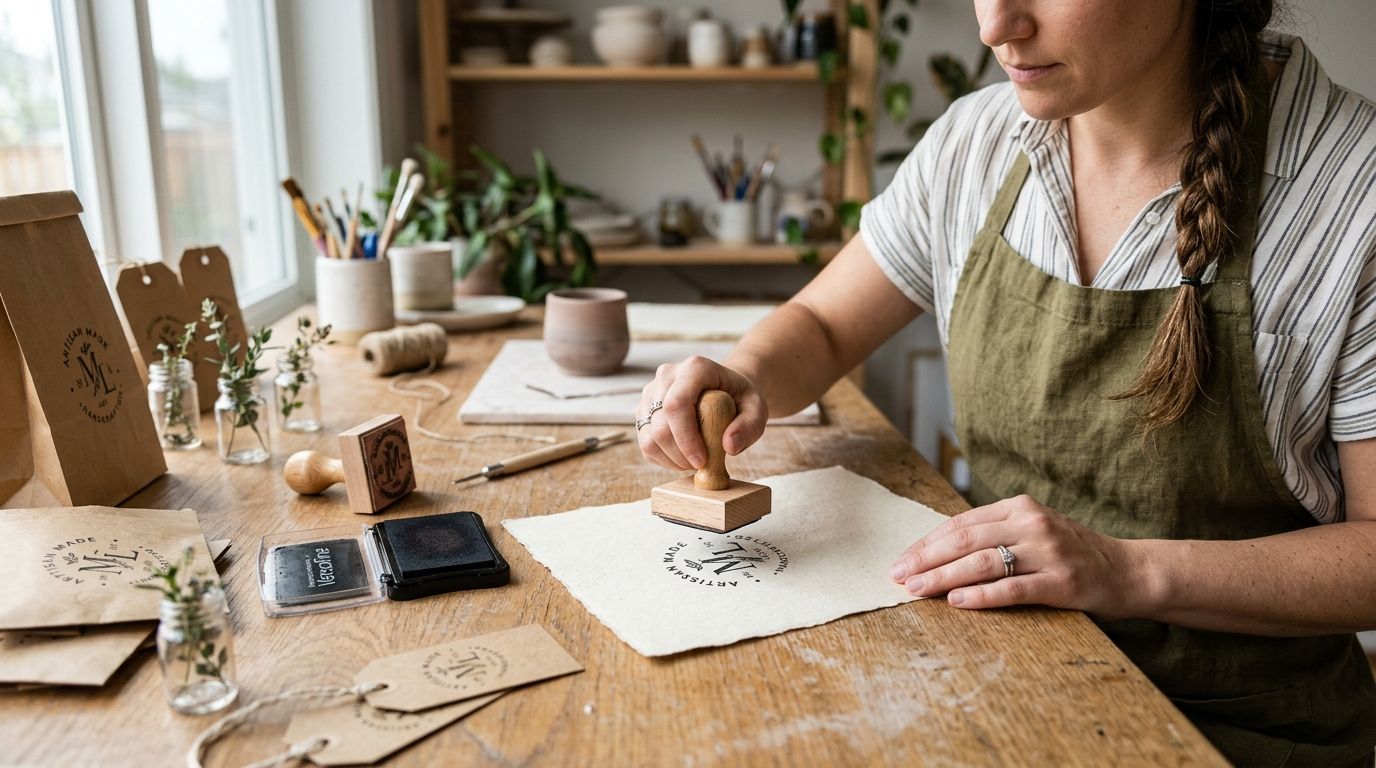
Custom stamps for artists and makers are self-inking or hand-mounted tools that print a signature, logo, or care instruction in one press, built to replace hand-signing or hand-writing on every finished piece. Unlike a general office stamp, an artist's stamp has to survive contact with paint, clay, wood grain, or fabric without smearing, and it has to look intentional on a small print the same way it looks intentional on a large canvas.
- Custom stamps for artists work best as self-inking for high-volume packaging and pre-inked for signature-style branding on finished art.
- Match ink colour and stamp size to the surface first — a stamp built for kraft paper bleeds on raw canvas.
- Order a physical proof before a full run; digital previews miss how fine linework holds up at small scale.
- Print Fast produces custom stamps for artists and makers in Toronto with same-day and rush turnaround options.
Why custom stamps matter for artists and makers
Every piece an artist or maker sells needs some form of authentication or branding — a signature, an edition number, a care instruction, a shop logo on the back of a print. Doing that by hand on 50 prints or 200 candle labels burns hours that should go into making product, not signing it.
A custom stamp turns that repeat task into one press per item. It also standardizes how the brand looks across every sale, which matters more once a maker starts selling through wholesale accounts, markets, or an online shop rather than one-off commissions. The verdict: if you sign, date, or brand more than a handful of pieces a month, a custom stamp replaces the slowest part of your finishing routine. Print Fast handles that custom stamp work for Toronto and GTA studios on rush timelines, and you can start from the PrintFast.ca service list.
Choose your stamp type first
The biggest decision is mechanism, not design. Self-inking stamps carry their own ink pad inside the housing and reset automatically after each press. Pre-inked stamps use a solid ink reservoir inside the die itself, which gives finer detail on small text. Traditional wood-mount stamps need a separate ink pad but work better on uneven or textured surfaces like raw wood or leather.
- Self-inking: best for repeat packaging tasks — shipping boxes, tags, invoices
- Pre-inked: best for fine detail like a signature or small logo under 1 inch
- Wood-mount: best for textured surfaces — wood slices, leather, unfinished ceramics
- Notary-style self-inking units: relevant if your studio also handles signed documentation — the mechanism notes in self-inking stamps for notaries apply to any self-inking order
- Avoid pre-inked for large solid-fill logos — the ink reservoir covers big flat areas less evenly than a fresh pad
Design your imprint for small-format clarity
Most artist stamps run between 1 and 3 inches. Detail that looks fine on a screen at 300% zoom often turns into a smudge at actual size. Strip the design down before sending it to print.
- Convert gradients to solid line work — stamps cannot reproduce shading
- Keep line weight above 0.5pt so ink does not fill in thin strokes
- Test your signature or logo at actual print size, not zoomed in
- Leave clear space around the border so ink does not bleed onto the edges
- Skip small serif fonts under 8pt — switch to a bolder sans-serif for legibility
Match ink colour to your medium
Ink that looks crisp on white cardstock can vanish on kraft paper or bleed on raw canvas. Colour choice is a functional decision here, not just a branding one.
- Black or dark navy: best all-purpose choice for paper tags and invoices
- Brown or sepia tones: better contrast on kraft paper and wood
- Metallic or specialty inks: reserve for finished art pieces, not high-volume packaging
- Test on the actual material you will stamp — not a paper sample — before ordering a full stamp run
Size your stamp to the surface
A stamp sized for a 4-inch shipping label looks oversized on the back of a 5x7 print. Size the stamp to the smallest surface it will regularly touch, then check it still reads clearly at that size.
- Under 1 inch: signature-only stamps for the corner of finished art
- 1 to 2 inches: logo plus small text, ideal for tags and cards
- 2 to 3 inches: full branding block with logo, name and website — best for packaging and boxes
- Over 3 inches: rarely needed for handheld work; a printed label handles larger areas better
Order proofs before a full run
A digital mockup never shows how the die actually presses. Fine text that reads cleanly on screen can clog or blur on the physical stamp. A proof round catches that before hundreds of impressions go wrong the same way.
- Request a physical proof, not just a digital PDF, on any order with fine detail
- Check the proof on your actual packaging material, not plain paper
- Confirm ink saturation — too much ink blurs edges, too little fades fast
- Approve spelling and edition numbering before the full batch runs, since a custom die cannot be edited after production
Build a workflow around packaging and invoicing
Stamps do double duty for makers who both create and sell. One stamp brands the product; a second handles the paperwork side of the business.
- A signature stamp on the back of every print or the base of every ceramic piece
- A logo stamp on kraft paper packaging or the inside of a gift box
- A dated stamp on invoices for wholesale or custom orders — the format notes in custom stamps for small business invoicing cover what belongs on an invoicing stamp
- Return address details on outgoing parcels — pairs with return address labels for small businesses for makers shipping direct to customers
- A care-instruction stamp for handmade textiles, ceramics or wood goods
If most of your sales happen through an online shop rather than in person, the stamp workflow extends into shipping. Makers selling through Etsy or a similar storefront often pair a branding stamp with printed packaging stickers — covered in custom stickers for Etsy and online sellers — so the unboxing matches the stamp on the product itself.
Get a custom stamp quote today
Same-day and rush turnaround options for Toronto and GTA artists and makers.
Care for and re-ink your stamp
A self-inking stamp keeps producing clean impressions if the pad gets re-inked before it dries out completely, not after. A wood-mount stamp lasts longer if it is cleaned after each session rather than left with dried ink in the die grooves.
- Re-ink self-inking pads at the first sign of a lighter impression, not after it fails completely
- Clean rubber dies with a damp cloth rather than solvent, which degrades rubber
- Store wood-mount stamps flat, not stacked, to avoid warping the mount
- Keep a spare ink pad on hand if the stamp runs daily during market season
Comparison: stamp options for artists and makers in 2026
| Option | Best for | Key limitation |
|---|---|---|
| Self-inking stamp | High-volume packaging, invoicing, repeat tasks | Bulkier housing, less precise on very fine detail |
| Pre-inked stamp | Signatures and small logos under 1 inch | Covers large solid fills less evenly |
| Wood-mount stamp | Textured surfaces — wood, leather, unglazed ceramics | Needs a separate ink pad, more setup per use |
| Notary-style self-inking unit | Studios that also handle signed paperwork | Overbuilt for simple product branding |
Verdict: self-inking wins for makers stamping packaging and invoices daily; pre-inked wins for anyone stamping a signature onto finished art.
Common mistakes artists and makers make with custom stamps
- Sizing the stamp to the design instead of the surface — a logo that looks balanced on a mockup often overwhelms a 3x5 tag
- Skipping the material test — ink behaves differently on kraft paper, canvas and glazed ceramic; testing only on office paper misses this
- Choosing pre-inked for large solid-fill logos — the coverage goes patchy long before the same design would fail on a self-inking pad
- Not budgeting time for a redesign — a custom die is not editable, so a rebrand means a new stamp order, not a tweak
- Using one stamp for finished art and shipping boxes — it wears faster and blurs the line between product branding and logistics
Makers who also work in-person markets usually want booth signage that matches the stamped branding — worth reviewing alongside custom table covers for craft fair and market vendors if 2026 is the year the booth setup gets a refresh.
FAQ
What is the best custom stamp for artists signing prints?
A pre-inked stamp under 1 inch works best for signing prints in 2026 because it reproduces fine signature detail more cleanly than a self-inking stamp. Keep line weight above 0.5pt so strokes do not fill in.
Is a self-inking stamp better than a wood-mount stamp for makers?
Self-inking stamps are better for high-volume repeat tasks like packaging and invoicing. Wood-mount stamps handle textured surfaces such as wood, leather and unglazed ceramics better.
How much does a custom stamp cost for a small studio?
Cost depends on stamp size, mechanism and ink type. Request a custom quote with your design and intended surface so the pricing reflects the actual build.
Can a custom stamp print on fabric or ceramics?
Yes, but choose an ink formulated for that surface and test on a scrap piece first. Standard paper ink smears on glazed or heavily textured materials.
How long does a self-inking stamp last?
A self-inking stamp keeps producing clean impressions as long as the pad is re-inked or replaced before it dries out. Cleaning the die after heavy sessions extends its life further.
Do I need a proof before ordering a full stamp run?
Yes. A physical proof on your actual packaging material catches ink bleed and lost detail that a digital mockup misses, and a custom die cannot be edited after production.
What size stamp works best for shipping packaging?
A 2 to 3 inch self-inking stamp fits logo, name and website text clearly on most shipping boxes and kraft paper. Anything larger is usually better handled by a printed label.
Should artists use the same stamp for art and invoices?
No. A small signature stamp for finished art and a separate dated branding stamp for invoices each last longer and keep both uses looking sharp.
One last thing
The step most makers skip is testing ink on the exact material batch they will use for the full run, not a sample sheet from a different roll. Kraft paper varies by supplier in texture and absorbency, and a stamp that reads crisp on one roll bleeds on the next. Run one test impression on the actual packaging stock before committing to a production run in 2026 — it costs nothing and catches the one mistake that is expensive to fix after a few hundred pieces are already stamped.


