
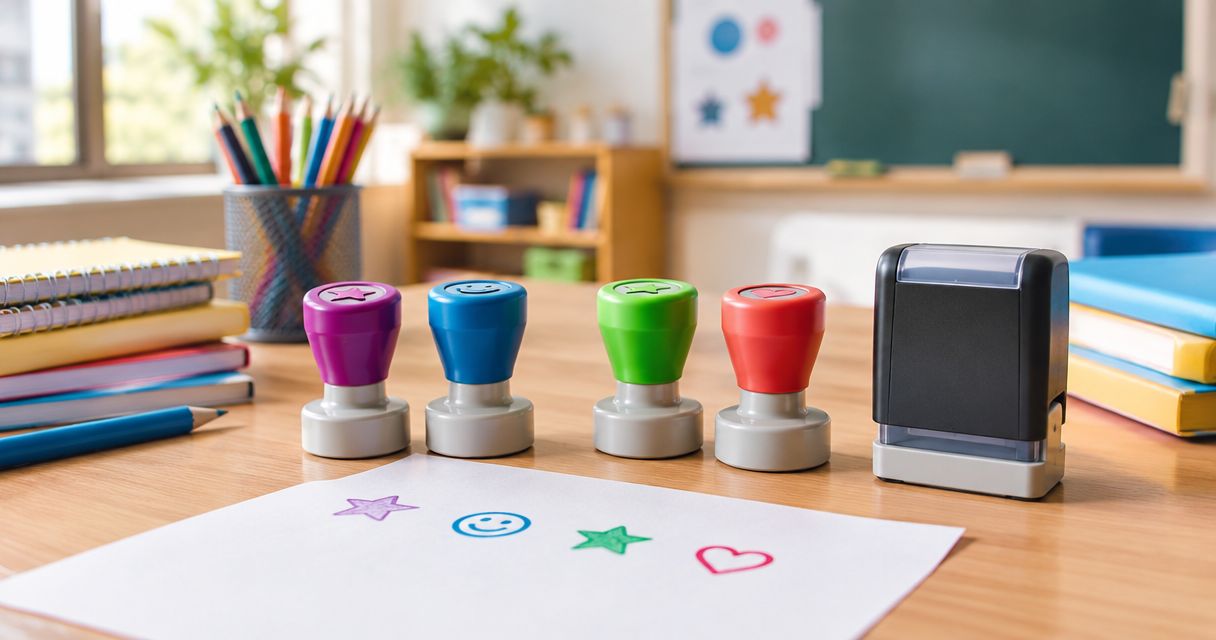
Custom stamps for teachers turn repetitive classroom tasks — grading papers, signing hall passes, checking out library books, sending home forms — into one stamp instead of a handwritten note every single time. Elementary and secondary teachers need stamps that survive daily use, read clearly on photocopies, and don't need a new ink pad every month.
- Self-inking stamps handle 5,000+ impressions before the ink pad needs replacing, making them the default pick for daily grading.
- Custom stamps for teachers work best at 3-5 words per line — cramming a full sentence onto a small stamp face blurs on photocopies.
- Print Fast produces classroom stamps with rush turnaround, which matters most in the weeks before September and again in January.
- Ordering one stamp per teacher instead of one per grade team is the most common budget mistake schools make.
Why custom stamps matter for teachers
A teacher grading 25-30 papers a night writes the same three phrases over and over: "See me," "Great work," "Missing name." A stamp replaces that repetition in one motion. The same logic applies to hall passes, library check-outs, and the stack of permission slips that need a teacher's name and room number every week.
Design principles for classroom stamps overlap with what independent makers already use for branding small items — Print Fast's guide to custom stamps for artists and makers covers the same size and layout constraints that apply to a grading stamp. The difference for a classroom is volume: a teacher's stamp gets used hundreds of times a term, so durability and ink pad life matter more than for a hobbyist.
The core segments inside "teacher stamps"
- Grading and feedback stamps ("Great job!", "Redo," "See me")
- Hall pass and bathroom pass stamps
- Library and classroom book check-out stamps
- Name and room number stamps for take-home folders
- Attendance and late-work date stamps
- Return address stamps for parent mailings
Decide what you actually need stamped
Most teachers order one stamp when they actually need two or three for different jobs. Separate grading stamps from administrative stamps — a "Great Job!" stamp and a hall pass stamp shouldn't be the same physical object passed between a desk drawer and a classroom door.
- List every repetitive task you currently handwrite in a week
- Group tasks by frequency: daily (grading), weekly (passes), occasional (parent mail)
- Decide which tasks need a date field and which don't
- Check whether your school or grade team already has a stamp you'd duplicate
- Note which stamps need to survive being shared between three or four classrooms
Choose self-inking, pre-inked, or traditional rubber
This is the single biggest decision and the one most teachers skip. Each mechanism has a different lifespan, a different feel, and a different failure mode in a classroom drawer full of pencils and paperclips.
- Self-inking stamps: press down, the ink pad flips up automatically, no separate pad to lose. Best for daily grading and hall passes.
- Pre-inked stamps: sharper, finer detail lines, good for signatures or small text, but the stamp itself eventually needs re-inking rather than a pad swap.
- Traditional rubber stamps with a wood or plastic handle: cheapest mechanism, needs a separate ink pad you supply, easy to lose the pad in a drawer.
- Date stamps: a self-inking or traditional stamp with a rotating date band, useful for late-work tracking.
The same mechanical trade-offs show up outside classrooms too — Print Fast's page on self-inking stamps for notaries covers the same self-inking mechanism at a heavier daily-use standard, which is a useful reference if your stamp will get passed between multiple teachers.
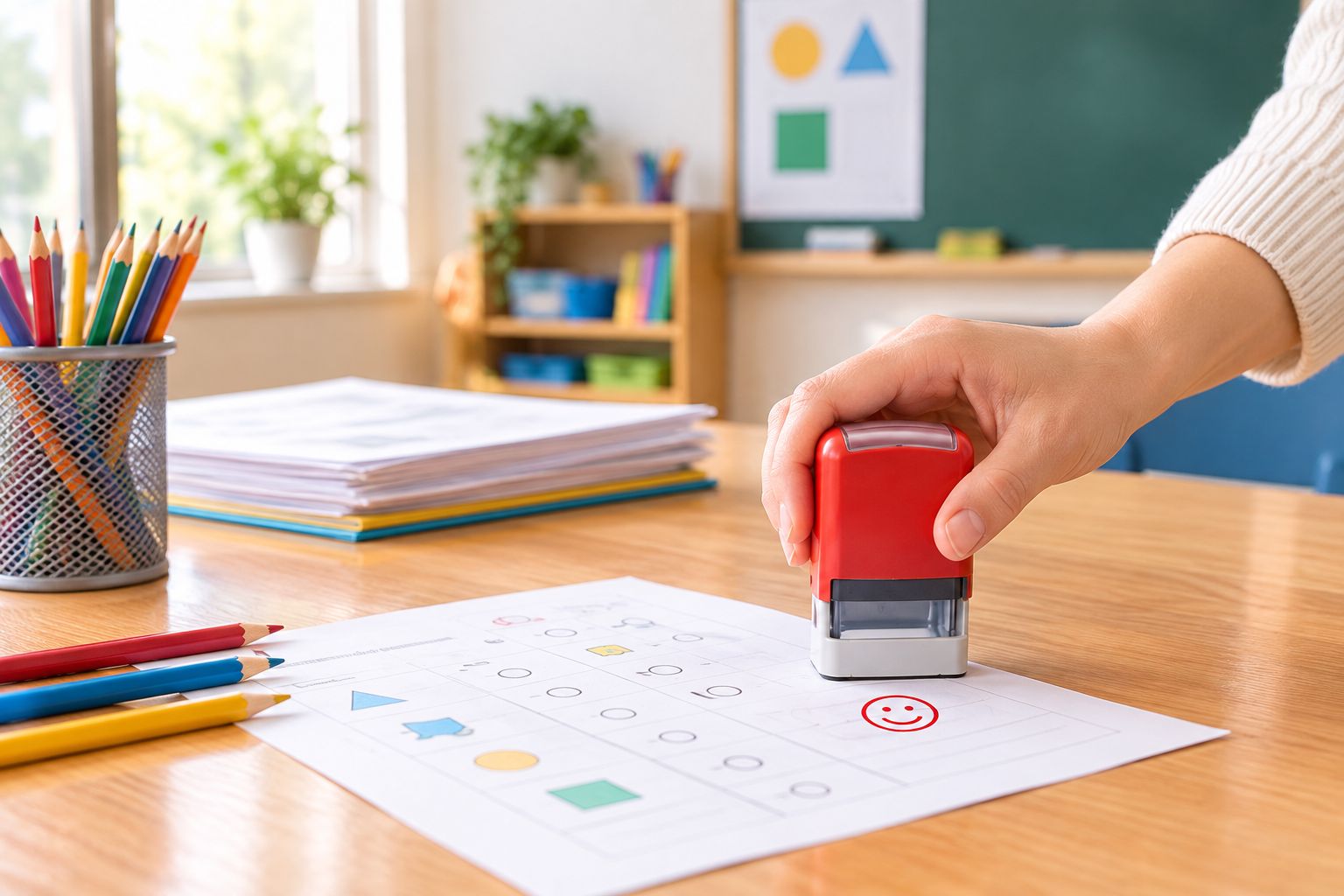
Write and design the stamp text
A stamp face is small — usually under two inches wide. Text that reads fine on a screen turns into a smudged block once it's stamped 200 times on cheap photocopy paper.
- Keep it to 3-5 words per line, no more than three lines total
- Use a sans-serif font for anything that will be photocopied again after stamping
- Skip full sentences — "See me" beats "Please come see me after class"
- Leave a blank line if you'll add a date stamp attachment later
- Test the layout at actual stamp size before ordering, not zoomed in on a screen
Pick a size and ink colour that reads clearly
Size and colour decide whether a stamp is legible on the third photocopy generation of a worksheet, which is where most classroom paper ends up.
- Red and blue read clearly on black-and-white photocopies; green and purple often wash out
- A stamp under 1 inch wide works for margins and small feedback marks
- A stamp closer to 2 inches works for a name-and-room-number block on folders
- Avoid light ink colours (yellow, light pink) on anything that gets copied again
- Match ink colour across a grade team so feedback looks consistent parent-to-parent
Order early instead of during the September rush
Classroom stamp orders spike twice a year: the weeks before the school year starts and again in early January when ink pads run dry from fall use. Ordering during either spike means waiting behind hundreds of other orders.
- Order stamps at the same time as other back-to-school printing, not after the first week
- Build in a few extra business days if the stamp needs school or board approval first
- Ask about rush turnaround if you're ordering after the term has already started
- Reorder ink pads before they run dry, not after a stamp starts printing faint
Standardize across your grade team or department
A single teacher ordering one stamp is the least efficient way to buy. A grade team of five teachers ordering matching "Great Job!" or hall pass stamps together gets consistent branding across every classroom and usually simplifies the order into one invoice instead of five.
- Agree on one wording and one ink colour across the team before ordering
- Assign one person to submit the combined order and design file
- Keep a shared spare stamp in the department office for a lost or broken unit
- Reorder together each fall instead of staggering individual replacements
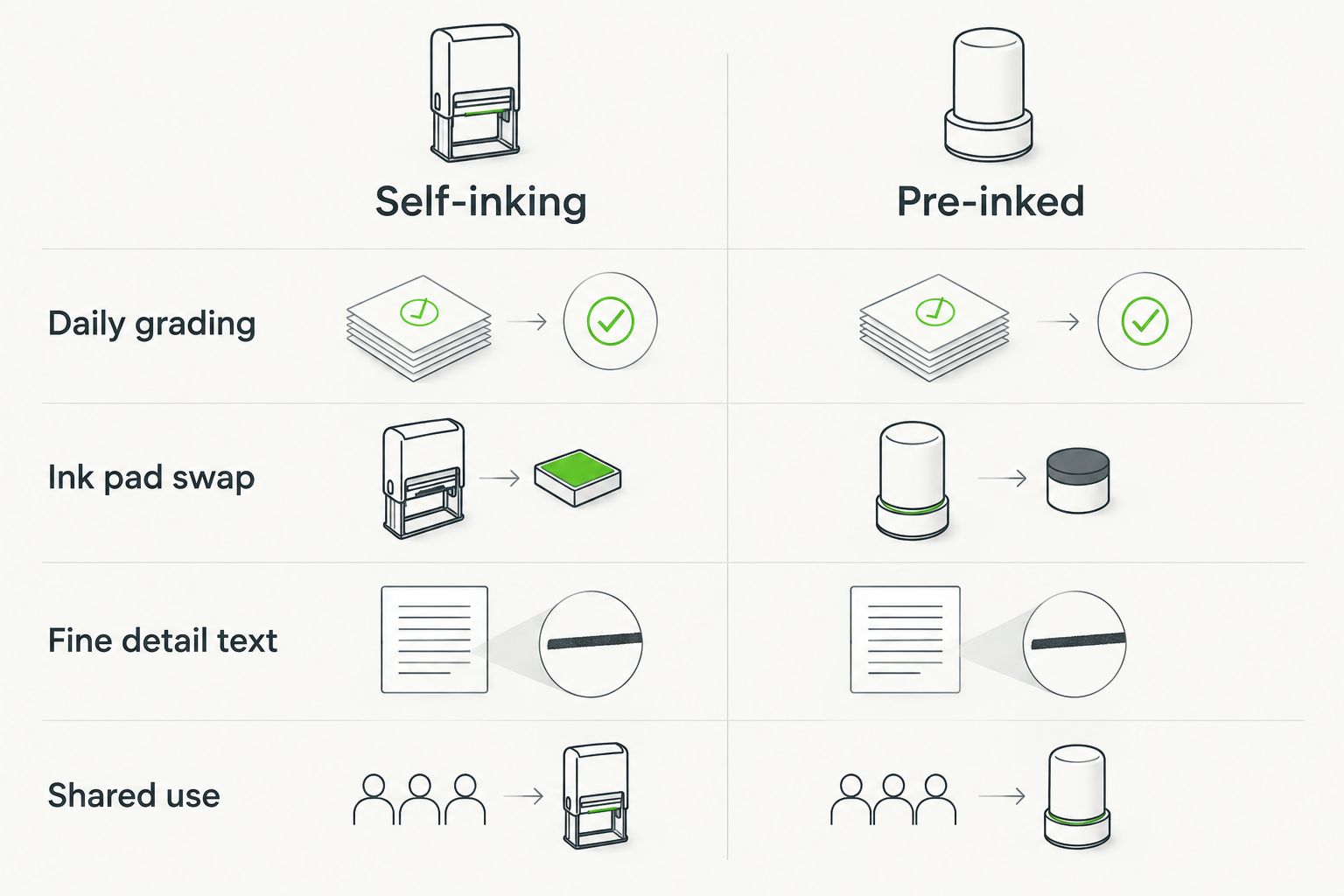
Comparing stamp types for classroom use
| Stamp type | Best for | Key limitation |
|---|---|---|
| Self-inking stamp | Daily grading, hall passes, shared classroom use | Bulkier body than a plain rubber stamp |
| Pre-inked stamp | Fine text, signatures, name stamps | Needs re-inking rather than a quick pad swap |
| Traditional rubber stamp | Budget orders, low-frequency tasks | Requires a separate ink pad you supply and store |
| Date stamp (rotating band) | Late-work tracking, attendance logs | Band needs manual adjustment each day |
A self-inking stamp is the right default for any teacher stamping more than a handful of papers a day in 2026 — it survives shared use across a grade team without a lost ink pad shutting the whole system down.
“A stamp with more than five words on the face is designed for a desk, not a classroom.”
Common mistakes teachers make when ordering stamps
- Ordering one stamp for a five-teacher grade team. One shared stamp means someone's always missing it during grading week.
- Choosing light ink colours that vanish on a photocopy. Yellow and light pink read fine in person and disappear once a worksheet gets copied again.
- Cramming a full sentence onto a small stamp face. Text that fits a screen doesn't fit a two-inch stamp without blurring.
- Skipping a separate hall pass stamp. Reusing a grading stamp for passes confuses students about what the stamp actually means.
- Waiting until the week school starts to order. September and early January are the two busiest stamp-ordering weeks of the year for any print shop.
FAQ
What are custom stamps for teachers used for?
Custom stamps for teachers cover grading feedback, hall passes, library check-outs, attendance dating and name-and-room stamps for take-home folders. Most classrooms need at least two separate stamps rather than one all-purpose stamp.
Is self-inking or pre-inked better for a classroom stamp?
Self-inking is better for daily grading and shared team use because the ink pad is built in and can't be lost in a drawer. Pre-inked suits fine text and signatures but needs re-inking instead of a quick pad swap.
What size stamp is best for grading papers?
Under 1 inch wide is standard for margin feedback marks like "Great job!" or "See me." Larger stamps around 2 inches suit name-and-room-number blocks on folders and forms.
Can I get a rush order on classroom stamps in Toronto?
Rush turnaround is available for classroom stamps, which matters most if you're ordering after the school year has already started rather than during the summer prep window.
How much text fits on a teacher stamp?
Keep it to 3-5 words per line and no more than three lines total. Full sentences blur once a stamp gets used hundreds of times on photocopy paper.
What ink colour is best for stamping schoolwork?
Red and blue read clearly through multiple photocopy generations. Light colours like yellow or light pink wash out once a worksheet is copied again.
Can a whole grade team order matching stamps together?
Yes, and it's the more efficient way to buy. One combined order with matching wording and ink colour keeps feedback consistent across classrooms and usually simplifies invoicing.
Do custom stamps work for library books and take-home folders?
Yes. A name-and-room-number stamp on a folder or a check-out stamp on a book cover replaces handwriting the same information dozens of times a week.
One last thing
The part teachers forget to budget for isn't the stamp — it's the ink pad. A self-inking stamp used daily through a school year typically needs a fresh pad before June, and a faint stamp on a graded paper looks worse to a parent than no stamp at all. Order a spare pad with the stamp itself instead of waiting for the ink to fade mid-term.


