

Cheque printing for property managers is the process of producing accurate, bank-compliant cheques for rent refunds, vendor payments and owner disbursements at the volume a multi-property portfolio actually runs, without a jammed office printer holding up a trust account payout. A single-property landlord can get away with a bank-issued chequebook. A property management company juggling five, ten or thirty trust accounts cannot, because each account needs its own stock, its own audit trail and its own reorder schedule.
- Cheque printing for property managers works best on preprinted security stock, not plain paper from a desktop printer.
- Print Fast in Toronto runs same-day and rush cheque printing for property management companies managing several trust accounts.
- Continuous sequential numbering matters more here than for a single-account small business, because auditors check for gaps.
- NCR carbonless forms cover the vendor authorization paperwork that has to travel with the cheque itself.
Why cheque printing matters for property managers
A property management company isn't printing one cheque design off one account. Most Ontario firms keep a separate trust account per building or ownership group, which means a separate cheque design, a separate signer and a separate audit trail for each one. Mix them up once and reconciliation at year-end turns into a week of tracing which cheque came from which account.
Speed matters just as much as accuracy. Rent refunds, contractor payments and owner distributions all cluster around month-end, and a stock shortage on the 28th is not a problem you can solve with a rush order to your bank. Business cheque printing for small businesses covers the basics of preprinted stock; property managers layer volume, multiple accounts and audit requirements on top of that base.
Preprinted, MICR-compliant, sequentially numbered cheque stock beats plain-paper printing for every property management company handling owner or tenant funds in 2026. That's the one-line verdict. The rest of this guide covers how to set it up.
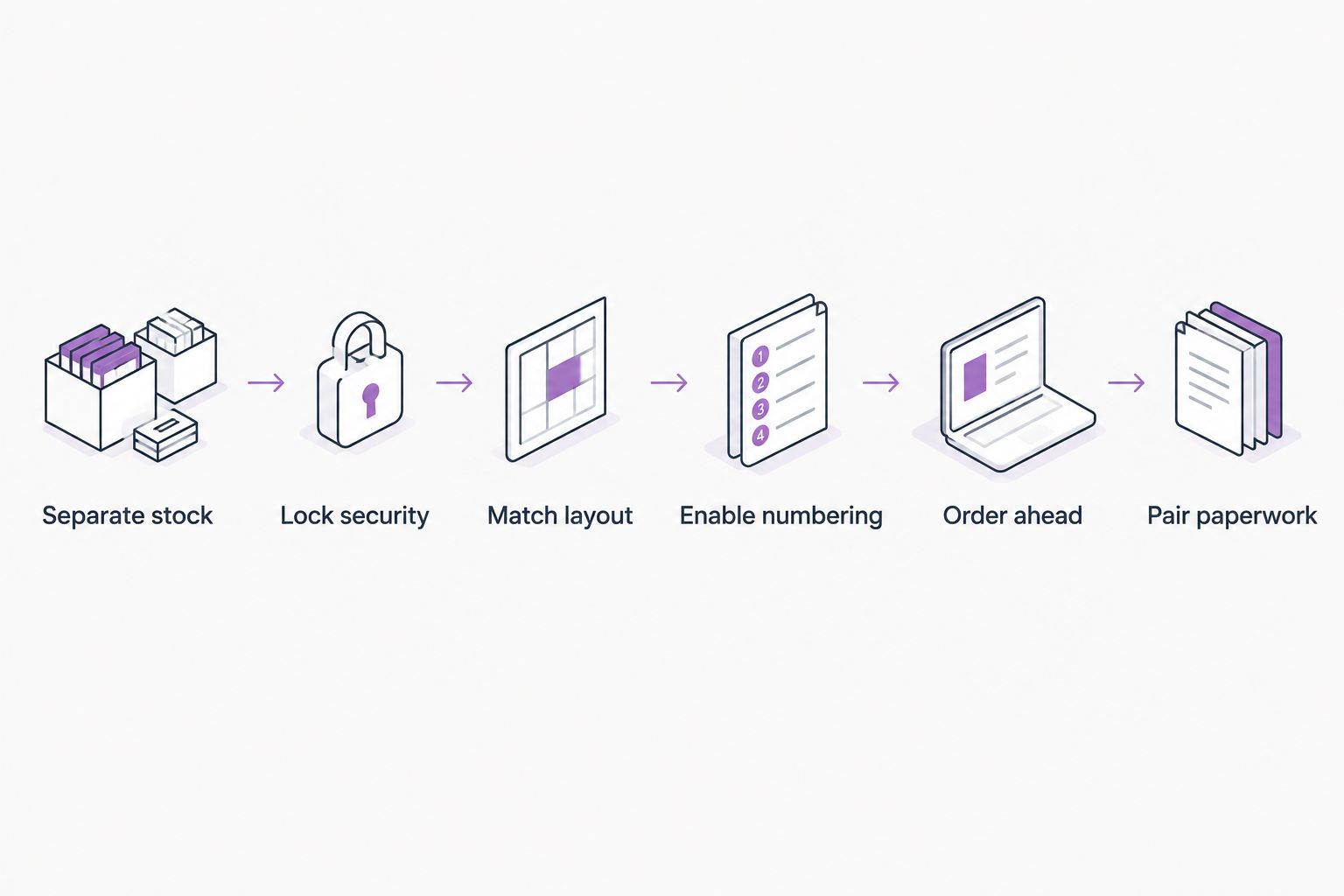
1. Separate your cheque stock by trust account
Don't run every property through one generic cheque template. Each account needs its own visual identity so a bookkeeper can tell them apart at a glance, and so an auditor never has to ask which building a cheque belongs to.
- Assign one cheque design and colour band per property or owner account
- Print voided samples first and file them with that account's paperwork
- Keep locked stock storage per building manager, not one shared office drawer
- Flag disbursement dates so no account's stock runs out mid-cycle
2. Lock down security features before you order
Any cheque touching owner distributions or tenant refunds is a fraud target. The stock itself should do most of the defensive work before a signature ever gets added.
- Choose cheques with a visible watermark and microprinting on the signature line
- Add chemical-reactive paper that shows tampering if someone tries to alter the amount
- Print with toner, not inkjet, since toner resists the solvents used to wash cheques
- Skip photocopiable stock entirely for any account handling owner payouts
3. Match the cheque layout to your accounting software
A cheque that looks right on screen can still fail automated bank processing. Payments Canada records MICR-encoded cheques as computer rejects when the line is damaged or marked, so test your layout before committing to a full print run.
- Confirm the MICR line position matches what Yardi, AppFolio or QuickBooks generates
- Run one test batch before ordering the full quantity
- Keep the signature block clear of any overlapping design element
- Order laser-compatible stock if cheques run through a shared office printer
4. Set up sequential numbering for audit trails
Property management audits check for gaps in cheque numbers before anything else. A reset-per-box numbering scheme makes that check impossible to pass cleanly.
- Request continuous numbering across the full order, not per-box resets
- Log the starting and ending number for every batch in your ledger
- Reconcile physical stock against issued numbers monthly, not once a year
- Flag any skipped or voided number immediately, before month-end close
5. Order ahead of your disbursement calendar
Month-end and quarter-end are when stock runs out, because that's when disbursement volume spikes across every property at once.
- Reorder at a two-week buffer, not when the drawer is already empty
- Bundle multiple property accounts into one order to cut per-run overhead
- Ask about same-day or rush turnaround for accounts caught short unexpectedly
- Build a standing reorder schedule tied to month-end and quarter-end payouts
6. Pair cheques with the paperwork that has to travel with them
A cheque proves payment happened. It doesn't document what the payment was for, and an auditor will ask.
- Use NCR carbonless forms for vendor payment authorizations that need a signature trail
- Attach an invoice or work order stamped as paid to every reimbursement cheque
- Mail owner and tenant cheques in envelopes with matching return address labels
- Keep letterhead consistent across the cheque, the cover letter and the envelope
Comparing cheque printing options for property managers
| Option | Best for | Key limitation | Verdict |
|---|---|---|---|
| Bank-ordered chequebooks | A single low-volume trust account | Slow reorder cycle, no bulk pricing across accounts | Hold |
| Software-generated plain-paper cheques | One-off, non-recurring payments | No security features, easy to alter after printing | Skip |
| Preprinted security cheque stock | Recurring disbursements on one or two accounts | Needs a reorder lead time built into your schedule | Buy |
| Custom preprinted cheques from Print Fast | Portfolios with several trust accounts needing rush turnaround | First order needs accurate MICR specs confirmed with your bank | Buy |
The clear winner for a multi-property portfolio is custom preprinted security stock ordered on a standing schedule — bank chequebooks don't scale past one account, and plain-paper cheques fail fraud checks the moment a bank flags an altered amount.
Get cheques ready before month-end
Same-day and rush cheque printing for property management accounts in Toronto.
Common mistakes property managers make with cheque printing
- Running owner disbursement cheques on plain office paper. It's the single fastest way to get a payment flagged for manual bank review.
- Resetting cheque numbers with every new box of stock. It breaks the continuous numbering an auditor needs to check for gaps.
- Waiting until the drawer is empty to reorder. That turns a routine reorder into a rush order right before a disbursement deadline.
- Using one cheque design across multiple trust accounts. It's the most common reconciliation error bookkeepers report when closing out several properties at once.
- Skipping the test batch. Discovering a MICR mismatch after 500 cheques are already printed costs more than the ten minutes a test run takes.
FAQ
What's the best cheque printing option for property management companies in 2026?
Preprinted security cheque stock with continuous sequential numbering is the best option for property management companies in 2026 because it holds up under bank fraud checks and keeps a clean audit trail. Bank-ordered chequebooks work for a single low-volume account; portfolios with several trust accounts need bulk, rush-capable printing instead.
How much does cheque printing cost for a property management company?
Cost depends on stock security features, order volume and how many trust accounts need separate designs, so check current pricing directly with a print provider. Ask for a quote scaled to monthly disbursement volume rather than a flat per-cheque rate.
Is toner-based printing better than inkjet for cheques?
Toner-based printing is better for cheques because toner fuses into the paper fiber and resists the solvents used to alter amounts. Inkjet ink sits on the surface and lifts easily, which is why banks flag inkjet-printed cheques more often during fraud review.
Can property managers use one cheque design across multiple trust accounts?
No, property managers should assign a distinct cheque design or colour band per trust account so reconciliation and audits don't cross accounts by mistake. Mixing stock between accounts is one of the most common reconciliation errors bookkeepers report on multi-property portfolios.
What is MICR encoding and why does it matter for cheque printing?
MICR, magnetic ink character recognition, is the machine-readable line at the bottom of a cheque that banks use to process payments automatically. A cheque with an incorrect MICR line delays clearing and can bounce back for manual review even when funds are available.
How fast can rush cheque printing be turned around in Toronto?
Same-day and rush cheque printing is available in Toronto for property managers who run short before a disbursement date. Confirm the exact cutoff time with your print provider, since same-day slots fill up fast around month-end.
Do property managers need NCR carbonless forms in addition to cheques?
Yes, NCR carbonless forms cover the vendor payment authorization or work order that has to travel with a reimbursement cheque, giving both parties a signed paper copy. The cheque itself proves payment; the carbonless form documents what the payment was for.
What's different about cheque printing for property managers versus small businesses?
Property managers typically need multiple trust account designs, higher batch volumes and continuous sequential numbering for audits, while a single small business usually needs one design at lower volume. The core stock and security requirements are otherwise the same.
One last thing
The accounts that get flagged most often in property management audits aren't the ones with printing problems — they're the ones where someone hand-wrote a small reimbursement cheque "just this once" instead of running it through the batch. A handwritten cheque is the easiest thing in the file for an owner or auditor to dispute in 2026, precisely because it skips every control the printed batch enforces. If a cheque is worth issuing, it's worth printing.


