
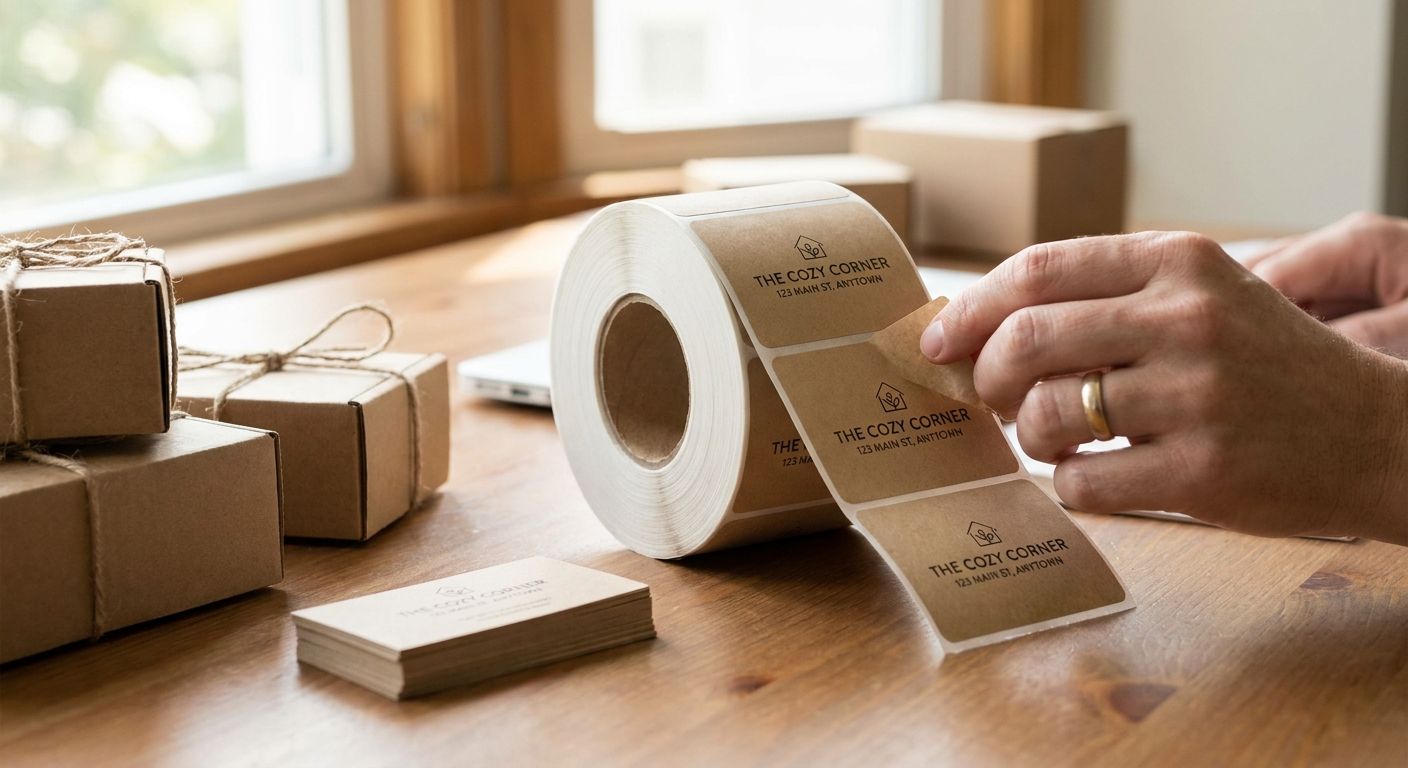
Return address labels for small businesses are pre-printed labels carrying your company name and address, applied to envelopes, invoices, packages and direct mail so every piece looks consistent and gets returned to the right place if delivery fails. A Toronto business mailing invoices, sending client packages, or running a postcard drop needs labels that survive handling, print clean at small point sizes, and match the rest of the brand on the envelope.
- Return address labels speed up invoice runs, direct mail and shipped packages for small businesses in 2026.
- Standard sheets print 30 labels per page at 1 x 2.625 inches on most laser and inkjet printers.
- DIY sheets work under roughly 50 pieces per run; anything larger, pre-printed rolls from a print shop save more time.
- Canada Post reads delivery addresses first - a slightly off return label still ships, but it slows any returned mail.
Why return address labels matter for small businesses
Every invoice, sample mailer or shipped order that leaves a Toronto small business carries a silent branding job: the return address. A label that's smudged, hand-written, or mismatched against the invoice inside makes a business look smaller than it is - and a mismatch between the return label and what's printed on your Print Fast letterhead or invoice stands out to a client who opens both at once.
Volume is the other driver. A business mailing 10 invoices a month can get away with a pen and a stamp. A business mailing 200 postcards for a campaign, or shipping 50 packages a week, needs labels that go on fast and read clean at a glance - which is where pre-printed sheets or rolls start paying for themselves over hand-writing or single-stamp runs.
How to get return address labels right
Pick your label size and material
Most small business return address needs fall into a narrow set of sizes and stocks. Match the label to the surface it's going on, not just the mailer type.
- Standard 1" x 2.625" sheet labels (30 per page) - fits most envelope corners
- Small 0.5" x 1.75" labels for shipping boxes with limited corner space
- Matte white for legibility on kraft or colored envelopes
- Clear/transparent for a printed-direct look on light packaging
- Weatherproof vinyl for outdoor drop boxes or courier bins
Decide what goes on the label
Keep it to what a sorter or a recipient actually needs - not a full letterhead.
- Business name, exactly as it appears on invoices
- Street address, unit number, postal code
- Phone number or website (optional, only if space allows)
- Small logo mark if the label is 1" tall or larger
Design the layout before you print
A label with cramped text or low contrast is slower to read and looks worse than no branding at all.
- Keep body text at 8pt minimum on a 1" label
- Left-align text; centered blocks read slower at a glance
- Leave at least 2mm of white space around the edge
- Match the label font to your invoice or letterhead font, not a default system font
Choose your printing method
Hand-writing works for a handful of pieces. Past that, three methods cover almost every small business:
- DIY inkjet/laser sheets - cheapest for low volume, print-your-own at the office
- Rubber address stamp - fast for repeat use, no printer needed, less consistent ink coverage
- Pre-printed labels from Print Fast - custom stamps for invoicing or full label runs printed same-day, built for higher volumes without per-piece printer jams
When an invoice run or mail campaign moves past a few dozen pieces a week, a same-day print order beats standing at a home printer feeding sheets one at a time. See custom stamps for small business invoicing for a faster invoicing setup that skips the label sheet entirely for repeat use.
Print a test sheet before running the full batch
Alignment drifts between printer models and even between print jobs on the same machine.
- Print one test sheet on plain paper first
- Hold it against a blank label sheet to check margins
- Confirm the printer driver is set to "actual size," not "fit to page"
- Check ink saturation on the actual label stock, not just plain paper
Apply labels correctly on envelopes and packages
Placement affects both how professional the piece looks and how postal sorting equipment handles it.
- Front top-left corner for standard envelopes, or centered on the back flap
- Bottom-left corner or under the shipping label for boxes
- Press firmly for 3-5 seconds on packaging tape or coated stock so labels don't lift in transit
- Batch-apply in stacks of 10-20 rather than one at a time to keep pace on large runs
Reorder before you run out
Running out mid-campaign means falling back to hand-writing the rest of the batch.
- Keep a buffer of at least one extra sheet or roll on hand
- Save the print-ready file so reorders don't need a redesign
- Standardize on one size across invoices, packages and mailers to simplify reordering
- Reorder at 20% remaining stock, not zero
Comparing your label options
| Option | Best for | Turnaround | Key limitation |
|---|---|---|---|
| DIY printer sheets | Under ~50 pieces/month | Whenever you have printer time | Slow at volume, alignment drifts between print jobs |
| Rubber address stamp | Repeat, low-design invoicing | Immediate once made | No logo, single ink color, inconsistent pressure |
| Pre-printed labels, Print Fast | Ongoing mail runs and packaging | Same Day / 24Hr / Rush | Needs a lead order rather than instant desk printing |
| Custom letterhead with printed return info | Law firms, consultants, formal mail | 24Hr / Rush | Higher per-piece cost than a label alone |
| Handwritten | One-off pieces only | Immediate | Not scalable past a handful of envelopes |
Verdict: for any Toronto small business mailing more than a few dozen pieces a month, pre-printed labels beat DIY sheets and stamps on both speed and consistency - order same-day rather than reprinting sheets every week.
Common mistakes small businesses make with return address labels
- Printing the address smaller than 8pt - legible on screen, unreadable once it's on an envelope in a mailbox
- Forgetting to update labels after a move - old stock keeps getting used because nobody flags it
- Mismatching the label font against invoices or letterhead - looks like two different businesses mailed the same envelope
- Ordering the exact quantity needed with no buffer - a spoiled sheet or two mid-run stalls the whole mailing
- Skipping the test print - a full batch printed off-center wastes the whole sheet, not just one label
Get labels printed same-day
Custom return address labels and stamps, ready same-day in Toronto.
FAQ
What size are standard return address labels?
Standard return address labels print at 1 x 2.625 inches, 30 per sheet, which fits most envelope corners and common laser or inkjet printers. Smaller 0.5 x 1.75 inch labels work better on shipping boxes with limited space.
Where does the return address go on an envelope?
The return address goes in the top-left corner of the front of the envelope, or centered on the back flap for a cleaner front-facing look. Canada Post sorting equipment reads the delivery address in the center or right side first, so return placement doesn't affect delivery speed.
Is a rubber stamp cheaper than printed labels for a small business?
A rubber stamp costs less upfront and works well for low-volume, repeat invoicing, but it can't carry a logo or multiple ink colors and slows down once volume climbs past a few dozen pieces a week. Pre-printed labels cost more per batch but apply faster at scale.
Can I print return address labels at home?
Yes, DIY printer sheets work fine for small businesses mailing under roughly 50 pieces a month on a standard inkjet or laser printer. Past that volume, alignment drift and printer jams make pre-printed sheets from a print shop faster.
Do return address labels need to match my letterhead?
Matching the label font and layout to your invoice or letterhead keeps the mail piece looking like it came from one consistent business. A mismatch is one of the most common small business mistakes and it's noticeable the moment a client opens the envelope.
How many return address labels should a small business order?
Order enough for at least one full quarter of mailing volume plus a 15-20% buffer for misprints or last-minute runs. Running out mid-campaign forces a fallback to hand-writing addresses on the remaining pieces.
What material should return address labels be for shipped packages?
Matte white stock works for most shipped packages and reads clearly against kraft or brown boxes. Weatherproof vinyl labels hold up better for anything going through outdoor courier drop boxes or long transit times.
One last thing
Canada Post's automated sorting scanners key off the delivery address, not the return address - so a return label that's a few millimetres off-center still ships on time. Where it matters is the piece that gets returned to sender: a smudged or missing return address on that one envelope means it never finds its way back, and the invoice or sample inside just disappears. Print the return label as carefully as the delivery one, even though only a fraction of mail ever needs it.


