
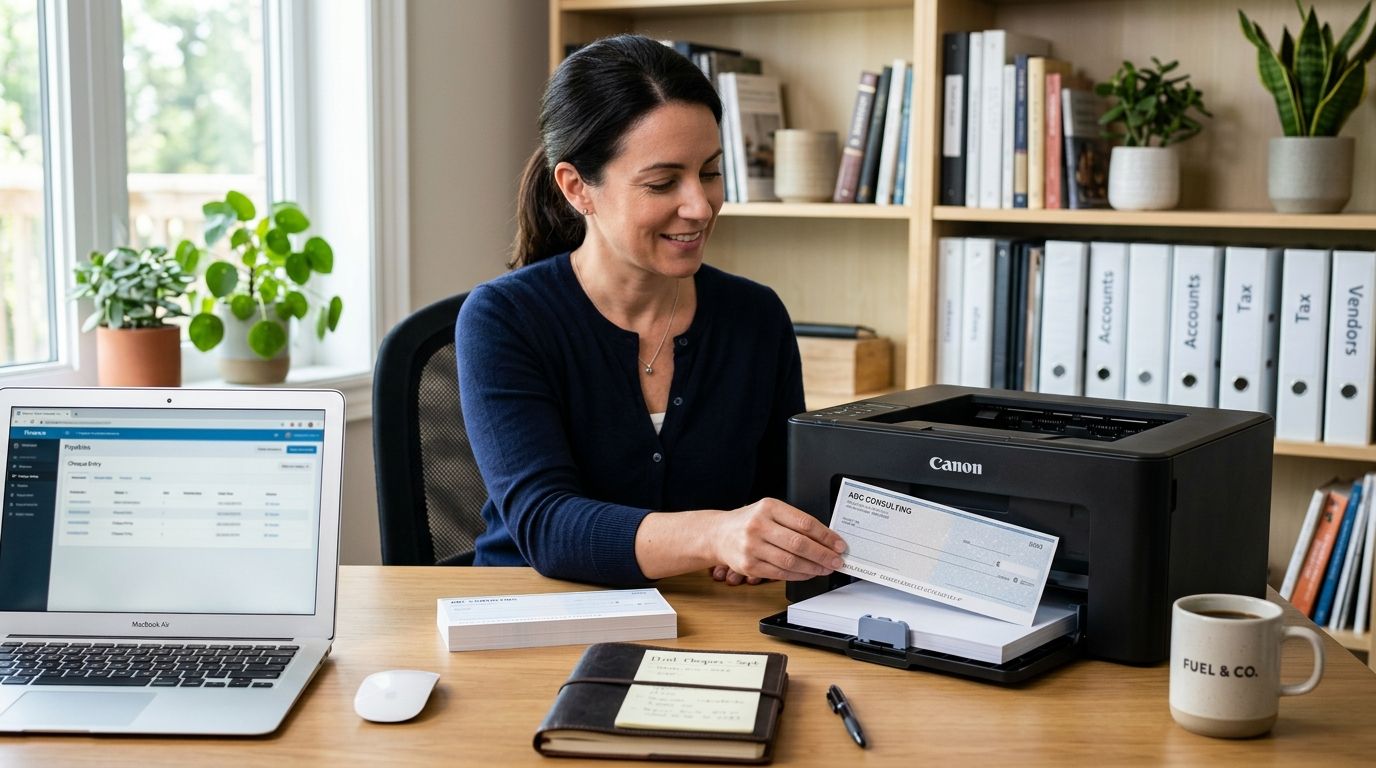
Business cheque printing for small businesses in 2026 comes down to three real options: your bank, your accounting software, or a MICR-certified specialty printer — a general Toronto print shop is not one of them, and any guide that tells you otherwise is skipping the compliance step. Small operators run far fewer cheques than a payroll department at a national retailer, so the priority isn't volume pricing — it's getting the MICR line right, keeping a clean paper trail, and not blowing a payroll deadline waiting on a reorder.
- Business cheque printing for small businesses in 2026 runs through your bank, accounting software, or a MICR-certified printer.
- MICR ink and CPA-approved formatting are mandatory; regular toner cheques get flagged or delayed at the bank.
- PrintFast.ca doesn't produce MICR cheque stock but covers the stamps, letterhead and forms that surround every cheque run.
- Order new cheque stock 3-4 weeks ahead of a payroll cycle — reprints routinely take longer than owners expect.
Why this matters for small businesses
A missed cheque deadline isn't an abstract SEO problem — it's a vendor who doesn't get paid on time or a payroll run that slips a day. Small businesses don't have a finance department catching a bad MICR line before it hits the bank, so the person ordering the cheques is usually the same person reconciling them a month later.
The other difference is scale of everything else around the cheque. A five-person shop still needs remittance advices, invoicing stamps, and letterhead that matches the cheque stock — just far fewer of each than a 500-person company. Getting your custom letterhead consistent with your cheque format matters more when a client only ever sees one or two pieces of your paperwork a year; inconsistency reads as unprofessional fast.
How business cheque printing actually works for small businesses
Choose your cheque printing method first
Most small businesses default to whatever their bank offers, but that's not always the fastest or cheapest route once you're issuing more than a handful of cheques a month.
- Bank-ordered cheques — the default for low-volume issuers, ordered directly through your business banking portal
- Accounting-software printing — QuickBooks, Sage, and Wave all support direct cheque printing onto blank stock
- MICR-certified specialty printers — dedicated cheque printing companies that supply pre-encoded, bank-compliant stock
- In-house laser printing — using a MICR toner cartridge and blank cheque paper you control end to end
- Manual cheque books — still valid for very low-volume operations, but slowest to reconcile
Verify MICR and security compliance before you print anything
The magnetic ink character recognition (MICR) line at the bottom of every cheque has to read correctly through a bank's automated clearing system, or the cheque bounces back for manual processing — which slows down the person you're paying.
- Confirm your printer or provider uses actual MICR toner or pre-encoded MICR stock, not standard laser toner
- Match your cheque format to Canadian Payments Association (Payments Canada) formatting standards
- Include a void pantograph or watermark so altered or photocopied cheques are visibly invalid
- Use sequential numbering with no gaps — a missing number is the first thing a bookkeeper flags
- Keep your bank routing and account numbers exactly as issued; a single digit error voids the batch
Match your cheque stock to your banking software
Business cheques aren't one standard size. Voucher cheques with a stub, wallet-style cheques, and continuous-feed formats each need different stock, and using the wrong one jams a laser printer or misaligns the MICR line.
- Confirm your accounting software's supported cheque formats before ordering stock
- Order voucher-style stock if you need a built-in remittance stub for vendor payments
- Stick to laser-compatible stock if you're printing in-house — inkjet cheque stock smears MICR ink
- Keep a small buffer of extra stock on hand for reprints and voided cheques
Set up your invoicing and stamping workflow
Once the cheque itself is handled, the paperwork around it is where small businesses actually lose time — chasing a signature stamp, hunting for a duplicate invoice copy, or re-keying a remittance note by hand. This is where PrintFast.ca fits into the process, not the cheque printing itself.
- Set up a self-inking invoice stamp workflow so paid, void, and endorsement stamps are consistent across every signer
- Use NCR forms for contractors and invoicing to keep a carbon copy of every invoice tied to the cheque that paid it
- Standardize remittance notes so vendors can match a cheque to an invoice number without calling you
- Assign a single point person to log every cheque number issued, even in a two-person shop
Standardize your business stationery around your cheques
A cheque that shows up alone, with no matching letterhead or return address, reads as informal to a vendor or landlord expecting a professional paper trail. This is a same-day fix, not a redesign project.
- Match letterhead fonts and colours to your cheque stock where your bank allows custom printing
- Use consistent return address labels on every mailed cheque and remittance envelope
- Keep a presentation folder on hand for accountants or auditors reviewing a full cheque run
- File a physical or scanned copy of every cheque with its matching invoice the same day it's cut
Sort the paperwork around your cheque run
Same-day stamps, letterhead and forms from Toronto's rush print shop.
Track and reconcile every cheque run
Small businesses skip this step more than any other, and it's the one that turns into a year-end headache with your accountant.
- Log every cheque number issued, voided, or stopped in one shared sheet
- Reconcile against your bank statement monthly, not just at tax time
- Keep a written stop-payment procedure so any signer knows what to do if a cheque is lost
- Store six years of cheque records, matching Canada Revenue Agency retention requirements
Plan your ordering timeline around payroll and vendor cycles
Most small businesses order cheque stock reactively — right when they're about to run out. That's the single biggest cause of a missed payroll date in 2026.
- Reorder cheque stock 3-4 weeks before you expect to run low, not the week you run out
- Build in extra lead time around bank holidays and year-end, when providers slow down
- Keep a minimum buffer of 25-50 cheques on hand at all times for a five-person office
Comparing cheque printing options for small businesses
| Option | Best for | Key limitation |
|---|---|---|
| Bank-ordered cheques | Occasional, low-volume issuers | Reorder cycles run 1-3 weeks; little design control |
| Accounting-software printing (QuickBooks, Sage, Wave) | Businesses already reconciling books in that software | Needs compatible blank stock and a correctly calibrated printer |
| MICR-certified specialty printer | Payroll runs and high-volume vendor payments | Certification and proofing add lead time before the first batch ships |
| In-house laser printing | Businesses that want same-day control | You own the MICR toner, the stock, and the error risk |
Verdict: if you're issuing fewer than 20 cheques a month, accounting-software printing on compliant blank stock is the fastest path in 2026 — reserve a specialty MICR printer for payroll volume.
Common mistakes small businesses make with cheque printing
- Using regular toner instead of MICR toner — the encoding line reads incorrectly and the bank kicks the cheque back for manual handling
- Skipping sequential number tracking — a gap in the numbering is the first thing flagged in a year-end reconciliation
- Ordering cheque stock and business stationery from unrelated vendors — mismatched fonts and paper stock make a cheque run look inconsistent
- No written stop-payment procedure — a lost cheque becomes a scramble instead of a two-minute fix
- Waiting until the stock runs out to reorder — reprints and new-format approvals routinely take longer than owners budget for
FAQ
What's the best way to print business cheques in 2026?
For most small businesses, printing directly from accounting software like QuickBooks, Sage or Wave onto compliant blank MICR stock is the fastest option in 2026. Higher-volume payroll operations get more consistency from a dedicated MICR-certified cheque printer.
Is business cheque printing different from personal cheque printing?
Yes — business cheques typically require a voucher stub for remittance details and stricter MICR compliance since they clear through commercial banking channels. Personal cheques rarely need that level of formatting.
Do business cheques need MICR ink?
Yes, the magnetic ink character recognition line at the bottom of every cheque must be printed in MICR-compatible ink or pre-encoded stock. Standard laser or inkjet toner doesn't read correctly through automated bank clearing systems.
Can I print business cheques myself with a laser printer?
Yes, as long as you use a MICR toner cartridge and laser-compatible blank cheque stock matched to your accounting software's format. Inkjet printers and standard toner risk smearing or misreading the MICR line.
How long does business cheque printing take?
In-house printing from accounting software is same-day once stock is on hand. Ordering new certified MICR stock through a bank or specialty printer typically needs several weeks for proofing and approval, so reorder well before you run low.
Can PrintFast.ca print my business cheques?
No — MICR-encoded cheque stock requires bank certification that a general print shop doesn't carry. PrintFast.ca covers the surrounding paperwork instead: invoicing stamps, NCR forms, letterhead and presentation folders that pair with your cheque run.
What size is a standard business cheque?
Most Canadian business cheques run either a standard voucher format with a remittance stub or a wallet-size format without one, depending on your accounting software's template. Check your software's supported formats before ordering blank stock.
How many cheques should a small business keep in reserve?
A five-person office should keep roughly 25-50 cheques on hand at all times and reorder 3-4 weeks before running low. Waiting until stock is nearly gone is the most common cause of a missed payroll date.
One last thing
The part small businesses underestimate isn't the printing — it's the six-year record retention requirement from the Canada Revenue Agency. If your cheque log lives in a shoebox instead of a shared sheet, you'll spend more time reconstructing it at audit time than you ever spent ordering cheque stock in 2026.


