
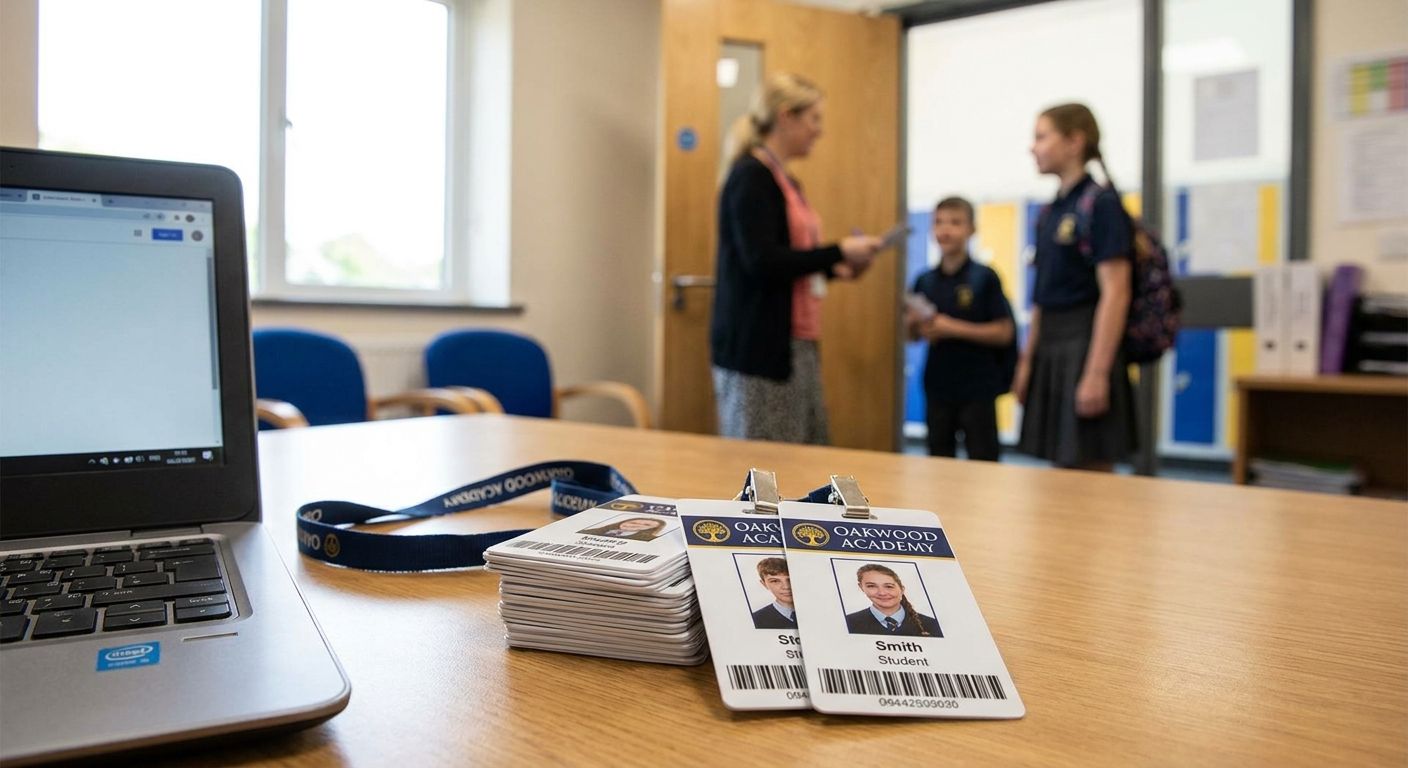
Plastic ID cards for schools cover everything from kindergarten name badges to staff access cards, and getting the format wrong means reprinting a stack of 200 cards two weeks into the school year. This guide breaks down what actually matters for schools and student programs ordering ID cards in 2026, and what to skip.
- Standard CR80 PVC cards (3.375 x 2.125 in) fit off-the-shelf lanyards and badge holders — buy this size.
- Laminated PVC beats plain paper for K-12 daily wear; paper cracks and fades within a term.
- Order a printed proof before a full batch of plastic id cards for schools ships — typo reprints cost more than the proof step.
- Same-day and rush turnaround matters most in the first two weeks of September and January intake.
- Skip oversized or novelty card stock — most scanners and lanyard clips are built for the CR80 standard.
Why this matters
A school ID card isn't just a name tag. It gates cafeteria access, ties to library and attendance systems in some boards, and doubles as proof of enrollment for field trips and after-school programs. Get the size wrong and every lanyard clip and scanner in the building becomes a problem. Get the material wrong and you're reordering by November because 300 laminate-free cards cracked in kids' pockets.
Most schools and student program coordinators in Toronto and the GTA order plastic ID cards for schools once a year, in a batch tied to registration. That means one order has to hold up for 10 months of daily handling, and there's rarely budget or patience for a mid-year reprint. Print Fast handles custom print quotes for exactly this kind of one-shot, must-be-right batch job.
Who this is for
This guide is built for school administrators, office managers, and student program coordinators — the person ordering 50 to 2,000 cards a year for students, staff, volunteers, or camp participants. If you're managing a September intake, a summer camp roster, or a new after-school program that needs badge-based access, the buying calls below apply directly to you.
What to look for in plastic ID cards for schools
Card material and durability
PVC beats paper for anything a student carries daily. Laminated PVC resists cracking, fading, and the coffee-cup-lid scratches that plain cardstock can't survive past a few weeks. For K-12 programs where cards live in backpacks and pockets for a full school year, material is the first decision, not an afterthought.
Standard sizing for lanyards and scanners
CR80 is the standard credit-card size used across ID badging — 3.375 x 2.125 inches, the same footprint set by the ISO 7810 ID-1 standard. Every off-the-shelf lanyard clip, badge reel, and vertical holder sold at office supply stores is built for this size. Ordering a custom or oversized dimension means custom holders too, which most schools don't budget for.
Single-sided vs. double-sided printing
Single-sided works for a name, photo, and grade or classroom. Double-sided earns its cost when the back needs a barcode for library checkout, a QR code for attendance apps, or emergency contact info. Decide this before the print run — adding a second side later means reprinting the entire batch.
Turnaround around intake dates
September and January intake weeks are when every school in the GTA needs cards at once. A Rush or Same Day order matters most in that narrow window — outside of it, standard turnaround is fine. Plan the order date around your registration deadline, not the other way around.
Proof approval before the full batch
One misspelled name or wrong grade on a proof is a five-minute fix. The same error caught after 300 cards print is a full reorder. Always ask for a digital proof and check names, spelling, and photo cropping before the batch runs.
Reorder volume for new enrollments
Schools add students mid-year — transfers, late registrations, new staff. Confirm reorder minimums and turnaround up front so a batch of 15 replacement cards in November doesn't sit behind a full production queue.
Top picks for schools and student programs
Standard CR80 PVC card — the safe pick. Standard credit-card size, laminated PVC stock. This is the default for a reason: it fits every lanyard and holder on the market and holds up through a full school year of daily handling. Verdict: Buy.
Adhesive-back paper ID card — the budget pick. Cheaper per unit and fine for short-term programs — a one-week summer camp, a single-day field trip badge, a volunteer event. It won't survive a full term of pocket-and-backpack wear, so match it to a short program length, not a year-round student ID. Verdict: Consider.
Punched card with lanyard slot — the daily-wear pick. A pre-punched hole or slot at one corner is the small detail that saves the most hassle: no clip breaking off, no card lost because it wasn't secured. For any card a student wears around their neck all day, this beats a plain flat card. Verdict: Buy.
Double-sided card with barcode or QR — the upgrade pick. The back carries a scannable code tied to library systems, attendance apps, or cafeteria point-of-sale. Worth the extra cost only if the school actually has a system that reads it — confirm compatibility with your IT or library coordinator before ordering. Verdict: Consider.
Oversized or novelty card stock — the wildcard. Larger-than-standard cards look distinctive but don't fit standard lanyard clips, badge reels, or card scanners built around the CR80 footprint. Unless every holder and reader in the building is custom-sized to match, this creates more problems than it solves. Verdict: Skip.
Need a batch quoted for September intake or a summer program? Confirm the count and deadline early — rush windows fill up fast in the two weeks before school starts.
What to avoid
- Non-standard card sizes. They look fine on a screen and then don't fit a single lanyard clip the school already owns.
- Skipping the printed proof. A batch of plastic id cards for schools with one wrong grade level or a cropped-out photo is a full reprint, not a quick fix.
- Ordering at the last minute without confirming rush turnaround. A Same Day or 24Hr window works when it's booked ahead — not when it's assumed the day before orientation.
If your program also needs printed signage for orientation day or an open house — directional signs, a welcome table sign — the same rush-turnaround logic applies to custom lawn signs for school events, sized and printed on the same kind of tight deadline.
Verdict comparison
| Card type | Best for | Durability | Verdict |
|---|---|---|---|
| Standard CR80 PVC | Full school year, all grades | High | Buy |
| Adhesive-back paper | Short programs, single events | Low | Consider |
| Punched with lanyard slot | Daily wear, younger grades | High | Buy |
| Double-sided with barcode | Library or attendance-linked systems | High | Consider |
| Oversized/novelty stock | Not recommended for standard holders | Low compatibility | Skip |
Staff and volunteer badges often run alongside student cards on the same order — if your office also needs quick-turn business cards for new hires, the same rush logic covers same-day business card turnaround for staff onboarding.
FAQ
What size are plastic id cards for schools?
Standard school ID cards use CR80 size, 3.375 x 2.125 inches, the same footprint set by the ISO 7810 ID-1 standard. This size fits standard lanyard clips, badge reels, and card holders sold anywhere in Canada.
Is PVC better than paper for student ID cards?
Yes, for anything a student carries daily. Laminated PVC resists cracking and fading over a full school year, while plain paper or cardstock wears out within weeks of pocket and backpack handling.
How fast can a school order plastic ID cards before the school year starts?
Rush and same-day turnaround options exist for tight registration deadlines, but September intake weeks book up fast across Toronto and the GTA. Confirm your count and deadline with the printer as early as possible, ideally weeks before orientation.
Do school ID cards need a lanyard hole or slot?
A pre-punched slot is worth adding for any card worn around the neck daily, since it prevents lost clips and dropped cards. Flat cards without a slot work fine for cards kept in a wallet or pocket instead.
Can plastic ID cards include a barcode for library or attendance systems?
Yes, double-sided printing can carry a barcode or QR code on the back tied to library checkout or attendance apps. Confirm with your school's IT or library coordinator that the code format matches your existing scanner system before ordering.
What happens if a name is misspelled on a printed ID card batch?
A printed proof catches spelling and photo cropping errors before the full run prints, which is why proof approval is a required step, not optional. Skipping the proof on a batch of 200-plus cards turns one typo into a full reprint.
How many plastic ID cards should a school order at once?
Order for full enrollment plus a small buffer for mid-year transfers and late registrations, since reorders in November often queue behind other production. Ten to fifteen percent over headcount is a reasonable buffer for most schools.
Are paper ID cards good enough for a summer camp program?
Adhesive-back paper cards work fine for short programs like a one-week camp or a single-day field trip badge. They're not durable enough for a full school term, where laminated PVC is the better call.
One last thing
The detail that trips up most first-time orders isn't the card material — it's the lanyard slot placement. A punch hole in the wrong corner puts the photo upside down when clipped, and nobody notices until 200 cards are already worn wrong all day. Confirm slot position on the proof, not after the batch prints.