
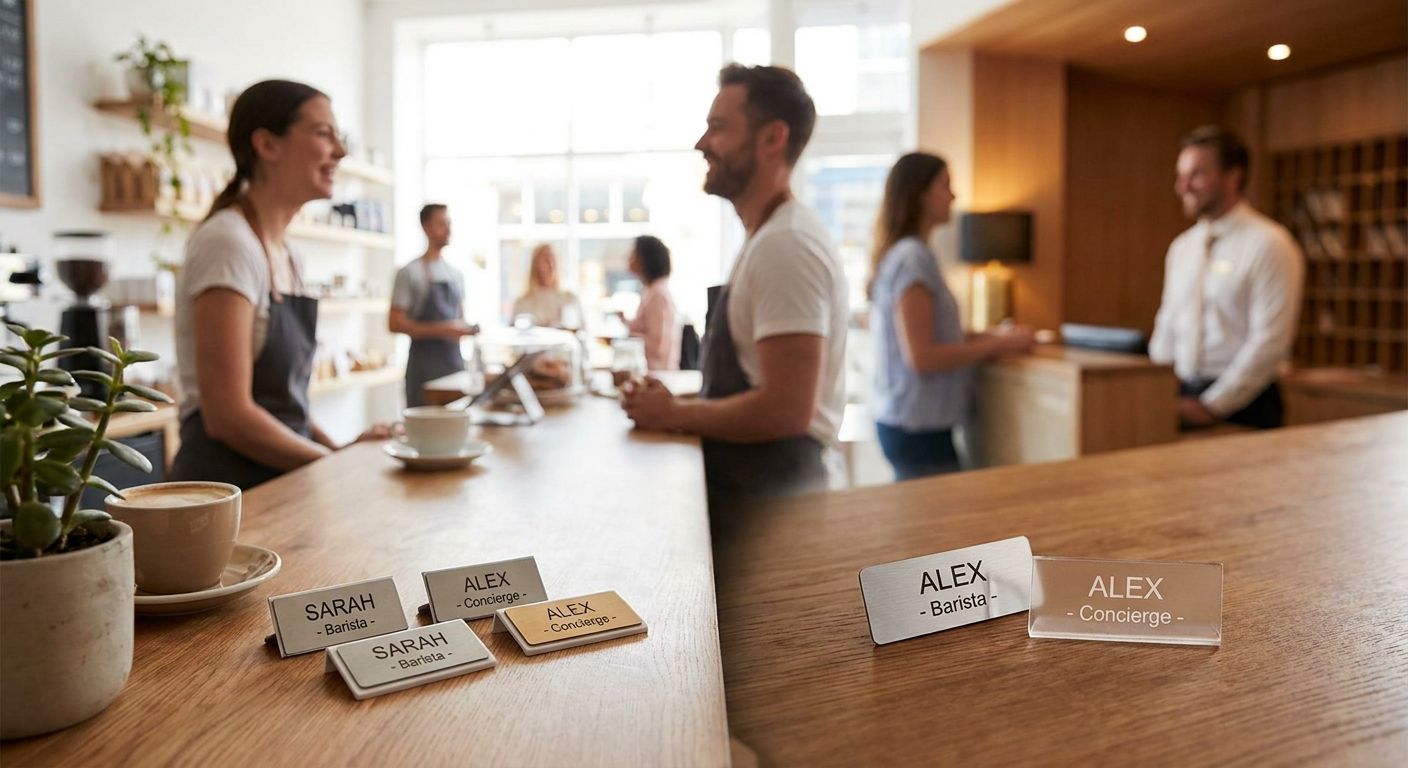
Custom name tags for retail and hospitality staff are printed ID badges showing a name, role and store branding, worn so customers can identify staff fast and get help without hunting for a supervisor. Retail floors and restaurant service lines put more stress on a name tag than an office ever will — spills, grease, sweat, constant clipping and unclipping through a shift, and staff turnover that means a batch needs reprinting every few months.
- Rigid plastic custom name tags outlast paper or laminated tags on retail and hospitality floors in 2026.
- Magnetic backs avoid pin holes in uniforms and aprons — the standard pick for hospitality staff.
- Order in small reprint batches, not one giant run, to handle retail and hospitality turnover cheaply.
- Print Fast (printfast.ca) offers same-day and 24-hour rush printing for staff ID and name tag reorders.
Why this matters
A customer walking into a store or restaurant scans for two things fast: who works here, and who can help. A name tag answers both without a word said. On the floor, that shaves seconds off every interaction — a real difference when a line is forming at the register or a table is waving for the check.
The segment problem is turnover and wear, not design. Retail and hospitality staff cycle through jobs faster than most industries, so a name tag order isn't a one-time print — it's a recurring need. A tag that fades after a few washes of a uniform pocket or cracks after a season of clipping on and off means reordering every quarter instead of every year or two. That reprint cadence is the real cost driver in 2026, more than the initial print run.
Why custom name tags matter for retail and hospitality staff
Retail and hospitality name tags carry a second job most office badges never do: they double as brand surface. The tag sits at chest height in every customer interaction, on every shift, on every staff member — more impressions per week than most storefront signage collects. Get the colour and logo wrong and it reads sloppy at close range.
Speed is the other segment-specific pressure. A restaurant hiring three servers before a long weekend cannot wait a week for badges. Start at Print Fast for the format basics, then work through the steps below to build a name tag program that survives a full shift, not just the photo.
Set the information hierarchy first
Decide what goes on the tag before picking material or shape. Retail and hospitality customers scan a tag in under two seconds, so hierarchy beats decoration.
- First name in the largest, boldest text on the tag
- Role or department underneath in smaller type (Cashier, Server, Manager)
- Store or restaurant logo in a corner, not competing with the name
- Pronouns as an optional line only if your team has asked for it
- Location or branch name if you operate more than one site
Choose a material that survives the shift
Paper and cardstock tags look fine on day one and start curling or fading by week three under grease, steam or sweat. Retail and hospitality floors need something tougher.
- Rigid plastic (PVC) for durability against spills and daily handling
- Laminated cardstock only for short-term events or seasonal hires
- Metal-look plastic for a premium finish in upscale hospitality settings
- Backing type (magnetic, pin, clip) decided as part of the material spec, not bolted on later
Pick an attachment method staff will actually use
The wrong attachment gets left in a locker by week two. Match the method to the uniform, not to the cheapest option.
- Magnetic backs for aprons, blouses and thin fabrics — no holes, no damage
- Pin backs for heavier uniforms and jackets that can handle a puncture
- Clip backs for tags worn on lanyards or belt loops
- Adhesive backs only for single-day or event use, never daily wear
Match the tag to your brand look
A name tag that clashes with your signage or uniform colour reads as an afterthought. Retail and hospitality brands that keep tags consistent with signage look more established, even at a single location.
- Use your primary brand colour as the tag background or border
- Keep the logo small and identical to what runs on your signage and menus
- Pick one font family across all tags — mixed fonts read as unplanned
- Check the tag under your actual store lighting before committing to the full batch
- Confirm the first name is legible from three feet away, the real counter distance
Plan for turnover before it happens
Retail and hospitality staffing changes fast — seasonal hires, part-timers, and quick exits are normal. A name tag program built for a static team breaks the first time someone quits mid-shift.
- Keep a small stock of logo-only blank tags for same-day fills
- Track who holds an active tag so departed staff badges get pulled
- Set a reorder trigger (every 10-15 new hires, or quarterly) instead of waiting for a shortage
- Assign one person to own the design file and the reorder
This is where the fully manual approach hits a wall: designing, proofing and waiting a week for 15 tags every time someone starts doesn't scale. Print Fast runs same-day and 24-hour rush turnaround on ID and name tag printing, so a Monday hire can wear a finished tag by their second shift instead of week three.
Reorder in small batches, not one big run
Ordering 200 tags once a year sounds efficient until half sit unused because staff turned over before they were issued. Small, frequent batches match retail and hospitality reality better.
- Order in batches of 10-25 tags tied to actual hiring cycles
- Keep the design file locked so reorders don't drift in colour or font
- Reorder blanks separately from named tags
- Build reorder cost into the onboarding budget, not a surprise annual expense
Get staff name tags printed fast
Same-day and 24-hour rush printing for name tags and employee ID cards in Toronto.
Comparison: name tag options for retail and hospitality staff
| Option | Best for | Key limitation |
|---|---|---|
| Rigid plastic (PVC) badge | Daily-wear retail and hospitality staff | Higher unit cost than paper |
| Laminated cardstock tag | Short-term events, seasonal hires | Curls and fades within weeks of daily wear |
| Metal-look plastic badge | Upscale hospitality, front-of-house managers | Premium cost across a large team |
| Magnetic-back tag | Thin uniforms, aprons, blouses | Can slip on very lightweight fabric |
| Pin-back tag | Jackets and heavier uniforms | Leaves a small hole in fabric |
| Adhesive label tag | Single-day events only | Not durable for repeated daily use |
Rigid plastic with a magnetic back is the standard pick for retail and hospitality custom name tags in 2026 — it survives spills, clips on and off cleanly, and doesn't damage uniforms. Pros: multi-season life, clean print, no fabric damage. Cons: costs more per unit than laminated cardstock, and a lost plastic tag stings more than a lost paper one.
“If a customer can't read the first name from three feet away, the name tag isn't doing its job.”
Common mistakes retail and hospitality teams make
- Printing the name only, no role. Customers scanning for a manager waste time when the tag says "Sarah" and nothing else.
- Choosing paper or laminated tags for daily wear. Fine for a launch week, degraded fast under grease, steam and sweat.
- Ordering one large batch instead of planning for turnover. Half the run goes unused when staff change before tags are issued.
- Font sized for a screen, not a counter. A tag that reads clearly at 12 inches on a monitor can be unreadable at three feet in dim service lighting.
- No reorder trigger. Departed staff keep wearing old tags, or new hires go weeks bare, because nobody owns the reorder.
FAQ
What's the best material for custom name tags in retail and hospitality?
Rigid plastic (PVC) with a magnetic back is the best material for retail and hospitality custom name tags in 2026. It survives spills, daily clipping and repeated wear far better than paper or laminated cardstock.
Is magnetic or pin-back better for staff name tags?
Magnetic backs are better for thin uniforms like aprons and blouses because they leave no hole. Pin backs work better on heavier jackets that can take a puncture without damage.
How fast can custom name tags be printed for new hires?
Print Fast offers same-day and 24-hour rush printing on staff ID and name tags in Toronto, so a new hire can have a finished tag before their second shift.
Should a name tag include a role or job title?
Yes. Customers scanning a floor for a manager or server rely on the role line, not just the first name, to know who to approach.
How often should retail or hospitality businesses reorder name tags?
Set a reorder trigger tied to hiring volume, such as every 10-15 new hires or once a quarter, rather than waiting until supply runs out.
Are paper name tags good enough for daily retail use?
No. Paper and laminated tags curl and fade within weeks under grease, steam or sweat, so they need replacing far more often than rigid plastic.
Can name tags match store branding and signage colours?
Yes. Using the same colour and font as your signage keeps the tag consistent with the overall brand look, which matters even at a single location.
What information should go on a hospitality staff name tag?
First name in the largest text, role or department underneath, and a small logo. Add the location name if you run more than one site.
One last thing
Magnetic backs beat pins for a reason most teams miss until it's too late: pin holes accumulate on a uniform across a season and eventually tear near the seam. Any retail or hospitality operation replacing uniforms partly because of pin damage should switch new hires to magnetic-back custom name tags at the next reorder in 2026 — a small spec change with a real fabric-cost payoff.


