
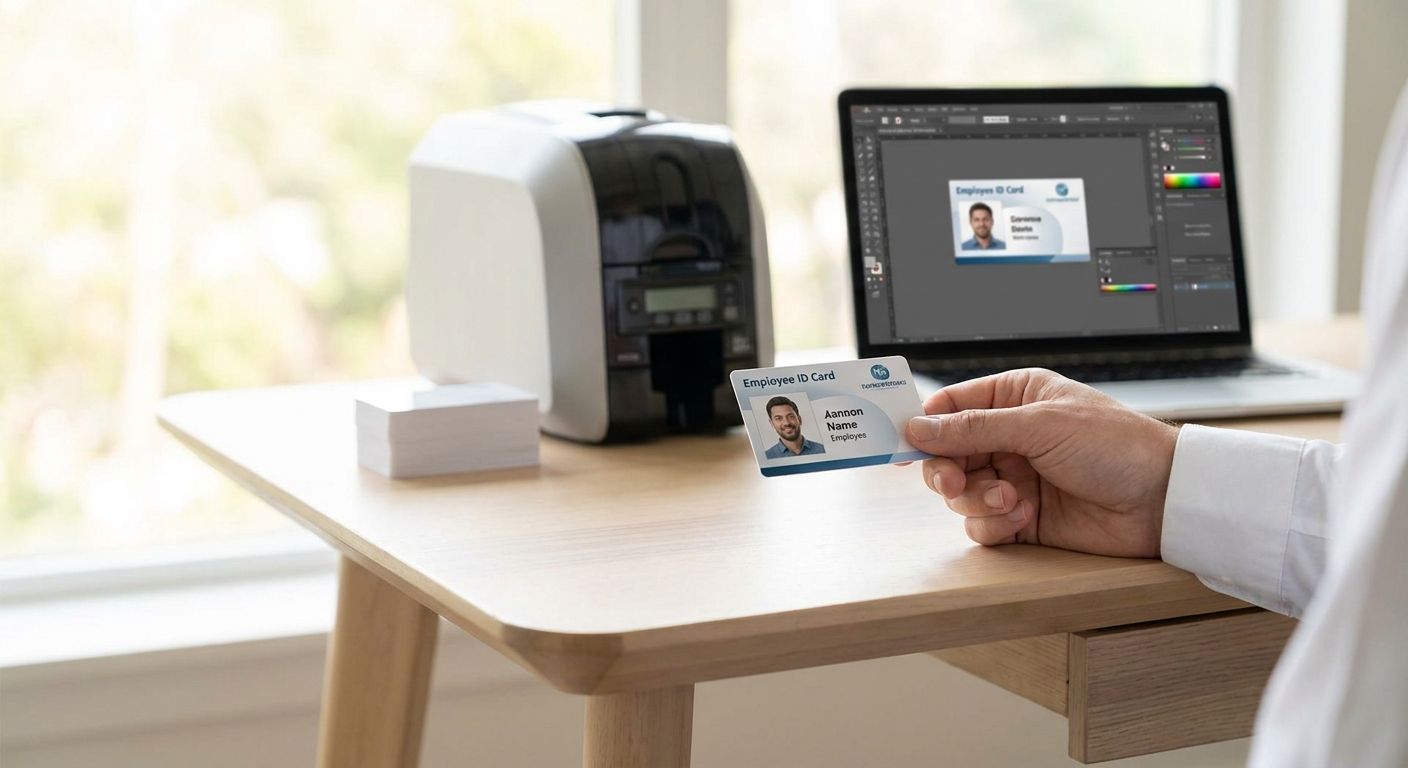
Employee ID card printing for small businesses in Toronto and the GTA comes down to three decisions: what material holds up to daily wear, how fast you need the cards in hand, and whether you need security features beyond a name and photo. Get those three right and badges for a 5-person office or a 50-person warehouse look the same: professional, durable, and ready before the next shift starts.
- PVC employee ID cards win for daily wear and access control — Buy for teams over 10 staff in 2026.
- Laminated paper badges cost less but crack fast — Consider only for short-term events or temp hires.
- NFC-enabled smart ID badges add tap access — Consider if door security is already on your 2026 budget.
- Same-day rush printing covers new hires starting this week — Buy when onboarding can't wait.
Why employee ID card printing matters in 2026
A badge does more than confirm someone works for you. It controls who walks past the front desk, which staff member a customer trusts at the counter, and how fast a new hire looks like part of the team instead of a visitor. Retail, food service, daycare, and healthcare operators in the GTA get asked for staff ID more often than they expect, and a laminated sheet from a home printer does not hold up to that scrutiny.
Small businesses also turn over staff faster than enterprises, which means ID card printing is not a one-time order — it's a recurring line item. Getting the custom quotes process dialed in early saves you from scrambling every time you hire.
Who this guide is for
This is for Toronto and GTA business owners, office managers, and operations leads running teams of roughly 5 to 50 people who need employee ID card printing on a repeatable basis — not a one-off conference badge. If you're issuing badges for access control, customer-facing identification, or basic HR compliance, the criteria below apply whether you're a clinic, a warehouse, or a five-location retail chain.
What to look for in employee ID card printing for small businesses
Card material and durability
PVC plastic and laminated paper are the two real choices, and they age very differently. PVC survives a badge reel, a pocket, and daily handling for years; paper laminate starts to peel and crack within months of regular use. If staff wear badges every shift, material is the first filter, not the last.
Turnaround time
New hires don't wait for a two-week print run. Same-day and 24-hour turnaround matter more for ID cards than almost any other print product, because onboarding dates rarely move to fit a print schedule. A 1-hour rush option covers the day someone shows up unannounced needing a badge before their shift starts.
Security and access features
A photo and name field is the baseline. Barcodes, QR codes, or an NFC chip step things up if you're pairing badges with a door access system or time-tracking software. Decide this before you print — adding a chip later means reprinting the whole batch.
Branding consistency
A badge is a mini piece of company collateral. Consistent logo placement, color, and font across every employee's card reads as organized; mismatched templates from three different print runs read as disorganized, especially to customers who see the badge at checkout.
Local reprint support
Someone will lose a badge, spill coffee on it, or need a replacement photo within the first year. Working with a Toronto-based printer means a reprint is a same-day fix, not a shipping delay from an out-of-province vendor.
Cost at low volume
Small businesses order in batches of 5 to 30 cards, not 500. Confirm pricing holds up at that volume before committing to a material or vendor — some print shops quietly penalize small runs.
Top picks for employee ID card printing
1. PVC ID cards — the safe pick Standard PVC badges run about 30 mil thick, the same weight as a typical bank card, and hold a printed photo and logo without fading under daily handling. They're the default for any team wearing badges five days a week. Verdict: Buy for any team over 10 staff needing durable, long-life cards in 2026.
2. Laminated paper ID badges — the budget option These cost less to produce and work fine for short-term staff, seasonal hires, or single-event volunteers who only need identification for a few weeks. They don't survive a badge reel or a back pocket for months, so they're the wrong call for full-time employees. Verdict: Consider only for temporary or seasonal roles.
3. NFC-enabled smart ID badges — the wildcard An embedded NFC chip turns a badge into a tap-to-access or tap-to-clock-in tool, which matters if you're already running a door access system or want to phase one in during 2026. The setup process is similar to configuring a tap-enabled business card, just applied to a badge instead of a networking card. Verdict: Consider if access control or time tracking is already on your roadmap; Skip if you just need a name and photo.
4. Same-day rush ID cards — the fire drill pick A new hire starting tomorrow doesn't care that your usual print run takes three days. Rush production, the same model used for same-day business cards for last-minute meetings, applies directly to ID badges when onboarding can't slip. Verdict: Buy whenever a start date is inside 48 hours.
What to avoid
- Home-printed or inkjet badges. They fade within weeks under fluorescent light and look unofficial the moment a customer glances at one closely.
- Generic template designs. A badge with no logo, wrong font, or stock border makes a five-person business look like it printed IDs on a whim rather than running a real operation.
- Skipping lamination on high-touch cards. A badge handled dozens of times a day — retail, food service, front desk — needs a laminate layer or it scuffs and cracks inside a month.
Verdict comparison table
| Card type | Turnaround | Durability | Best for | Verdict |
|---|---|---|---|---|
| PVC ID card | Same-day to 24hr | Years of daily wear | Full-time staff, 10+ employees | Buy |
| Laminated paper badge | Same-day to 24hr | Weeks to a few months | Seasonal or temp hires | Consider |
| NFC-enabled smart badge | 24hr to rush | Same as PVC, plus chip | Access control or time tracking | Consider |
| Rush same-day badge | 1hr to same-day | Depends on base material | New hires starting within 48 hours | Buy |
Get a Same-Day ID Card Quote
Rush employee ID card printing available across Toronto and the GTA in 2026.
FAQ
How much does employee ID card printing cost in 2026?
Cost depends on material, chip features, and order volume, so get a custom quote for exact 2026 pricing on your card count. PVC badges typically cost more per unit than laminated paper, but they last far longer per card.
What size are employee ID cards?
Most employee ID cards use the CR80 standard, 3.375 by 2.125 inches — the same size as a credit card. That size fits standard badge reels, lanyard holders, and card printers without custom cutting.
Is PVC or laminated paper better for employee ID cards?
PVC is better for any staff member wearing a badge daily, since it survives years of handling versus a few months for laminated paper. Laminated paper only makes sense for short-term or seasonal roles.
How fast can I get employee ID cards printed?
Rush options run from 1-hour to same-day production, which covers a new hire starting within 48 hours. Standard 24-hour turnaround works fine for planned batches ordered ahead of a start date.
Do employee ID cards need a photo?
A photo isn't legally required for most small businesses, but it's the single feature that makes a badge useful for identification at a front desk or checkout counter. Name-only badges work for low-security environments like small offices.
Can employee ID cards include NFC or a barcode?
Yes — NFC chips and barcodes can be embedded during printing if you're pairing badges with an access control or time-tracking system. Decide on chip features before the first print run, since adding them later means reprinting the batch.
What's the difference between an employee ID card and a business card?
An employee ID card identifies someone as staff, usually with a photo and title, while a business card is a networking tool meant to be handed out. Some small businesses now combine the two using NFC-enabled cards for staff who also do client-facing networking.
One last thing
The badge material decision matters more than the design software you use. A well-designed PVC card in 2026 will still look sharp in 2028; a nicely designed laminated paper badge will be cracked and yellowing by the end of its first year on a lanyard.