
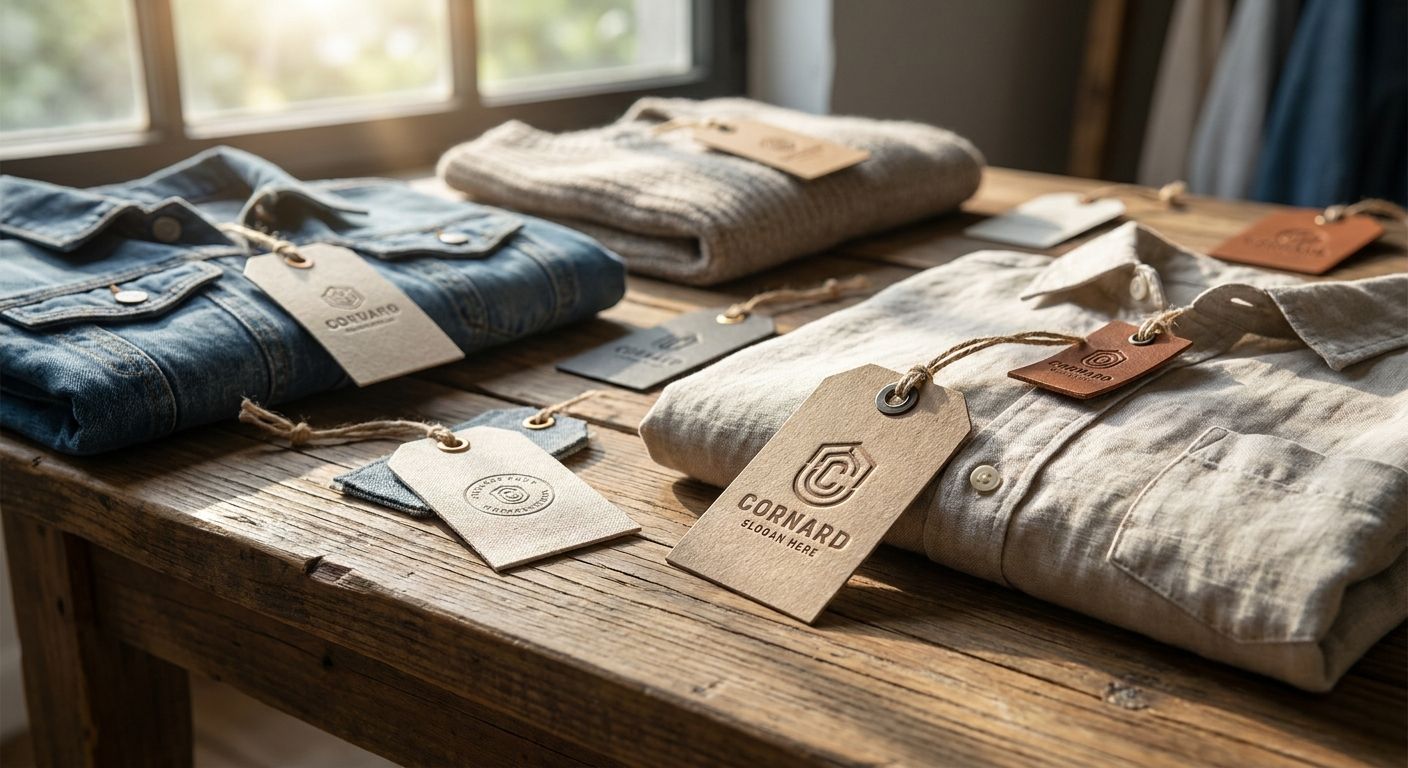
Custom hang tags for clothing brands are printed tags attached to garments with the aim of communicating price, size, care and brand story before a shopper commits to a purchase. Apparel is different from most retail categories because the tag gets touched, read, folded, and photographed for unboxing videos, so it has to survive handling as well as look good on a shelf.
- Hang tags for clothing brands need 80-120lb cardstock or thicker to survive racks and shipping.
- Print Fast offers same-day and 24hr rush printing in Toronto for last-minute hang tag reorders.
- String and safety-pin attachments outsell plastic barb tags for small apparel runs under 500 units.
- Fibre content and dealer identity belong on the sewn-in label, not the hang tag, under Canadian textile rules.
Why hang tags matter for clothing brands
A clothing brand's hang tag is doing two jobs a flyer or business card never has to: selling the garment and surviving the supply chain. It gets clipped through fabric, dragged across a folding table, stuffed into a poly mailer, and handled by every customer who checks the price before trying something on.
That's why apparel brands can't treat hang tags like a generic label job. A tag printed on flimsy stock tears at the pin hole within days on a rack. A tag with a barcode set too small doesn't scan at the register. For a small Print Fast clothing client, getting the tag right the first time matters more than getting it fast — though in Toronto, both are usually on the table.
Update your product information hierarchy
Before any design work starts, lock down what actually has to be on the tag versus what belongs on a sewn-in label.
- Brand name and logo, sized to stay legible at 2 inches or smaller
- Price (or a removable price sticker slot, if wholesale and retail pricing differ)
- Size and SKU or style number
- Barcode, positioned with clear margin so scanners read it first try
- Social handle or QR code if the tag doubles as a marketing touchpoint
Choose your tag material and stock weight
Material decides whether the tag survives a season of handling or falls apart in a shopping bag.
- 80-120lb cardstock for standard retail tags — enough rigidity to resist folding
- Kraft or uncoated stock for a natural, sustainable look on casualwear brands
- Coated or laminated stock for tags that need to resist moisture or handling oils
- Textured or embossed stock for premium and boutique lines where feel matters as much as look
Pick the right size and shape for your garment category
Size and shape should match how the garment is displayed, not just what looks nice in a mockup.
- Standard rectangular tags (2"x3.5" or similar) for most folded apparel
- Elongated tags for scarves, belts, and accessories where a square tag gets lost
- Die-cut shapes (rounded corners, custom silhouettes) for brands leaning on packaging as marketing
- Mini tags under 1.5" for children's wear or delicate items where a full-size tag overwhelms the garment
Decide the attachment method before you finalize the die line
The attachment point changes your die-cut dimensions, so decide this before finishing artwork.
- Cotton string or twine loops, hand-tied — cheapest, works for runs under 500 units
- Safety pin attachment — fast, low-cost, common for basics and t-shirts
- Plastic barb tag pins (tagging guns) — standard for higher-volume apparel and denim
- Ribbon loops for boutique or gift-adjacent lines where presentation carries the sale
For a first production run, hand-tied string and a home paper cutter get you a usable batch with zero equipment cost. Once you're reordering the same tag for restocks, a rush print partner with same-day and 24Hr turnaround options removes the bottleneck of waiting on overseas manufacturing for a design that hasn't changed.
Design for legibility at small scale
A hang tag is read from arm's length in three seconds, not studied like a brochure.
- Minimum 8pt type for anything a customer needs to actually read
- High contrast between text and background — no light grey on white
- One dominant color plus black text beats a busy four-color layout for readability
- Leave 1/8" of white space around the edge so nothing gets clipped in cutting
Print a test batch before committing to bulk
Run a small proof batch before locking in a production quantity.
- Print 10-20 tags at home or with a local shop to check color match against your garment tags
- Test the attachment hole placement against your actual folded garment
- Scan every barcode on the test batch before approving the full run
- Check the tag under store lighting, not just screen or daylight
Order your production run with a fast-turnaround print partner
Once the design and material are locked, ordering becomes a logistics problem, not a design problem. Print Fast handles rush hang tag orders on the same same-day and 24Hr turnaround it applies to business cards and packaging stickers, with custom quotes for run size and stock. Clothing brands doing frequent small-batch drops — a new capsule every 4-6 weeks — lean on this instead of holding thousands of unsold tags from an overseas minimum order.
Brands that also sell direct-to-consumer often pair hang tags with matching packaging stickers on the custom stickers for small business packaging run, so the unboxing experience matches the in-store tag.
Comparison: hang tag production options for clothing brands
| Option | Best for | Cost factor | Key limitation |
|---|---|---|---|
| DIY home printing | First prototype or single sample run | Paper and ink only, no minimum | Not durable enough for retail handling |
| Local rush print shop (Print Fast) | Restocks, small drops, last-minute reorders | Custom quote based on stock and quantity | Not built for six-figure unit runs |
| Overseas bulk manufacturer | Large seasonal orders locked months ahead | Lower per-unit cost at high volume | 6-10 week lead time, high minimums |
| Online print marketplace | Mid-size one-off orders with flexible templates | Per-unit pricing varies by vendor | Limited stock and finish options |
Print Fast is the pick for Toronto and GTA clothing brands that need a hang tag reorder in days, not weeks, without committing to a bulk minimum.
Common mistakes clothing brands make with hang tags
- Ordering before finalizing SKUs. Printing 5,000 tags with a size or style number that changes mid-season wastes the whole batch.
- Choosing stock that's too thin. Tags under 80lb cardstock tear at the pin hole before the garment even reaches a shopper.
- Shrinking the barcode to fit a design. A barcode under industry-standard size fails scanners at checkout, which slows down every sale.
- Skipping the test batch. Color that looks right on screen often prints darker or duller on uncoated stock — a 20-tag proof catches this before a 2,000-unit order doesn't.
- Treating the hang tag as the legal label. Fibre content and dealer identity requirements under Canada's Textile Labelling Act apply to the garment's sewn-in label, not the removable hang tag — the tag can repeat that information, but it isn't a substitute.
Get a hang tag quote today
Same-day and 24hr rush printing for clothing brand hang tags in Toronto.
FAQ
What's the best hang tag material for clothing brands?
80-120lb cardstock is the standard for retail apparel hang tags in 2026 because it resists tearing at the pin hole while staying affordable at volume. Boutique and premium lines often move up to textured or coated stock for a heavier feel.
How much does hang tag printing cost?
Cost depends on stock weight, size, color count and quantity, so pricing is best confirmed with a custom quote rather than a flat rate. Rush and same-day orders typically carry a turnaround premium over standard scheduling.
Is same-day hang tag printing available in Toronto?
Yes, same-day and 24hr rush turnaround is available for clothing brand hang tags through local Toronto print shops like Print Fast. This works best for reorders of an existing design rather than a first-time design that still needs proofing.
What's the difference between a hang tag and a woven label?
A hang tag is a removable paper or cardstock tag attached by string, pin or ribbon, while a woven label is sewn permanently into the garment. Legal fibre content and care information belongs on the woven label, not the hang tag.
What size should a clothing hang tag be?
Most apparel hang tags run 2" by 3.5" or close to it, which fits standard tagging gun pins and reads clearly on a rack. Accessories and children's wear often use smaller or elongated shapes suited to the item.
How do I attach a hang tag to clothing?
String or twine loops and safety pins are the two most common attachment methods for small apparel runs, both hand-applied with no equipment needed. Higher-volume brands switch to a tagging gun with plastic barb pins for speed.
Can hang tags include a barcode?
Yes, barcodes are standard on retail clothing hang tags and should be printed at full industry-standard size with clear margin so point-of-sale scanners read them on the first pass. Shrinking a barcode to fit a design is one of the most common reorder-triggering mistakes.
What's the minimum order for custom hang tags?
Minimums vary by print partner: overseas manufacturers often require large bulk minimums, while local rush print shops can typically handle smaller custom-quoted runs suited to a single drop or restock.
One last thing
Most clothing brands design the hang tag and the sewn-in label as two separate projects handled by two separate vendors — and end up with a barcode that matches on one and not the other. Lock the SKU and barcode format across both before either goes to print, not after.


