
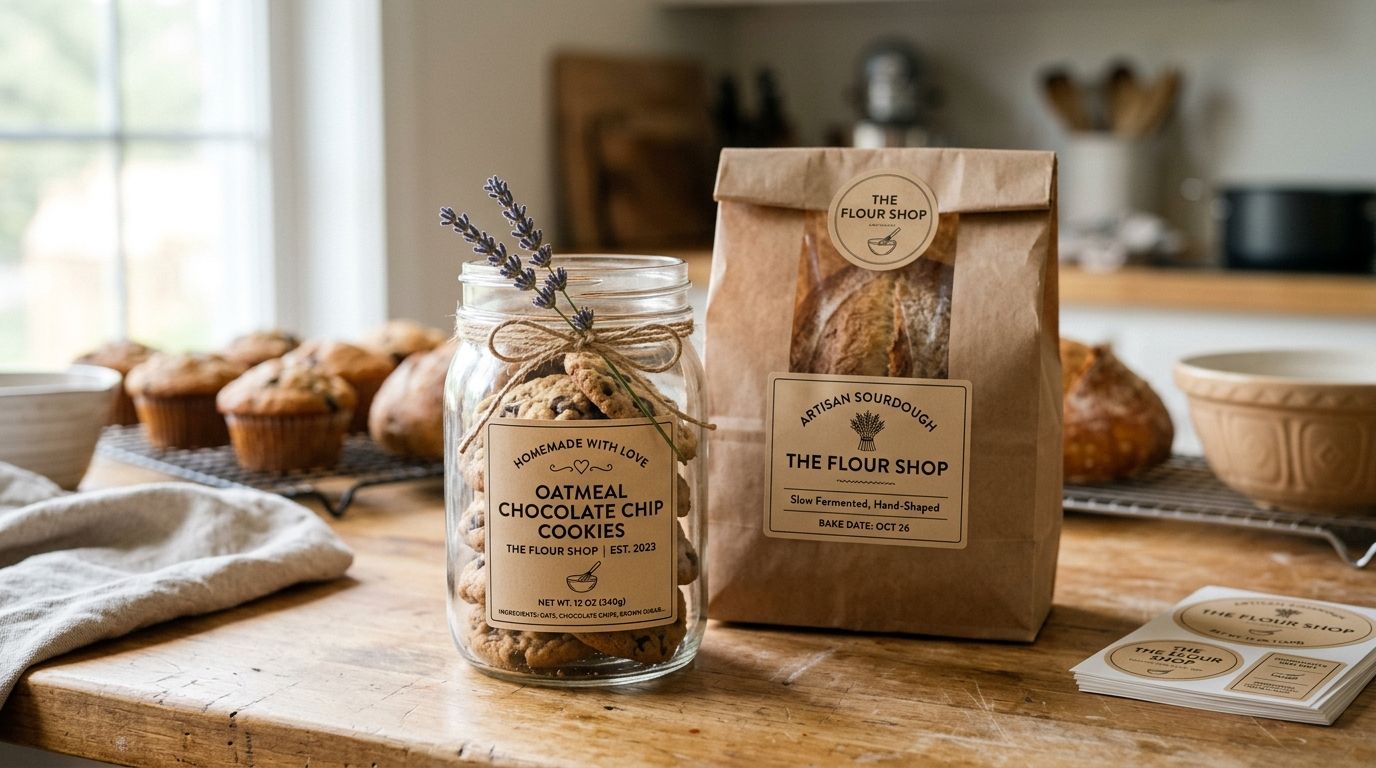
Custom labels for home bakers and small food brands cover the product stickers, ingredient tags and packaging labels that go on jars, bags, boxes and baked goods sold at markets, through Etsy or by local delivery. A home bakery's labels have to survive fridge condensation, freezer frost and shipping friction in a way an office label never does, and they usually carry allergen and net-weight information a retail brand's labels skip.
- Waterproof vinyl beats paper for anything refrigerated, frozen or shipped in 2026 - paper labels smear and peel.
- Canadian food sellers need allergen and net-quantity info on the label, not just a logo.
- Print Fast prints custom labels for home bakers with same-day and rush turnaround for Toronto/GTA sellers.
- Order a proof run of 25-50 labels before committing to a full batch to catch sizing and adhesive issues.
- Reorder on a schedule, not when you run out - most home bakers underestimate label volume for peak season.
Why this matters for home bakers and small food brands
A home baker selling banana bread at a Saturday market has different label needs than a shop printing flyers. The product touches moisture, cold and hands, and the label often doubles as the only ingredient disclosure a customer sees before buying.
Getting the label wrong costs more than a bad flyer would. A smeared allergen line on a jar of jam is a liability question, not just a design flaw. A label that peels off in a delivery box means a customer opens a package with an unlabeled product inside.
Most home bakers also order small and order often - a dozen jars this week, three dozen cookie bags next week. That volume pattern rules out big commercial print runs and points toward a print partner that can turn around shipping labels and product stickers in small batches without a long lead time.
Set your label requirements before you design anything
Start with what the label legally and practically needs to carry, not with the design.
- Confirm which allergens apply - Canada's priority allergen list covers things like peanuts, tree nuts, milk, eggs, soy, wheat and sesame
- Decide if you need a net weight or volume statement (most packaged food sold to the public does)
- List your ingredients in descending order by weight, the standard format for Canadian food labels
- Note any claims you want to make (gluten-free, nut-free, small-batch) since these get scrutinized more than plain descriptions
- Check if your municipality or the province requires a business name and contact line on the label
Get the compliance list locked before you touch a design file - reprinting a full batch because you forgot an allergen line costs more than the extra ten minutes upfront.
Choose a label material built for what the product actually touches
Paper labels look fine on a shelf and fail everywhere else a home bakery product goes.
- Standard paper stock for shelf-stable, room-temperature items handled once (dry mixes, non-perishable gift jars)
- Waterproof vinyl or polypropylene for anything refrigerated, frozen or exposed to condensation - jams, sauces, dips, frozen dough
- Freezer-grade adhesive for products going straight into a chest freezer, since standard adhesive lets go below a certain temperature
- Oil-resistant stock for baked goods packaged in butter-heavy items (shortbread, brownies) where grease bleeds through paper
- Matte finish if customers will write on the label (best-before dates, batch numbers) by hand
A local shop that stocks waterproof and freezer-adhesive options in small quantities beats a big-box printer that only carries standard paper stock - this is where a print partner like Print Fast becomes the faster path once you know which material your product needs.
Pick a shape and size that fits your existing packaging
Don't design the label first and hope it fits the jar.
- Measure the flattest surface of your container, not the widest point
- Round labels for jar lids, rectangular for bags and boxes, custom die-cut for irregular shapes like cookie bags with a fold
- Leave a 2-3mm margin from any curved edge so the label doesn't wrap or wrinkle
- Standardize on one or two sizes across your product line to simplify reordering
- Test the label on the actual container before ordering a full run, not on a flat sheet of paper
Design for legibility at small sizes
Most home bakery labels run under two inches across, which is smaller than most first-time designers plan for.
- Use a font size no smaller than 6pt for ingredient lists, 8pt minimum for anything customer-facing
- Keep the brand name and product name as the two largest elements - everything else is secondary
- Test contrast against the container color, not just against white in your design software
- Avoid thin script fonts for allergen or ingredient text - readability beats style here
- Print a physical proof and read it at arm's length before approving the full order
Decide on finish and adhesive strength
The finish affects how the label survives handling, and the adhesive affects whether it stays on.
- Gloss finish for a shelf-ready look on dry goods and gift items
- Matte finish for a hand-written or rustic aesthetic, common for small-batch jam and preserve brands
- Permanent adhesive for single-use packaging (bags, boxes)
- Removable adhesive for reusable jars customers return or refill
- Freezer-rated adhesive for anything stored below zero for more than a day
Order a proof run before committing to volume
A batch of 500 labels with the wrong size or a typo is a wasted order, not a minor inconvenience.
- Order 25-50 units first, even if the per-unit cost is higher than a bulk run
- Check the label against the actual product, not a mockup, before signing off
- Confirm the adhesive holds after 24 hours in the fridge or freezer if that's the product's storage condition
- Get a second person to proofread ingredient and allergen text - typos in compliance text are the ones that matter most
- Lock the final file only after the physical proof passes
Set up a reorder system so you don't run out mid-batch
Running out of labels the night before a market is a self-inflicted problem.
- Track label usage against your production schedule, not just against calendar time
- Reorder at 25% remaining stock, not zero
- Keep your approved print file on hand so a reorder doesn't need a new design round
- Build in a buffer for seasonal spikes (holiday markets, gift season) when volume jumps
- Work with a print shop that offers rush or same-day turnaround for the weeks you miscalculate - Print Fast's same-day and 24-hour options cover exactly this gap for Toronto and GTA sellers
Get a custom label quote today
Same-day and rush printing for Toronto/GTA home bakers and small food brands.
Comparing label options for home bakers and small food brands
| Option | Best for | Key limitation |
|---|---|---|
| Home printer + printable label sheets | Testing a design before committing to a real order | Not waterproof; adhesive fails in fridge or freezer condensation |
| Local rush print shop (Print Fast) | Toronto/GTA sellers needing waterproof, freezer-rated labels on short notice | Still needs a print-ready file to hit same-day turnaround |
| Print-on-demand marketplace services | One-off custom die-cut shapes for a gift order | Slower shipping, no same-day option |
| Big-box retail label kiosk | A quick basic label in a pinch | No allergen-compliant templates, limited adhesive choices |
Home printer sheets: Hold for early design testing, Skip for anything going in a fridge. Local rush printer: Buy if you're in the GTA and need waterproof or freezer-rated labels this week. Print-on-demand: Buy only when timeline isn't a factor. Retail kiosk: Wait unless it's a genuine emergency.
“If the label can't survive a night in the fridge, it's not a food label - it's a sticker.”
Common mistakes home bakers make with labels
- Ordering paper labels for refrigerated or frozen products - the adhesive lets go within days and the print smears
- Skipping the allergen line because the product "obviously" contains it - customers and inspectors need it stated, not implied
- Designing at full size on a screen, then shrinking to fit a two-inch jar - text that looked fine at 100% becomes unreadable at final size
- Ordering one big batch before the first market instead of a small proof run - a sizing or adhesive problem in a 500-unit order is expensive to fix
- Waiting until the label runs out to reorder - a rush order the night before an event costs more stress than a scheduled reorder would
FAQ
What's the best label material for home bakers in 2026?
Waterproof vinyl or polypropylene is the best material for anything refrigerated, frozen or shipped. Standard paper stock works fine for shelf-stable, room-temperature products handled once.
Do home bakers need allergen labels in Canada?
Yes - Canadian food labeling rules require declaring priority allergens like nuts, dairy, eggs, wheat and soy on packaged food sold to the public. This applies to home bakers selling at markets or online, not just registered manufacturers.
How small can text be on a food label and still be legible?
Keep ingredient and allergen text at 6pt minimum and customer-facing text at 8pt or larger. Smaller than that becomes hard to read at arm's length, which defeats the purpose of the label.
Is a home printer good enough for food labels?
A home printer works for testing a design before ordering, but the labels aren't waterproof and the adhesive fails in fridge or freezer conditions. Switch to a printed vinyl or freezer-rated label once you're selling for real.
How fast can custom labels be printed in Toronto?
Print Fast offers same-day and 24-hour turnaround on custom labels for Toronto and GTA sellers, which covers most last-minute market or restock situations. Standard orders typically take longer depending on quantity and design complexity.
What size proof run should a home baker order first?
Order 25 to 50 labels first, even at a higher per-unit cost, to catch sizing, adhesive or text errors before committing to a full batch. A wrong size or typo in a 500-unit order is far more expensive to fix.
Can custom labels be reordered without redesigning?
Yes - once a proof passes and the print file is locked, reordering the same label just needs the approved file resent. Keeping that file on hand is what makes rush reorders fast.
What's the difference between removable and permanent label adhesive?
Permanent adhesive is meant for single-use packaging like bags and boxes that get discarded with the product. Removable adhesive suits reusable jars customers return or refill without leaving residue.
One last thing
The single most common label failure among home bakers isn't the design - it's ordering paper stock for a product that goes in a fridge. Check the material against the product's storage temperature before anything else, and the rest of the label decisions get a lot easier.
Order product labels from Print Fast: product labels at PrintFast.ca. Need a price first? Submit a custom quote request.


