
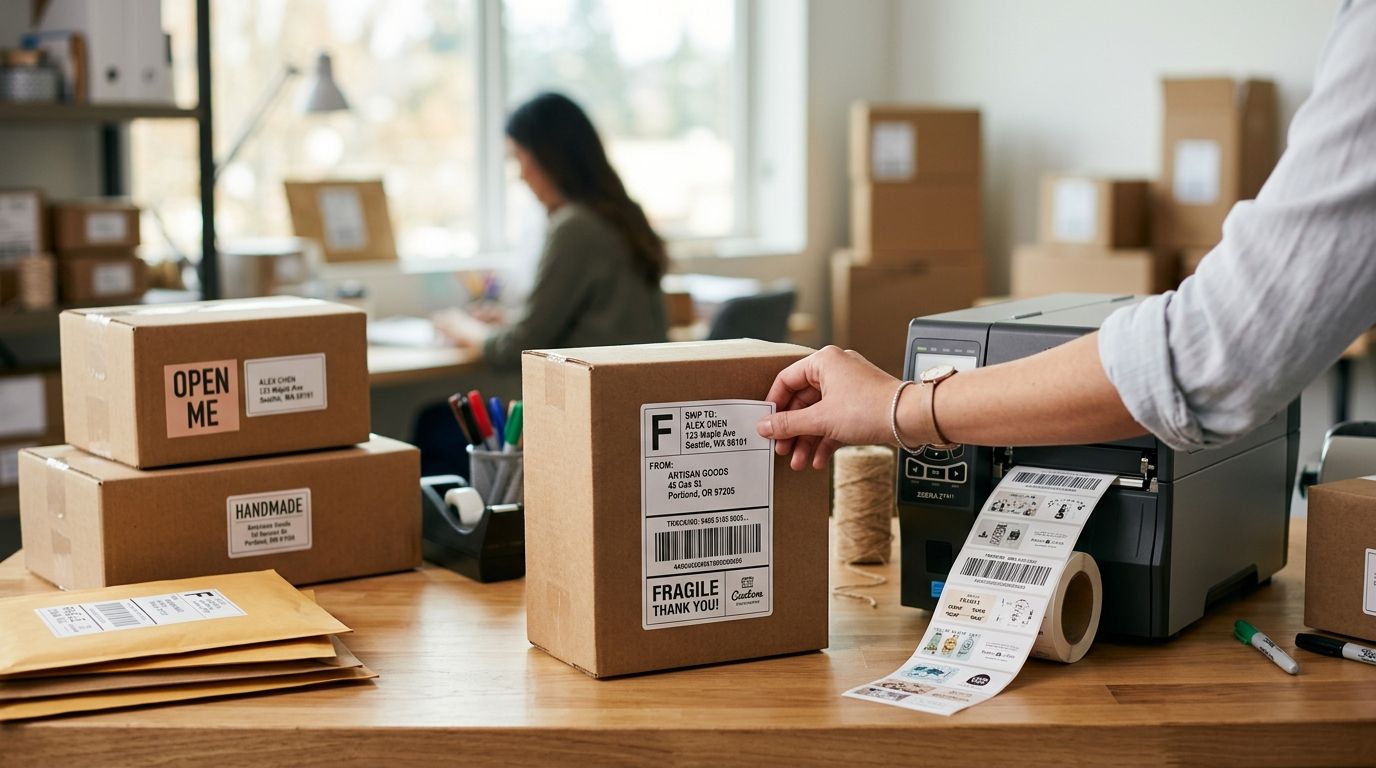
Small businesses that ship or mail products need label printing built for scanners, weather and order volume — not a laser printer running on its last cartridge. Etsy sellers, direct mail marketers and GTA retailers shipping daily orders have different label needs than someone printing a one-off mailing label at home.
- Label printing for shipping and mailing needs weatherproof stock and a scannable barcode, not standard copy paper.
- Return address labels and shipping labels use different adhesive and finish specs than packaging stickers.
- Batch runs of 250+ pieces cut per-order handling time for online sellers shipping daily.
- Same-day label printing in Toronto covers rush jobs when a shipment deadline lands with no notice.
- Desktop inkjet smears in humid or cold conditions; professionally printed labels hold up.
Why label printing matters for shipping and mailing
A shipping label that smears, peels, or fails a barcode scan costs more than the reprint. It costs a missed pickup, a returned package, or a mailroom sort error that delays a direct mail campaign by days. For a small business shipping five to fifty orders a day, that failure rate compounds fast.
Label printing for this segment isn't about design — it's about survival through handling. A return address label that peels off in a Canada Post sorting bin, or a barcode that a scanner can't read because a laminate sheet covers the quiet zone, creates the same result: a package that doesn't move.
The how-to spine
Match the label stock to how it ships
Start with the environment the label travels through, not the printer you already own. Cold-chain shipments, outdoor mailbox drops and warehouse handling each punish a different stock in a different way.
- Matte paper for indoor mail and lightweight parcels
- Waterproof vinyl or polypropylene for outdoor or cold-chain shipments
- Thermal-direct rolls for high-volume shipping stations printing 100+ labels a day
- Kraft stock for eco-positioned packaging
- Clear poly for over-stickering an existing branded box
Format the label for barcode and scanner accuracy
A barcode that looks fine on screen can still fail on a handheld scanner. Contrast, size and clear margin matter more than the graphic around it.
- Keep a blank quiet zone of roughly 1/8 inch on each side of the barcode
- Use black ink on white or light backgrounds only
- Skip glossy laminate directly over the barcode — glare blocks the scan
- Size the barcode to carrier minimums, not a shrunk-down default
- Test-scan a sample of 10 before running the full batch
Build a return address label system
Once the format is locked, print the return address as a fixed asset instead of re-typing it into every shipping label template. This is where a faster path beats doing it by hand every time. Return address labels printed in bulk at Print Fast keep the name, logo and address consistent across a full shipping season.
- Pre-print name and logo on sheets of 30 for hand-addressed mail
- Order rolls of 500 or more for automated shipping stations
- Set a reorder point at 20% of stock remaining
- Match label dimensions to the envelope window size
- Keep one master file so every reprint matches the last batch exactly
Batch-print labels for order volume
Printing one label at a time when order volume climbs past a handful a day wastes hours a week. Etsy and online sellers running daily fulfillment do better with scheduled batch runs than one-off prints.
- Print weekly batches sized to the coming week's expected order count
- Number batches sequentially so a misprint is traceable
- Keep carrier shipping labels physically separate from product packaging stickers
- Stage printed labels by ship date, not by product SKU
- Build in a 48-hour buffer before known peak sales days
Add tracking and barcode elements correctly
Carrier scanning systems expect specific barcode formats. Guessing at the format causes bounce-backs that show up only after the package is already in transit.
- Use Code 128 or GS1-128 formats for carrier compatibility
- Never let packing tape cross the barcode area
- Check barcode contrast under actual warehouse or garage lighting, not just a monitor
- Run a 10-piece test batch before committing to a full print run
- Keep barcode format identical across every SKU to avoid scanner confusion
Pick adhesive and finish for the weather your shipments face
Adhesive failure shows up days after the label is applied, which makes it the hardest defect to catch before it costs a shipment.
- Permanent acrylic adhesive for cold-chain or refrigerated shipments
- Removable adhesive for returnable or reusable packaging
- Matte finish to cut scanner glare on handheld devices
- UV-resistant laminate for anything sitting in a mailbox or on a porch
- Freezer-grade adhesive specifically for frozen goods shipments
Set up a mailing label workflow for direct mail campaigns
Direct mail runs a different clock than shipping. A postcard or flyer mailing needs address accuracy checked before the print run, not after 500 pieces are already labelled.
- Clean the mailing list against Canada Post address standards before printing
- Print address labels in the same batch size as the mail piece itself
- Sort labels by postal code before applying, not after
- Keep a proof copy of the first sheet to catch formatting errors early
- Reconcile the final labelled count against the mail piece inventory before drop-off
Compare the label printing options
| Option | Best for | Turnaround | Key limitation |
|---|---|---|---|
| Desktop inkjet or laser at home | Occasional, low-volume shipments | Same day (self-print) | Ink smears in humid conditions; no barcode calibration |
| Local rush print shop (Print Fast) | GTA sellers needing 1Hr, Same Day or 24Hr batches | 1Hr / Same Day / 24Hr | Requires local pickup or delivery window |
| Big-box retail print counter | One-off small runs | Same day to 24Hr | Limited stock options, no rush guarantee |
| National online print-by-mail service | Large recurring orders planned weeks out | Roughly a week by mail | Shipping time kills last-minute jobs |
Verdict: for GTA small businesses shipping or mailing on a tight deadline, a local rush print shop beats a desktop printer or a mail-order service on reliability and turnaround — home printing wins only for the occasional single-label job.
Common mistakes small businesses make with shipping and mailing labels
- Printing shipping labels on standard copy paper. It smears the first time a package sits on a rain-soaked porch.
- Sizing barcodes below carrier minimums. Batch runs of tiny barcodes come back as unscannable at the depot, and the return trip costs a full shipping cycle.
- Skipping a return address label entirely. Handwritten returns slow down sorting and increase misdelivery on bulk mail.
- Running a peak-weekend batch through a low-volume home printer. Ink heads clog mid-run right when order volume is highest.
- Mixing adhesive types across SKUs. Pack stations end up guessing which label goes on which product, and mistakes ship out the door.
FAQ
What's the best label printing option for small shipping volumes?
For occasional single-label jobs, a desktop printer works. For daily or weekly order volume, a local print shop offering same-day batch runs is more reliable than home printing.
Is thermal label printing better than inkjet for shipping labels?
Thermal-direct printing holds up better under high-volume daily shipping because it skips ink entirely, avoiding smear issues that inkjet has in humid or cold conditions.
How much does label printing cost for small businesses?
Cost depends on stock, adhesive type and order volume. Check current pricing directly with a print shop for a custom quote based on your specs.
Can I get same-day label printing in Toronto?
Yes. Same-day and rush label printing is available in Toronto and the GTA for businesses that need labels before a shipment or mailing deadline.
What adhesive works best for cold or frozen shipments?
Freezer-grade permanent acrylic adhesive holds up on cold-chain and frozen shipments where standard adhesive can lift or fail.
Do return address labels need different specs than shipping labels?
Yes. Return address labels are typically smaller and printed on standard paper stock, while shipping labels need barcode-ready formatting and often a weatherproof finish.
What size should a shipping barcode be?
Follow your carrier's published minimum barcode size, and keep a clear quiet zone of roughly 1/8 inch around it so scanners read it cleanly.
Is label printing at home reliable for daily order volume?
Not for most sellers. Home inkjet printers struggle with ink consistency and barcode contrast once daily order volume climbs past a handful of shipments.
One last thing
The single spec most sellers skip is the quiet zone — the blank margin around a barcode. Laminate right over that margin and the label still looks fine to the eye, but a scanner reads nothing. Check that margin before any batch run over 50 pieces, and the reprint calls stop.
Order custom labels and stickers from Print Fast: custom labels and stickers at PrintFast.ca. Need a price first? Submit a custom quote request.


