
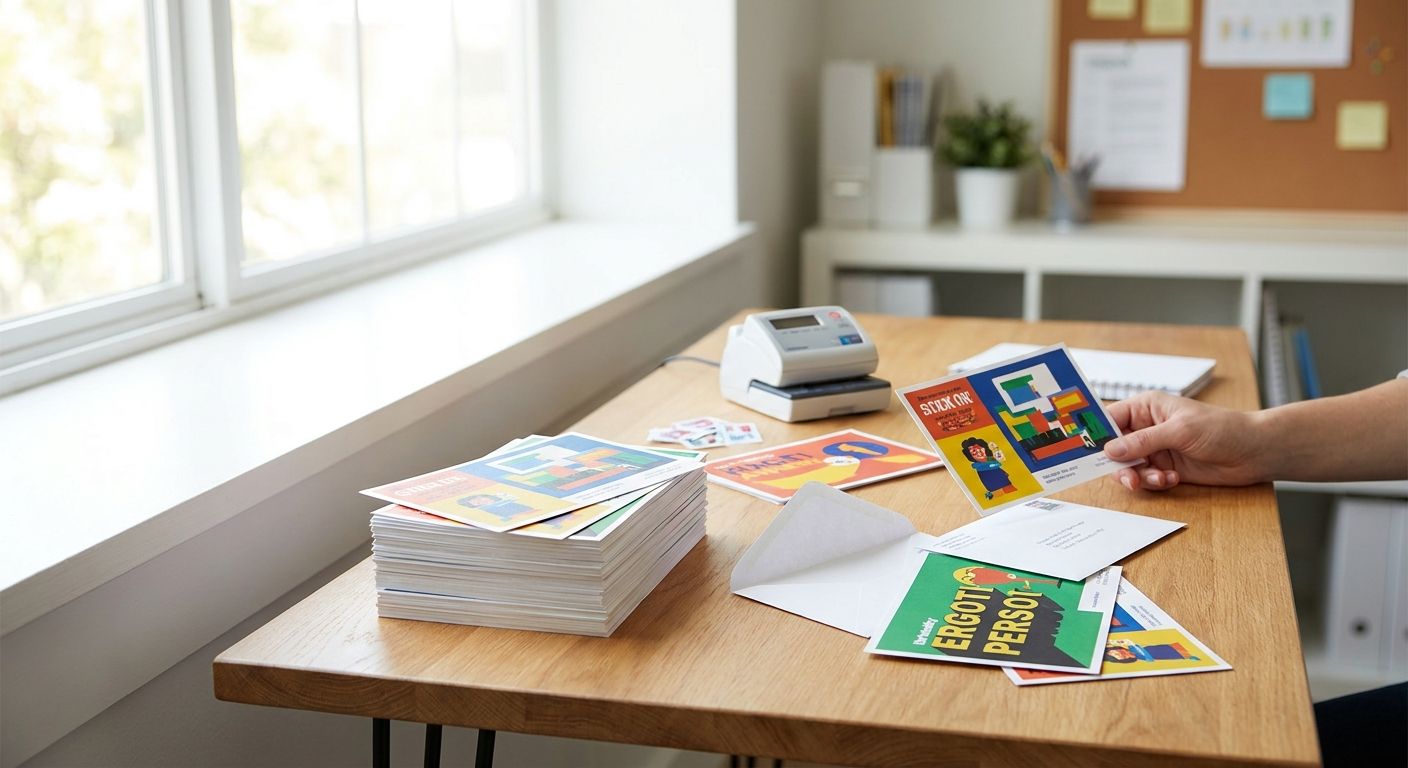
Postcards for direct mail are printed mailers sent through Canada Post or a local delivery service to reach a defined list of addresses, with the aim of driving a specific action — a call, a visit, a redeemed offer — without an envelope to open first. Small business owners running local campaigns need a format that works on a tighter list and a tighter budget than national retailers, and postcards are the one direct mail format built for exactly that.
- Postcards for direct mail skip the envelope, so the offer is visible the second it hits the mailbox.
- Same-day and rush turnaround matter more for small business owners than for national mailers with 90-day lead times.
- 4x6 and 6x9 postcards cover most local campaigns; oversized formats suit real estate and grand-opening pushes.
- Print Fast handles rush postcard runs alongside same-day business cards and lawn signs for GTA small businesses.
Why postcards for direct mail matter for small business owners
A postcard has no envelope, so there's no barrier between the mailbox and the message. That single fact is why postcards for direct mail consistently pull attention that a sealed letter doesn't — the offer, the date, and the call to action are visible before the recipient decides whether to keep reading.
Small business owners in Toronto and the GTA don't run mail campaigns the way a national chain does. Lists are smaller, timelines are shorter, and a single event — an open house this weekend, a grand opening next Friday — often drives the whole mailing. That's a different problem than a retailer planning a Q3 catalogue drop six months out.
The practical result: a small business postcard campaign lives or dies on turnaround. If the print order takes two weeks, the open house has already happened. Print Fast runs rush and same-day print jobs specifically because local campaigns get planned on short notice, not on a marketing calendar.
Build a direct mail postcard campaign that works
Define the list before you design anything
A postcard sent to the wrong address is a wasted print run no matter how good the design is. Start with the list, not the artwork.
- Pull a radius list around the physical location for local promotions
- Use a saturation list (every address on a route) for grand openings and new-store awareness
- Segment past customers separately from cold prospects — different offer, different copy
- Confirm the list is deduplicated before ordering print quantities
- Match print quantity to list size plus 5-10% for spoilage, not a round number
Pick a size that fits the message
Postcard size drives both cost per piece and how much copy you can fit. Oversized cards get noticed in a stack of mail; standard cards keep cost per piece down for bigger lists.
- 4x6 for single-offer promotions with one headline and one call to action
- 5x7 when you need a photo plus a short offer paragraph
- 6x9 or larger for real estate listings, grand openings, or anything with a floor plan or map
- Match the size to the envelope-free reading distance — a mailbox glance, not a desk read
Write copy for a five-second read
A postcard gets scanned, not studied. The headline and the offer need to survive a glance.
- Lead with the benefit or the date, not the business name
- One call to action per card — call, visit, scan, redeem
- Put the expiry date or event date in a spot that can't be missed
- Keep body copy under 25 words if there's a phone number or QR code on the same face
- Drop the legal disclaimer to the smallest legible size, not the main copy block
Choose stock and finish for how the card gets handled
A postcard travels through a sorting machine and a mail carrier's hand before it reaches a mailbox. Stock choice affects whether it arrives crisp or bent.
- 14pt or 16pt cardstock for standard mailers — thin enough to mail, stiff enough to survive
- Gloss or UV coating on the image side for photo-heavy real estate or event cards
- Matte finish where a pen needs to write on the card (RSVP cards, coupons)
- Rounded corners for a friendlier feel on grand-opening and retail promotions
Add a response mechanism that's easy to track
A postcard without a way to measure response is a print expense with no data attached.
- A unique phone extension or tracking number per campaign
- A QR code linking to a landing page built only for that mailing
- A promo code printed on the card, redeemable in-store or online
- A deadline that forces a decision instead of an open-ended offer
Time the print and mail drop around the event, not the design
The biggest small-business mistake is designing first and printing whenever it's convenient. Work backward from the mail date.
- Confirm Canada Post's delivery window for the target route before setting a print deadline
- Build in a buffer day between print pickup and drop-off
- Use rush or same-day print runs when the campaign was decided less than two weeks out
- Order same-day business cards alongside the postcard run if the campaign includes an in-person event, so both pieces arrive together
Postcards vs. other direct mail formats
| Format | Best for | Key limitation |
|---|---|---|
| Postcards | Local promotions, event announcements, real estate listings | Limited copy space compared to a letter |
| Letters (envelope mail) | Detailed offers, formal notices, B2B outreach | Lower open rate — envelope must be opened first |
| Flyers / door drop | Broad neighbourhood awareness, no address list needed | No personalization, harder to track response |
| Existing customer lists, repeat promotions | Easily ignored or filtered; no physical presence |
Postcards win for small business owners running one-time or seasonal local campaigns — they cost less per piece than letters, get read faster than flyers, and land in a mailbox instead of a spam folder.
Common mistakes small business owners make with postcard mail
- Mailing before the offer is decided. Locking in a print date before the promotion or event date is finalized forces rush pricing that could've been avoided.
- Skipping the tracking mechanism. A postcard with no QR code, no promo code, and no dedicated phone line makes it impossible to know if the mailing worked.
- Using a stock list instead of a targeted one. A generic "everyone within 5km" list wastes budget on addresses that were never a fit for the offer.
- Treating postcard copy like a flyer. Cramming five offers onto one card kills the five-second readability that makes postcards work in the first place.
- Ignoring companion print pieces. A postcard that drives foot traffic to an event with no presentation folders for real estate closings or matching signage on-site loses the consistency that built the response.
Get a rush postcard quote today
Same-day and 24Hr postcard printing for GTA small business campaigns.
FAQ
What size postcard works best for direct mail campaigns?
4x6 works for single-offer promotions with a tight budget, while 6x9 suits real estate listings or grand openings that need a photo and more copy. Match the size to how much information the offer actually requires — bigger isn't automatically better for response rate.
How much does postcard printing cost for a small business campaign?
Cost depends on quantity, stock, and finish, and Print Fast provides custom quotes based on the specific run. Rush and same-day orders typically carry a premium over standard turnaround, so request a quote once the list size and mail date are set.
Is direct mail still worth it in 2026 for small businesses?
Direct mail still works in 2026 for local, event-driven campaigns because postcards reach a physical mailbox that isn't competing with a spam filter. It performs best paired with a trackable response mechanism like a QR code or promo code.
Can I get postcards printed same day?
Yes, same-day and rush postcard printing is available for campaigns planned on short notice, which covers most small-business mailings tied to a specific event date. Standard turnaround costs less, so use rush only when the mail date is already fixed.
What's the difference between postcards and flyers for direct mail?
Postcards go to a specific mailing list through Canada Post and support tracking, while flyers are typically door-dropped across a neighbourhood with no addressing or personalization. Postcards cost more per piece but let you target and measure the exact audience you mailed.
Do postcards need a call to action?
Yes, every postcard for direct mail needs one clear call to action — call, visit, scan, or redeem — because a postcard gets a five-second glance, not a full read. Cards with multiple competing offers see lower response than single-offer cards.
What stock should I use for mailed postcards?
14pt or 16pt cardstock is standard for mailed postcards because it survives sorting machines and handling without bending. Add gloss or UV coating on the image side for photo-heavy campaigns like real estate listings.
One last thing
The postcard rarely works alone. A grand-opening mailer that drives someone to a storefront with no real estate lawn signs-style signage or matching in-store signals loses the momentum the mail piece created — the print pieces around the event matter as much as the postcard itself. Small business owners who pair the mailer with custom stickers for packaging on any product sample or takeaway see the branding carry past the mail date, not just on the day it arrives.
That pairing is why postcard campaigns tied to a single event date perform better than open-ended ones: the mail piece, the signage, and the follow-up material all point to the same deadline.


