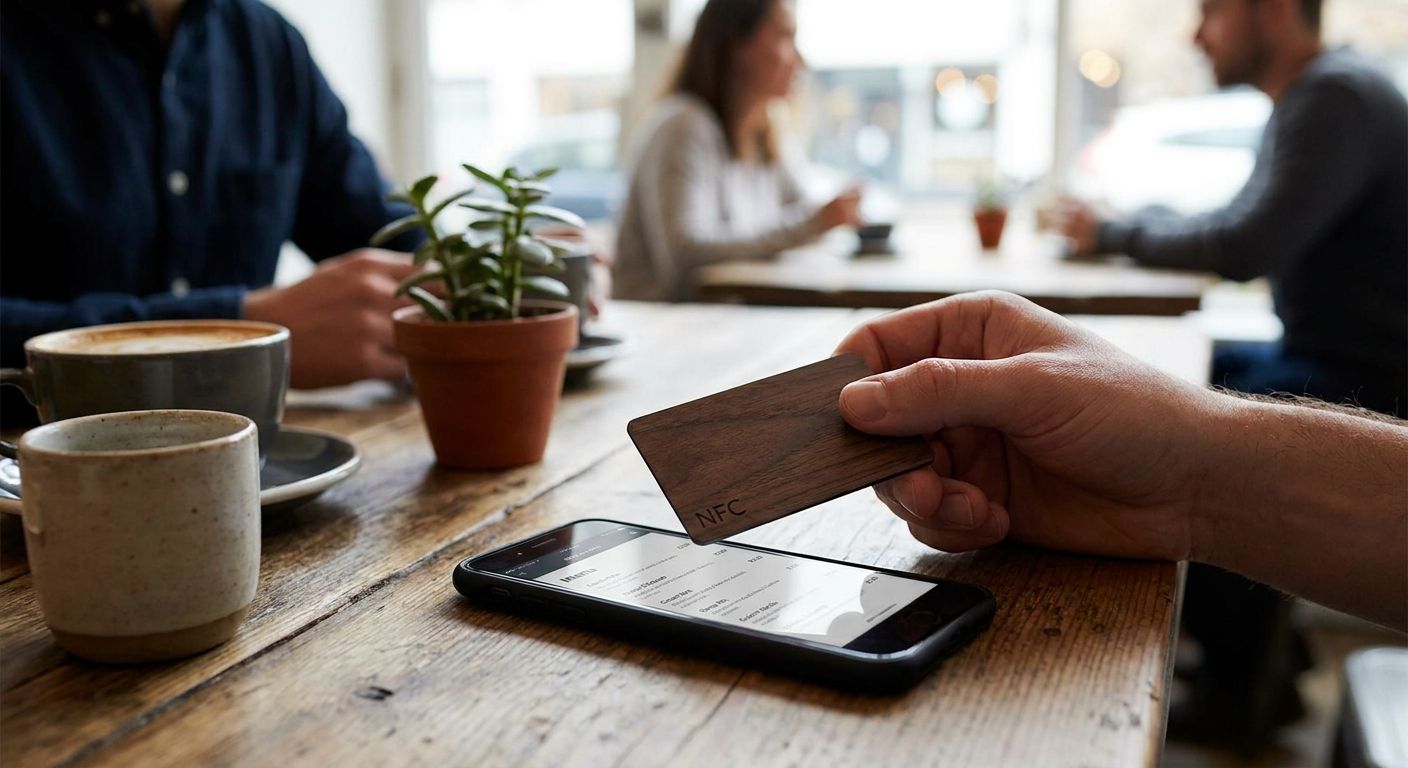
A tap-to-review NFC business card turns a five-minute Google review ask into a two-second phone tap at the table, and in 2026 more Toronto restaurants and cafes are handing these out instead of paper inserts.
- NFC business cards for restaurants work best with an NTAG213 or NTAG215 chip - Buy the standard PVC version.
- Metal and bamboo NFC cards suit upscale cafes but cost more per unit - Consider before a bulk order.
- QR+NFC hybrid cards catch guests on older phones without NFC - Buy if your clientele skews older.
- Rush print shops turn around standard business card stock in as little as 24 hours in 2026.
- Skip single-write chips if your review link, menu, or loyalty page changes more than once a year.
Why this matters
A server can ask for a Google review a hundred times a week and still get a fraction of that in actual reviews, because typing a business name into a phone at a dinner table is friction. An NFC chip removes that friction: tap, land on the review page or loyalty sign-up, done. Cafes running loyalty programs see the same benefit at the counter — a tap replaces a punch card or a staff member pointing at a QR poster taped to the register.
The catch is that "NFC business card" covers a wide range of chip types, card materials, and price points, and most guides selling them skip the details that matter for a restaurant's day-to-day use: grease resistance, chip rewritability, and how fast you can reorder when a card disappears into the dish pit. If you're also sourcing standard printed business cards for staff, Print Fast runs rush and same-day printing out of Toronto, which matters more than it sounds once you've ordered the wrong chip type and need a paper backup fast.
Who this is for
This is for restaurant owners, cafe managers, and hospitality marketers who want a tap-based card for review generation, loyalty sign-up, or table-side ordering — not for anyone who just wants a cheap QR sticker. If your team changes the linked page (a new review platform, a seasonal menu, a rotating loyalty app) more than once a year, the chip choice below matters as much as the card material.
What to look for in NFC business cards for restaurants
Chip type and rewrite capability
Most restaurant NFC cards run on the NXP NTAG21x family — NTAG213 (144 bytes), NTAG215 (504 bytes), or NTAG216 (888 bytes). A rewritable chip lets you point the same card at a new URL when your review platform or menu link changes. That flexibility matters far more in a restaurant than in a one-time retail promo.
Read range and phone compatibility
NFC read range tops out around 4 centimetres, so the tap has to be deliberate — a feature at a host stand, not a bug. iPhones running iOS 11 or later (2017 onward) and most Android phones since roughly 2012 read NFC natively without an app. A small share of older devices still can't, which is why a printed QR backup earns its space.
Card material for a kitchen-adjacent environment
Standard PVC handles grease, condensation, and a trip through a server's apron pocket better than paper-laminate stock. Metal and bamboo cards look sharper on a hostess stand but add cost and weight for identical chip functionality.
Branding space and QR fallback
The front needs your logo and a short instruction ("Tap for our menu"); the back needs room for a printed QR code. A card with no QR fallback quietly loses every guest whose phone can't tap.
Reorder speed and rush turnaround
Cards get lost, soaked, or handed out three times faster than planned during a launch week. Rush print shops like Print Fast turn standard business card stock around in as little as 24 hours, which is the number to plan around when you're reordering staff cards alongside an NFC batch.
Total cost across chip, card, and programming
Per-card price is really three line items: the chip, the card stock and printing, and the programming step. Get all three broken out on the quote. A low card price paired with an expensive encoding fee can land above a bundled option.
Top picks for restaurant and cafe NFC cards in 2026
Standard PVC card with an NTAG213 chip — the safe pick. 144 bytes is plenty for a single redirect URL: a Google review link, a loyalty sign-up, or an online ordering page. PVC shrugs off the wipe-downs a card takes at a host stand. Buy — the default for a single-location restaurant that wants one clean link and nothing else.
QR+NFC hybrid card — the safety net. Printed QR on the back, embedded chip on the front, so the phone that taps and the phone that can't both land on the same page. Buy — any restaurant with a mixed-age clientele should default to this over NFC-only.
Metal NFC card with an NTAG216 chip — the fine-dining flex. 888 bytes has room to point at a multi-option landing page — menu, reservations, and reviews from one tap — instead of a single URL, and the card reads as premium on a white tablecloth. Consider — worth the upgrade at a higher check average, not at a fast-casual counter.
Bamboo or eco-composite NFC card — the sustainability pick. Same NTAG213 chip in a wood-fibre shell instead of PVC, which fits a cafe brand built on sourcing messaging. Consider — order a small run first, since composite stock can read differently than PVC on older phones.
NFC table talker or tent card — the wildcard. Same chip technology, but it sits on the table instead of in a wallet, so loyalty taps don't depend on a server remembering to hand something over. Skip as a business card replacement; Consider as an add-on when counter-service loyalty is the real goal.
What to avoid
- Stick-on NFC tags applied to a regular printed card. They peel after a few wipe-downs and look cheap next to an embedded chip.
- Single-write, non-rewritable chips. Fine for a one-off event card, wrong for a menu or review link that will change inside a year.
- Any NFC card with no printed QR fallback. You lose every guest on a phone that can't tap, and you never find out how many that was.
Verdict comparison table
| Format | Chip | Storage | Best for | Verdict |
|---|---|---|---|---|
| Standard PVC | NTAG213 | 144 bytes | Single-location restaurants, one link | Buy |
| QR+NFC hybrid | NTAG213/215 | 144–504 bytes | Mixed-age clientele | Buy |
| Metal | NTAG216 | 888 bytes | Fine dining, multi-link landing page | Consider |
| Bamboo/eco | NTAG213 | 144 bytes | Sustainability-branded cafes | Consider |
| Table talker | NTAG213 | 144 bytes | Counter-service loyalty add-on | Skip as card replacement |
Need staff business cards fast?
Rush and same-day business card printing out of Toronto.
FAQ
What is an NFC business card for a restaurant?
It is a card with a small chip embedded inside that a guest taps with their phone to open a linked page instantly. Restaurants point that link at a review page, a loyalty sign-up, or a digital menu instead of asking guests to type a URL.
Do all phones read NFC business cards?
No. iPhones on iOS 11 or later (2017 onward) and most Android phones since around 2012 read NFC without an app, but a share of older devices cannot. That gap is the reason to print a QR code on the back.
Is a QR code as good as NFC for a restaurant card?
A QR code works on any smartphone camera and costs nothing extra to print, while NFC is faster but needs a compatible phone. A hybrid card carrying both reaches the most guests.
Can I reprogram an NFC business card after printing?
Yes, if the chip is a rewritable type such as NTAG213 or NTAG215. Single-write chips lock the link permanently, which becomes a problem the first time your menu or review platform changes.
What is the read range of an NFC chip?
About 4 centimetres, so the guest has to hold the phone close and on purpose. That short range is deliberate and prevents accidental taps in a crowded dining room.
How fast can I reorder business cards for my restaurant?
Standard business card stock moves fast: rush print shops in Toronto turn it around in as little as 24 hours in 2026. Chip programming lead time sits with your NFC supplier and is quoted separately.
Should a cafe use a table talker instead of a card?
A table talker works better for counter-service loyalty because it does not depend on staff handing anything out. A wallet-sized NFC card works better for review generation at a sit-down restaurant.
How much chip storage do I actually need?
144 bytes on an NTAG213 holds one redirect URL, which covers most single-location restaurants. Step up to 504 or 888 bytes only when you are linking to a multi-option landing page.
One last thing
The chip gets all the attention, but the printed QR code on the reverse is what protects your review count in 2026 — every dining room still has guests whose phones will not tap. A hybrid card costs a little more per unit and captures the guests an NFC-only card silently misses.