
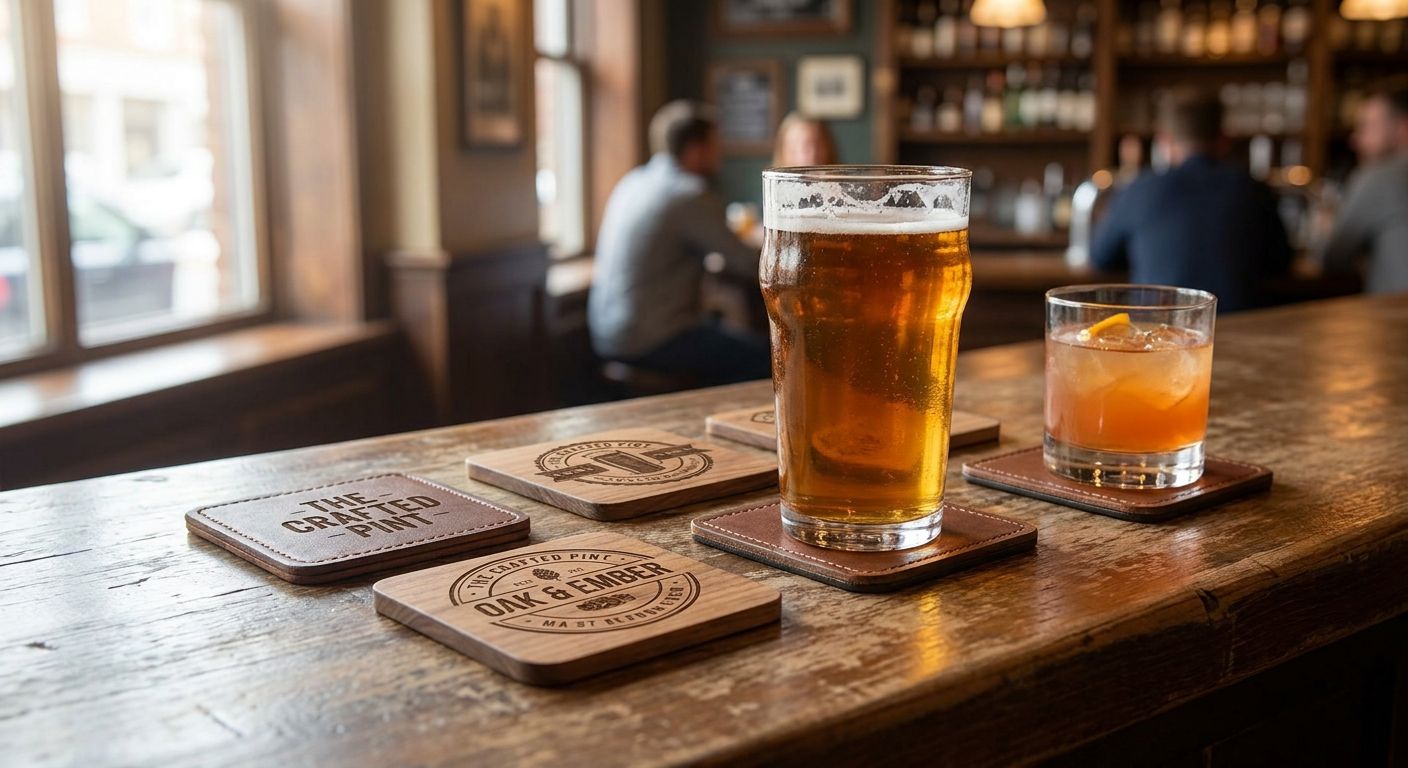
Custom coasters for bars and restaurants protect tables, extend brand visibility to every seat, and give a patio or dining room a finished look without the cost of tabletop signage. A bar's coaster needs differ from a café's or a caterer's: high liquid volume, fast table turns, and glassware that ranges from pint glasses to rocks glasses all change what material and size actually work.
- Pulp board coasters absorb condensation best for bars serving cold pints and cocktails; go 4x4 inch (10x10cm), the standard glass-ring size.
- Cork and synthetic coasters cost more per unit but survive dishwashing and daily reuse for higher-volume restaurants.
- Print Fast runs custom coasters same day or next day for GTA bars needing stock before a weekend rush or opening night.
- Design the logo off-center so the drink ring doesn't sit on top of it — the single most common bar coaster mistake in 2026.
- Order in batches of 250-500 for a single location; smaller runs cost more per coaster and larger runs sit in storage.
Why custom coasters matter for bars and restaurants
A coaster is the only piece of print that sits in a guest's hand for the full length of a visit. Menus get read once and set aside; a coaster stays under the glass through every refill, which means the logo, the QR code, or the happy-hour reminder gets seen repeatedly during a single sitting.
For bars specifically, the material choice is functional before it's branded: pulp board pulls moisture away from the table, which matters when a round of pints sweats through a two-hour service. Restaurants with lower drink volume and higher table turnover care more about durability and reorder speed than absorbency alone.
Coasters also solve a problem table tent cards don't: they're disposable-friendly for high-turnover bars, so a design refresh for a seasonal promo or event doesn't mean replacing a permanent tabletop fixture.
Pick the material for your drink volume
The coaster material decision comes before size or design, because it determines how the coaster performs during service, not just how it looks on a shelf.
- Pulp board (absorbent paper pulp): standard bar choice, soaks up condensation from cold glasses.
- Cork: reusable, holds up to repeated wiping, common in cocktail bars with table service.
- Synthetic/PVC: waterproof, wipes clean, best for outdoor patios exposed to weather.
- Corrugated: cheaper stock, works for one-off events or promotions rather than daily bar use.
- Coated pulp board: adds a printable gloss finish without losing absorbency, a middle ground for restaurants that want sharper color reproduction.
Match size to your glassware
Standard coaster sizing is built around glass base diameter, not table space.
- 4x4 inch (10x10cm) square: fits most pint and rocks glasses, the most common bar order.
- 3.5 inch round: standard for wine glasses and smaller cocktail glassware.
- 4.25 inch round: fits larger craft beer glasses and steins.
- Custom die-cut shapes: match a logo silhouette but cost more to produce than standard squares or rounds.
Design for the drink ring, not just the logo
A coaster's center gets covered by the base of the glass for most of its life on the table. Designs that put the logo dead-center get hidden behind the exact object the coaster exists to protect.
- Push the primary logo or wordmark toward the outer third of the coaster, not the center.
- Use a border design or repeating pattern that still reads when the middle is obscured.
- Keep text minimum 8pt for legibility at arm's length in low bar lighting.
- Avoid thin serif fonts under dim lighting; bold sans-serif holds up better on pulp board's slightly textured surface.
- Test one proof under an actual glass before approving a full run — this catches ring placement problems no screen preview shows.
Order for turnover, not just for cost per unit
Bars burn through coasters faster than restaurants because of higher per-table item counts and disposal after wet use. Ordering the wrong quantity either forces a rush reorder mid-week or ties up storage space behind the bar.
- Calculate weekly usage: seats × average turns per night × nights open, then multiply by a buffer for spills and reorders.
- Order in batches of 250-500 per single-location bar; this range balances unit cost against storage space.
- Restaurants with lower drink volume can order smaller batches (100-250) since coasters last multiple services before replacement.
- Build in lead time for seasonal designs (holiday, patio season) — order at least a week before the promotion starts, not the week of.
- Keep one backup design in stock as a plain-logo fallback if a seasonal reprint runs late.
Plan turnaround around events, not around convenience
A grand opening, a sponsorship activation, or a weekend festival patio all create hard deadlines that don't move. Coaster turnaround needs to be planned against the event date, not against whenever the design gets finalized.
- Confirm proof approval at least 48 hours before the print run starts for standard orders.
- For last-minute needs — a sponsor logo added days before an event — ask about same-day or next-day custom coaster printing rather than assuming standard lead times apply.
- Build a buffer day between delivery and the event for a quality check on the full batch, not just the proof.
- Coordinate coaster delivery with other event print — banners for outdoor events or patio signage — so everything arrives in one drop instead of staggered shipments.
Print Fast prints custom coasters with same-day and next-day turnaround for Toronto and GTA bars and restaurants, which matters most when a design change or event date moves faster than a standard print schedule allows.
Get a custom coaster quote today
Same-day and rush printing for bars and restaurants across the GTA.
Pair coasters with the rest of your table print
Coasters rarely work alone on a restaurant or bar table. They're most effective as part of a small print system — coaster, tent card, maybe a QR-linked business card at the host stand.
- Match coaster colors to table tent card colors so the set reads as one campaign, not mismatched print runs.
- Use the coaster for a short call to action (a QR code to a loyalty program or menu) and let the tent card carry the longer copy.
- If the bar or restaurant collects contact info from regulars, an NFC business card at the counter extends the same digital touchpoint a coaster QR code starts.
- Keep packaging consistent if coasters double as retail giveaways — custom stickers for small business packaging work the same branding angle for takeout orders.
Comparison: coaster options by bar and restaurant use case
| Option | Best for | Key limitation |
|---|---|---|
| Pulp board | High-volume bars with cold drinks | Single-use, disintegrates if left wet too long |
| Coated pulp board | Bars wanting sharper color print | Slightly less absorbent than uncoated pulp |
| Cork | Cocktail bars with table service | Higher unit cost, needs wiping to reuse |
| Synthetic/PVC | Outdoor patios and weather exposure | Doesn't absorb condensation, guest wipes it themselves |
| Corrugated | One-off promotions or events | Not durable enough for daily bar service |
Verdict: pulp board wins for standard bar service in 2026 — it's the material behind most bar coaster orders because it does the one job a coaster exists for, pulling moisture off the table, at the lowest cost per unit.
Common mistakes bars and restaurants make with coasters
- Centering the logo under the glass. The drink ring covers the middle of the coaster for most of its life on the table — design around that, not through it.
- Choosing synthetic material for an indoor bar. PVC coasters don't absorb condensation, which defeats the point on an indoor bar table without patio wind or rain exposure.
- Ordering one flat quantity regardless of season. Patio season and holiday promotions burn through coasters faster than a slow Tuesday in February; static reorder quantities lead to mid-week shortages.
- Skipping the physical proof check. A screen preview doesn't show how a design reads under bar lighting or how thin text holds up on textured pulp stock.
- Treating coasters as a one-time print. A design that never updates stops getting noticed by regulars; seasonal refreshes keep the coaster doing its job as a visibility tool, not just table protection.
FAQ
What's the best material for custom coasters at a bar?
Pulp board is the best material for bars serving cold drinks in 2026 because it absorbs condensation off the table. Synthetic or PVC coasters work better on outdoor patios exposed to rain, since they don't absorb liquid at all.
What size should custom coasters be for restaurant use?
4x4 inch (10x10cm) square is the standard bar coaster size and fits most pint and rocks glasses. Round coasters at 3.5 inch suit wine glasses, while 4.25 inch rounds fit larger craft beer glasses.
How many custom coasters should a bar order at once?
Most single-location bars order 250-500 coasters per batch based on weekly drink volume and turnover. Restaurants with lower drink volume can order smaller batches of 100-250 since coasters last longer between replacements.
Is cork or pulp board better for bar coasters?
Pulp board is better for high-turnover bars because it's disposable and cheaper per unit. Cork is better for cocktail bars with table service, since it's reusable and holds up to repeated wiping.
How fast can custom coasters be printed for a bar opening?
Print Fast offers same-day and next-day custom coaster printing for Toronto and GTA bars and restaurants facing tight opening or event deadlines. Standard orders still need proof approval at least 48 hours before the print run to hit that turnaround.
Should coaster designs put the logo in the center?
No, centering a logo is the most common coaster design mistake because the drink glass covers the middle of the coaster for most of the table's turn. Push the logo or wordmark toward the outer third instead.
Do custom coasters work for outdoor patios?
Synthetic or PVC coasters work best for outdoor patios in 2026 because they resist rain and wind exposure without absorbing moisture the way pulp board does. Pulp board coasters break down faster outdoors if left in weather.
Can coasters be part of a bigger print campaign for a restaurant?
Yes, coasters work best paired with table tent cards and counter-level print using matching colors and a shared call to action. A QR code on the coaster and a longer message on the tent card cover both a quick glance and a longer read.
One last thing
The coaster material decision matters more than the design decision for bars specifically: a beautifully designed coaster on the wrong stock either falls apart mid-service or fails to protect the table at all, and neither outcome gets noticed for the right reasons. Get the pulp board versus synthetic call right first, then spend design time on keeping the logo out of the drink ring's path.


