
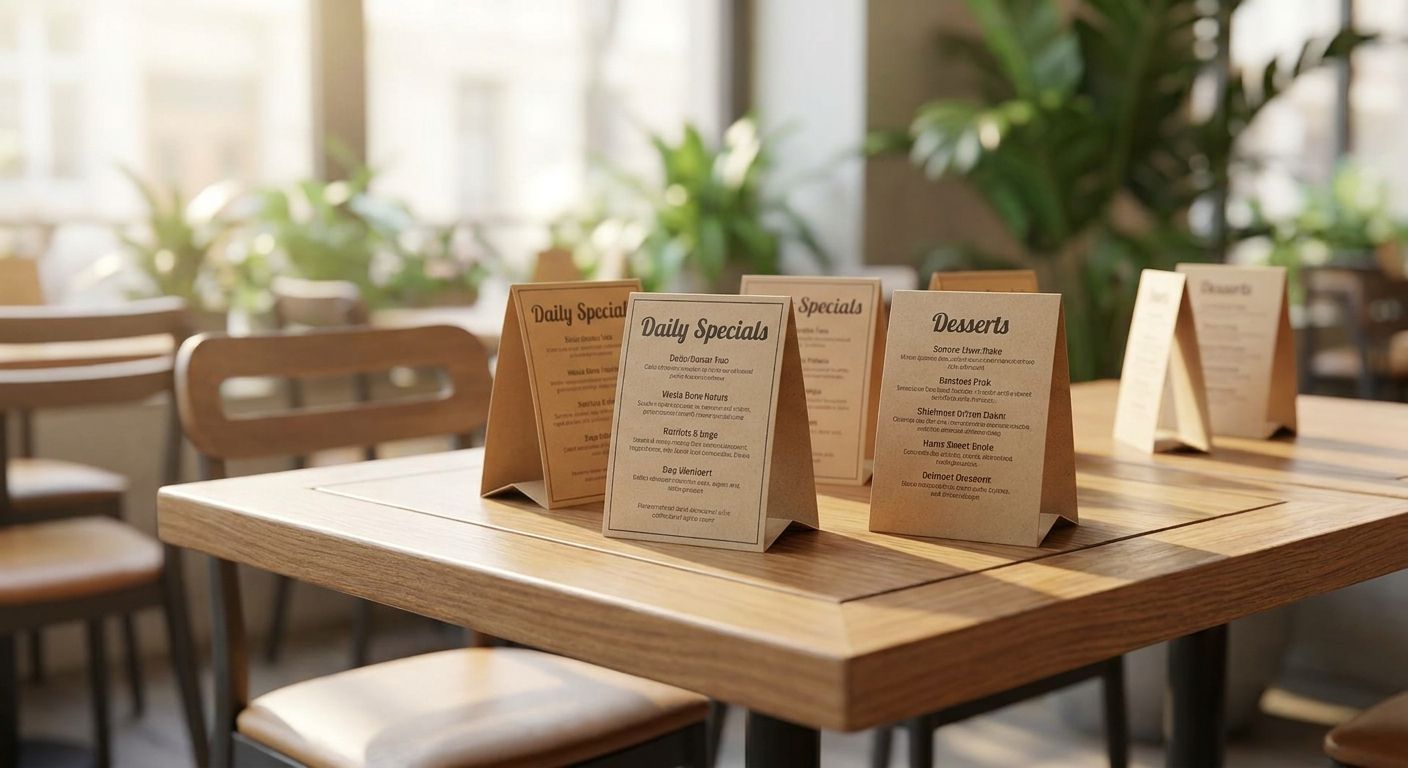
Table tent cards for restaurants put your best-selling item, seasonal special, or QR-code review link directly in front of a guest who's already seated and waiting — the highest-attention, lowest-cost real estate on the table. Restaurants and cafes need a different table tent than a retail counter card: they get bumped, wiped, spilled on, and replaced every few weeks, so stock and stand choice matter more than design flair.
- Table tent cards for restaurants hold up best on 14pt-16pt cardstock with lamination on patios and bar tables.
- Print Fast runs same-day and rush printing out of Toronto, so a menu refresh doesn't stall a weekend push.
- A double-sided 4x6 insert in a slot-in acrylic stand costs less to refresh than reprinting a full menu.
- Glossy paper with no lamination warps within days near hot plates and condensation — skip it for restaurant tables.
Why table tent cards matter for restaurants
Statistics Canada reported $101.4 billion in Canadian food-service and drinking-place sales in 2025, up 5.6% from 2024; Ontario recorded 6.0% growth. Restaurants Canada's Q1 2026 report shows the pressure beneath that growth: 54% of operators reported fewer guests and 71% reported declining profitability. A table tent should therefore have one measurable job — increase orders of a featured item, collect QR scans, or generate catering enquiries — rather than act as general decoration.
A server has seconds at the table before moving to the next order; a table tent works the whole time a guest waits for food. It doesn't need a screen, a login, or an app download — it sits there and sells while the kitchen does the work. Restaurants and cafes in Toronto and the GTA run tighter menu cycles than most retail categories: patio season, holiday menus, a new happy hour, a limited-run dish. Each cycle needs a fast reprint, not a full menu redo, which is exactly where a table tent earns its keep. Cafes pairing table tents with an NFC business card program for restaurants and cafes get a second contact point — one on the table, one in the server's hand.
Menu prices and specials change more in foodservice than almost any other small-business category, so the print you choose has to survive being reprinted often without becoming a line-item expense.
Set the promotion goal before you design anything
A table tent with no clear job gets ignored. Decide what this specific run is selling before you touch a template.
- Upsell a specific dish or drink (not "check out our menu")
- Push a loyalty signup or review QR code
- Promote an off-peak time slot (weekday lunch, late-night)
- Announce a limited-run seasonal item
- Drive a private event or catering inquiry
Choose the right size and stock for a restaurant table
Most restaurant table tents run 4x6 or A6, either double-wing or tri-fold, so they read from either side of a two-top or four-top.
- 14pt-16pt cardstock as the floor for anything that stays out more than a day
- Lamination or a UV coating on any table near a bar, patio, or open kitchen
- Double-sided printing so a tent reads correctly from any seat
- A matte finish under bright pendant lighting to cut glare
- Rounded corners if the tent sits near cutlery and gets handled often
Design for a three-second read
A guest glances at a table tent for a few seconds between courses — the design has to land in that window, not require study.
- One headline, one photo, one price, one call to action
- A QR code sized to scan from arm's length, not a thumbnail
- Contrast strong enough to read under dim restaurant lighting
- No more than two fonts and one accent colour
- Skip fine print — put terms on the receipt or menu instead
Pick a stand or holder built for restaurant traffic
The stand decides how long the card survives and how often it gets replaced.
- Acrylic slot-in stands for frequent insert swaps without buying new hardware
- Tri-fold self-standing cardstock for a no-hardware weekly special
- Weighted metal bases on patios where wind or a fan is a factor
- Magnetic backers for tables bussed roughly, where a stand tips easily
A restaurant swapping specials weekly should own the stand once and reprint only the insert — that's the cheaper long-term setup over reprinting a full tri-fold every time.
Set a print and swap schedule
Decide upfront how often the tent changes, because that decision drives the stock and the stand more than the design does.
- Weekly specials: reorder inserts only, keep the stand fixed
- Seasonal menus: reprint the full tent 4 times a year
- Evergreen promos (loyalty, QR review links): laminate and leave in place for months
- Event-driven runs: order rush for a launch date, not a routine reorder
A restaurant timing a menu refresh around a grand opening or relaunch often pairs table tents with vinyl banners for a grand opening so the outside signage and the tabletop promo push the same message on day one.
Proof for foodservice conditions, not office lighting
What looks right on a monitor doesn't always hold up under a restaurant's actual light and surfaces.
- Check colour match against your food photography, not a generic stock image
- Test contrast under the dimmest lighting condition in the room
- Confirm the QR code scans from a seated guest's phone at arm's length
- Check the stock doesn't glare under pendant or candle lighting
Tie the table tent to your takeout and packaging touchpoints
A table tent that promotes a loyalty program or a delivery order code works better when the same code shows up on the takeout bag or box. Restaurants running both dine-in and takeout often reuse the same QR or promo code across custom stickers for small-business packaging and the table tent, so the offer follows the guest home instead of dying at the table.
Get table tents printed fast
Same-day and rush printing out of Toronto for restaurant menu changes.
Comparison: table tent options for restaurants
| Option | Best for | Price | Key limitation |
|---|---|---|---|
| Acrylic slot-in stand + printed insert | Weekly specials, frequent swaps | Custom quote | Insert can slide out if the table gets bumped |
| Tri-fold self-standing cardstock | Short seasonal runs, no hardware | Custom quote | Less durable; plan on replacing every few weeks |
| Laminated double-sided tent | Bars, patios, high-spill tables | Custom quote | New laminate run needed for mid-cycle price changes |
| Digital tabletop display | Multi-location chains rotating menus often | Custom quote | Higher upfront cost; needs power and connectivity |
Verdict: a laminated double-sided tent in a reusable acrylic stand is the best default for most Toronto restaurants and cafes in 2026 — it survives spills, reads from both sides, and only the insert needs reprinting when the special changes.
Common mistakes restaurants make with table tents
- Printing on standard 80lb paper that curls within days near hot plates and steam
- Running one design all year and missing patio season, holiday menus, and off-peak windows
- Skipping a clear CTA or QR code, so the guest reads it and forgets before the server returns
- Placing tents where they block sightlines to the server or the kitchen pass
- Not budgeting for reprints when a menu price or special changes mid-quarter, so the tent quietly goes stale
FAQ
Order table tent cards from Print Fast: table tent cards at PrintFast.ca — same-day and 24-hour turnaround in Toronto.
What's the best stock for table tent cards for restaurants?
14pt to 16pt cardstock is the floor for restaurant table tents in 2026, with lamination added for bar, patio, or high-spill tables. Anything lighter warps within days near hot plates and condensation.
Is a tri-fold tent better than a slot-in acrylic stand?
A tri-fold card needs no hardware and suits short seasonal runs, while a slot-in acrylic stand costs more upfront but only needs a new insert when the special changes. Restaurants swapping specials weekly save money with the acrylic stand.
How often should a restaurant reprint table tents?
Weekly specials need insert-only reorders, seasonal menus typically get reprinted four times a year, and evergreen promos like loyalty QR codes can stay laminated in place for months.
How fast can a restaurant get table tent cards printed in Toronto?
Print Fast runs same-day and rush printing out of Toronto for GTA restaurants, so a menu change ahead of a weekend push doesn't require a week's lead time.
Do table tent cards need to be double-sided?
Yes for most restaurant tables — a two-top or four-top has guests seated on more than one side, and a single-sided tent only reads correctly from half the seats.
What size table tent works for most restaurant tables?
4x6 or A6 double-wing tents are the standard restaurant size in 2026, fitting standard acrylic slot-in stands without crowding place settings.
Should a table tent include a QR code?
A QR code linking to a review page, loyalty signup, or online order works well as long as it's sized to scan from arm's length under the room's actual lighting.
Are digital tabletop displays worth it over printed tents?
Digital displays suit multi-location chains rotating menus often, but the higher upfront cost and dependency on power and wifi make printed tents the more practical choice for a single-location restaurant.
One last thing
The cheapest way to test a new table tent promotion in 2026 isn't a full laminated run — it's a short batch of tri-fold cardstock tents you swap out in two weeks if the QR scans don't move. Commit to the acrylic stand and lamination once the promotion earns its place, not before.


