
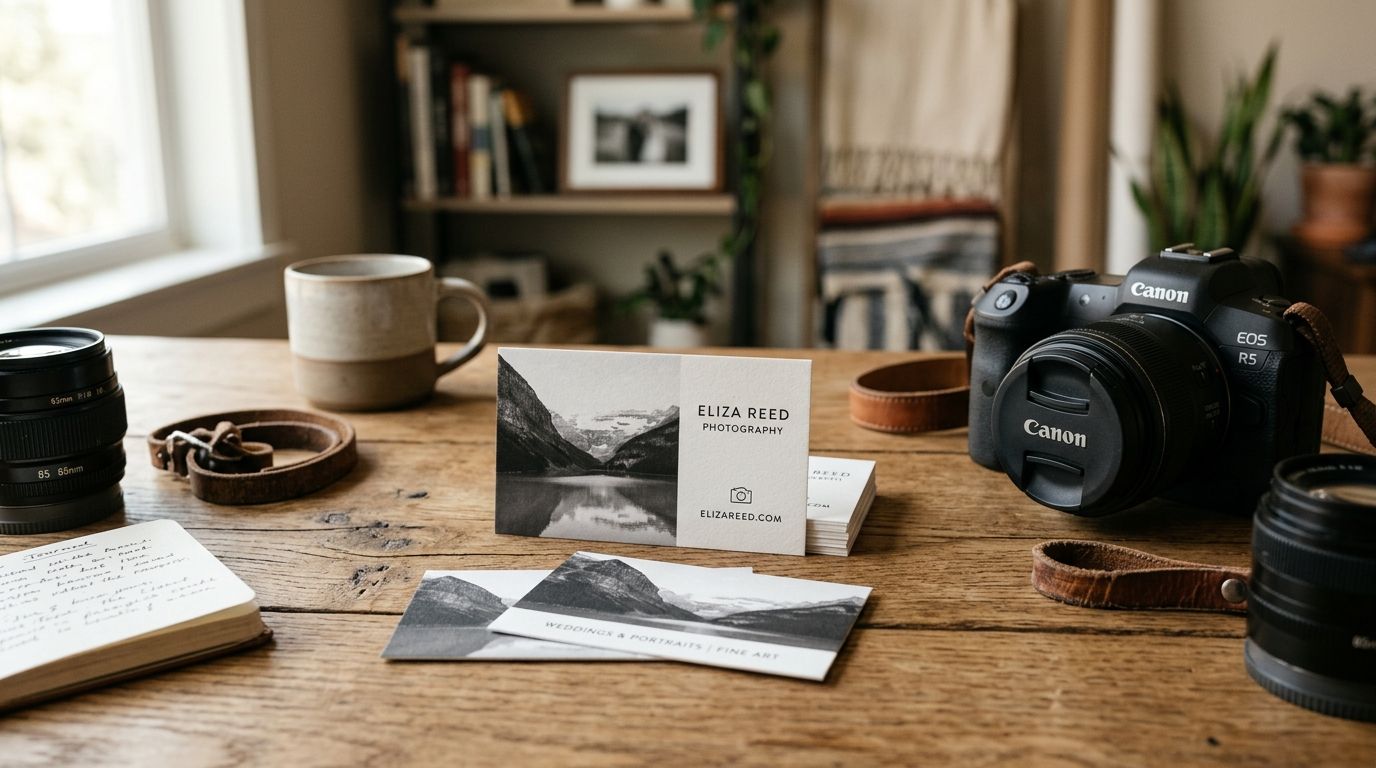
Business cards for photographers need to do more work than a standard card — they carry a visual portfolio in your pocket, not just a name and number. The verdict: photographers should print visual-forward, NFC-enabled cards on textured or matte stock, ordered in small batches so the look stays current with the latest work. A wedding photographer's card and a corporate headshot photographer's card should not look the same, because the client evaluating each one is judging different things — emotion versus professionalism.
- Photographers get more traction from cards showing one strong image, not a logo alone.
- NFC business cards for photographers link a tap directly to a portfolio site — no app needed.
- Print Fast prints business cards for photographers with Same Day and 24Hr turnaround in Toronto.
- Small runs of 100-250 cards keep photographers from carrying outdated portfolio images.
- Matte or soft-touch stock cuts glare, which matters for portrait and wedding work in 2026.
Why business cards for photographers matter more than for most freelancers
A photographer's card is judged as a design sample before it's read as contact info. Hand a potential client a flimsy, cluttered card and you've undercut your own portfolio in the first three seconds.
Most photographers work event to event — weddings on Saturday, corporate headshots on Monday, a school gym shoot midweek. The card has to survive bright venues, dim receptions, and outdoor markets, and it has to keep working when your style shifts every few months. The guide to business cards for freelancers and consultants covers the general freelance case; photographers layer on image quality, stock choice, and a fast link back to visual work.
Step 1: Define your photography niche before you design the card
A card for a wedding photographer and a card for a real estate photographer are not interchangeable. Decide what the card needs to say before you pick paper or layout.
- List your top 2-3 shoot types (weddings, portraits, product, real estate, events)
- Pick one hero image that represents your strongest, most recent work
- Confirm the niche matches your actual 2026 booking calendar, not what you shot three years ago
- Drop any service you no longer offer — a stale card confuses referrals
Step 2: Choose a paper stock and finish that matches your style
Stock choice is a design decision for photographers, not an afterthought. A moody, low-light wedding shooter and a bright, high-key product shooter need different finishes for the sample image to read correctly on paper.
- Matte or soft-touch stock for portrait and wedding photographers — cuts glare, feels premium in hand
- Gloss or spot-UV accents for product and commercial photographers — makes colour pop
- Uncoated recycled stock for photographers building an eco-conscious brand
- Thicker stock, 16pt and up, signals a photographer working at a higher price point
- Rounded corners or a die-cut shape when you want the card kept, not filed
Photographers going premium on stock usually want a matching layout. The rundown on premium business cards for luxury brands covers those finish options in more depth.
Step 3: Design a layout that shows the work without clutter
The biggest mistake on photographer business cards is treating them like a generic template with a logo swapped in. The card is real estate for one strong image plus minimal text.
- One hero photo on the front, no more — three thumbnails reads as a contact sheet, not a portfolio
- Name, one phone number, one email, one website; skip the second phone line and the fax number nobody uses in 2026
- White space around the image; no heavy borders or taglines crowding the frame
- A QR code or NFC chip on the back instead of a paragraph of services
- Typography consistent with your website and Instagram, so the card reads as the same brand everywhere
Step 4: Add an NFC chip or QR code that opens your portfolio
A card that only prints a URL asks the client to type it in later. Most won't. An NFC business card for photographers lets a phone tap the card and open the portfolio, booking page, or a specific gallery on the spot.
- Link the tap to your most recent gallery, not a generic homepage
- Update that linked page seasonally so the tap always shows current work
- Keep a QR code as backup for phones with NFC reading switched off
- Test the link on both iOS and Android before the run ships
Photographers who shoot networking-heavy work — corporate events, conferences, real estate — get the most out of this format. The guide on NFC business cards for networking events covers chip behaviour and linking in detail.
Step 5: Order a small sample run before committing to a big print
Print 50-100 cards first. Portfolios shift fast, and a 1,000-card order locks you into last year's hero image for a long time.
- Run a small proof batch to check colour accuracy against your actual photo files
- Check the printed image under venue lighting, not just your calibrated monitor
- Confirm the NFC link or QR code scans on the physical card, not only the digital proof
- Reorder in 100-250 card batches as your portfolio evolves through 2026
Step 6: Match turnaround to your shoot and meeting schedule
Photographers book new clients on short notice — a referral call today, a meeting tomorrow. Waiting a week for cards means missing the moment.
- Same Day printing when a meeting lands with less than 24 hours' notice
- 24Hr turnaround for a standard reorder ahead of a booked expo or bridal show
- 1Hr service when the design changes the morning of an event
- Standard turnaround for a planned seasonal refresh with no deadline pressure
Print Fast prints business cards for photographers on 1Hr, Same Day and 24Hr timelines, with local delivery across the GTA. The breakdown on same-day business cards for last-minute meetings covers what rush turnaround realistically looks like.
Get a quote on photographer business cards
Toronto rush printing with live support and local delivery.
Step 7: Put cards where photography clients actually decide
A stack of cards in a studio drawer books nothing. Distribution matters as much as design for photographers living on referrals.
- Hand a card to every guest at an event who compliments the work in the moment
- Leave a small stack at bridal shows, craft fairs and vendor expos with a display stand
- Tuck a card inside every printed photo delivery or album
- Give each client two cards — one to keep, one to pass along
Comparison: card formats for photographers in 2026
| Option | Best for | Key limitation |
|---|---|---|
| Standard printed card | New photographers building a first portfolio card | No digital link — clients type the URL manually or not at all |
| Premium stock card | Wedding and portrait photographers at higher price points | Costs more per card, so smaller runs make more sense |
| NFC business card | Photographers working expos, conferences and networking rooms | Needs the client's phone to support tap reading |
| QR-code card | Photographers wanting a digital link at low cost | Reads as less premium on a high-end portfolio |
Most photographers in 2026 land on premium stock with an NFC chip on the back — it handles the visual impression and the digital handoff in one object.
“If the card shows three photos, it reads as a contact sheet, not a portfolio. Pick one image.”
Common mistakes photographers make with business cards
- Cramming three photos onto one card. It reads as a proof sheet. One image, chosen hard.
- Ordering 1,000 cards with last year's hero shot. Portfolios move fast; runs of 100-250 stay current.
- Skipping the digital link entirely. A card with no QR code or NFC chip forces a manual search later, and most leads never make it.
- Using glossy stock for moody, low-light work. Glare washes out the shadow detail that defines the style.
- Printing one generic card for every niche. Wedding work and corporate headshot work need different tone, image and layout.
FAQ
What's the best paper stock for photographer business cards?
Matte or soft-touch 16pt stock suits most photographers because it cuts glare and feels premium in hand. Gloss finishes work better for bright, high-key product photography where colour pop matters more than shadow detail.
Are NFC business cards worth it for photographers?
Yes, for photographers who network at events, expos or bridal shows. An NFC card lets a client tap and land on a portfolio gallery instead of typing a URL later, which most people never do.
How many business cards should a photographer order at once?
Order in batches of 100-250. Photography portfolios change often, so a smaller run keeps the hero image current instead of locking in outdated work for a year.
Can I get same-day business cards printed for a photography client meeting?
Yes. Print Fast prints business cards for photographers on Same Day and 1Hr timelines in Toronto when a meeting comes up with short notice.
Should photographers use a QR code or an NFC chip?
NFC reads as more premium and skips the camera app entirely. A QR code is the reliable low-cost backup for phones without NFC reading enabled.
How is a photographer's business card different from a standard business card?
A photographer's card leads with one strong image instead of a logo, because the card itself is judged as a work sample. Stock and finish also matter more, since they change how colour and detail reproduce.
What size should a photographer's business card be?
Standard 3.5 x 2 inches works for most photographers and fits wallets and card holders without a custom order. Square or die-cut shapes stand out but cost more and can be awkward to store.
Do high-end photographers need a different card?
Photographers charging premium rates typically move to thicker stock, spot-UV accents or die-cut shapes to match their price point. The card should feel like the product the client is buying.
One last thing
The photographers who pull the most referrals aren't the ones with the fanciest card — they're the ones who reorder every few months so the image on the card matches what they're booking right now. A card frozen in 2023 quietly says the work hasn't improved since. Treat the reorder cycle as part of the portfolio, not a one-time purchase.


