
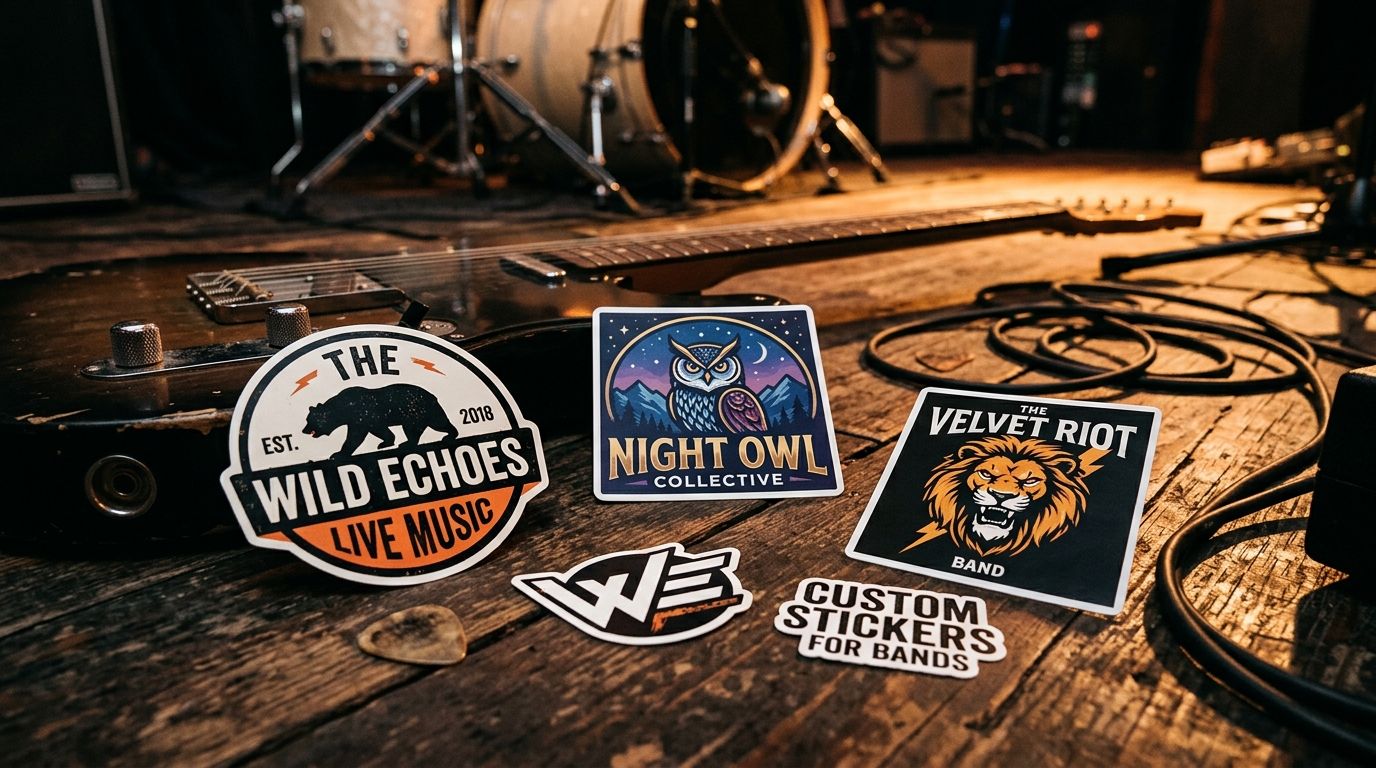
Custom stickers for bands are die-cut or kiss-cut adhesive graphics carrying a band's logo, album art or tour date, built to sell at the merch table, ship inside mail orders and stick to laptops, guitars and light poles where fans do the advertising for free. A working band needs stickers that survive a tour van, a rained-on venue window and a hundred hand-to-hand trades in one weekend — that's a different bar than a sticker sitting flat in a gift shop.
- Die-cut vinyl stickers with laminate coating are the standard for custom stickers for bands playing outdoor shows in 2026.
- Kiss-cut sheets cost less per unit and work best for mail-order merch bundles, not loose merch-table giveaways.
- Order in batches tied to a release or tour leg, not a flat annual number — art and dates change too often.
- Print Fast in Toronto handles same-day and rush sticker runs for bands with a show or a shipping deadline days out.
Why custom stickers matter for bands
A sticker is the cheapest merch item a band sells, and it's the only item fans stick somewhere public without being asked. A patch stays in a drawer; a sticker ends up on a bumper, a case or a venue bathroom mirror, and every one of those is a free impression for the band name.
Bands also move fast and print small. A single-city release show might need 100 stickers by Friday; a full tour run might need 500 split across three designs. That volume and turnaround pattern is why generic bulk sticker printers built for retail packaging don't fit — a band needs a shop that can turn a small batch around on short notice, print custom stickers for small business packaging style small runs, and not force a minimum order that eats the whole merch budget.
Verdict: bands get the most out of die-cut vinyl stickers ordered in tour-sized batches from a shop that offers rush turnaround, not from a big-box printer with a two-week minimum.
Choose the right sticker format
Format decides how the sticker survives a tour van and a merch table. Get this wrong and half the batch peels or fades before the second show of 2026.
- Die-cut vinyl — cut to the exact outline of the logo or artwork, the standard for merch-table and case stickers
- Kiss-cut sheets — several designs cut on one backing sheet, easiest to mail flat inside a merch order
- Holographic or foil — higher shine for limited-edition drops tied to a single release
- Clear vinyl — logo prints without a visible background, good for glass and instrument cases
- Matte laminate — cuts glare in stage photos and resists scuffing in a gig bag
Design art that reads at sticker size
Album covers and logos built for a 12-inch vinyl sleeve break down at 2 inches. Simplify before sending the file.
- Strip fine detail and thin serif type that turns to mud below 3 inches
- Keep contrast high — a dark logo on a dark background disappears from three feet away
- Build in at least a 1/8-inch bleed so the die-cut line doesn't clip the art
- Save at 300 DPI minimum; a JPEG pulled off a social feed will print blurry
- Test the design printed at actual size before approving the full run
Pick a size that matches how fans will use it
A band selling stickers alone needs a different size than one bundling stickers into a mail-order package.
- 2-3 inch — standard laptop and case size, the safest default for a merch table
- 4-5 inch — bumper and van-window size, works for a bolder single-colour logo
- 1-2 inch — mini stickers for stacking into a CD or vinyl mailer at no extra bulk
- Round or custom die-cut shapes cost more per unit than a simple rectangle or circle
Order the finish that matches the venue
An indoor merch table and an outdoor festival booth put different stress on the same sticker.
- Laminated vinyl — holds up to weather, sun and repeated handling at outdoor shows
- Uncoated matte — cheaper, fine for indoor-only merch tables and mail-outs
- Removable adhesive — safer for venue-provided surfaces that require no residue
- Permanent adhesive — the default for anything meant to stay put on a case or bumper
Time the print run to the release calendar
Stickers tied to a specific album or tour date lose value once that date passes, so batch size should track the 2026 release cycle, not a flat yearly guess.
- Print a small batch of 100-200 ahead of a single release show to test which design sells
- Reorder mid-tour once you know which design fans actually pick up
- Hold a reserve batch back for merch-table restocks between cities
- Use a rush or same-day run when a show date lands before the standard turnaround window — same-day sticker printing for product launches covers the same fast-turnaround process bands use for a last-minute tour leg
Distribute past the merch table
The merch table is one channel. Stickers earn more reach mailed and handed out where fans already are.
- Drop 2-3 stickers into every online merch order, the same tactic stickers for Etsy and online sellers uses to turn a single sale into repeat visibility
- Leave a stack at partner venues and local record shops
- Include a sticker in every physical press kit or promo mailer
- Hand loose stickers to the front rows during load-out, not just at the table
Need stickers before the next show?
Same-day and rush sticker printing for bands on a tour or release deadline.
Sticker options compared for bands
| Option | Best for | Key limitation |
|---|---|---|
| Die-cut vinyl | Merch tables and case stickers | Custom outline shapes cost more per sheet than a simple rectangle |
| Kiss-cut sheets | Mail-order bundles with multiple designs | Fans have to peel each sticker off the backing sheet themselves |
| Bumper stickers | Van, car and outdoor exposure | Larger format costs more per unit than a small case sticker |
| Holographic or foil | Limited-run release drops | Higher unit cost, not worth it for an everyday giveaway sticker |
| Clear vinyl | Instrument and laptop cases with visible background | Fine detail gets lost without a strong contrast colour |
Common mistakes bands make with stickers
- Ordering one flat batch for the whole year — release cycles and tour art change faster than a 500-unit order lasts, so half the batch goes stale
- Skipping lamination for outdoor shows — an uncoated sticker left on a car or gig bag fades and peels within a season
- Using low-res art pulled from a social feed — a logo saved off a phone screen prints blurry at sticker size even though it looked fine online
- Forgetting bleed and die-cut margin — art built without a 1/8-inch bleed gets clipped unevenly at the cutter
- Waiting until the week of the show to order — a standard print run doesn't fit a five-day tour window; rush turnaround has to be requested up front, not assumed
FAQ
What size sticker is best for a band merch table?
A 2-3 inch die-cut vinyl sticker is the standard merch-table size in 2026 — small enough to price cheap, large enough to read the logo from a few feet away.
Is die-cut or kiss-cut better for band stickers?
Die-cut works best for merch-table sales and case stickers because each design stands alone. Kiss-cut sheets work better for mail-order bundles where several designs ship together on one backing sheet.
How many stickers should a band order for a tour?
Start with 100-200 per design for a short tour leg and reorder mid-tour once you know which design fans actually pick up. That beats committing to one large batch upfront.
Do band stickers need lamination?
Laminated vinyl is worth it for anything going on a bumper, case or outdoor merch table because it resists fading and scuffing. Uncoated matte is fine for indoor-only giveaways.
How fast can custom stickers for bands be printed?
Rush and same-day sticker printing is available for bands with a show or shipping deadline days out. Standard runs still give the most consistent colour match across larger batches.
What file format do I need for a band sticker order?
A 300 DPI file with a 1/8-inch bleed is the minimum for a clean die-cut edge. Vector art holds up best when the same logo gets resized between sticker formats.
Can I put stickers inside mailed merch orders?
Yes, and dropping 2-3 stickers into every online order is one of the cheapest ways to extend reach past the merch table. The sticker travels wherever the buyer takes their gear.
Are holographic stickers worth it for a band?
Holographic and foil finishes cost more per unit and make the most sense for a limited-edition release drop. They are overkill for an everyday giveaway sticker handed out at every show.
One last thing
The batch that actually gets fans sticking things to their gear is rarely the biggest one — it's the design tied to a specific release, ordered small enough to sell out at the merch table before the next tour leg makes it look dated. Print Fast in Toronto runs same-day and rush custom stickers for bands who land a 2026 show slot with less notice than a standard print schedule allows, which matters more to a working band than a lower per-unit price on a batch that sits half-used in a merch bin.
Order custom labels and stickers from Print Fast: custom labels and stickers at PrintFast.ca. Need a price first? Submit a custom quote request.


