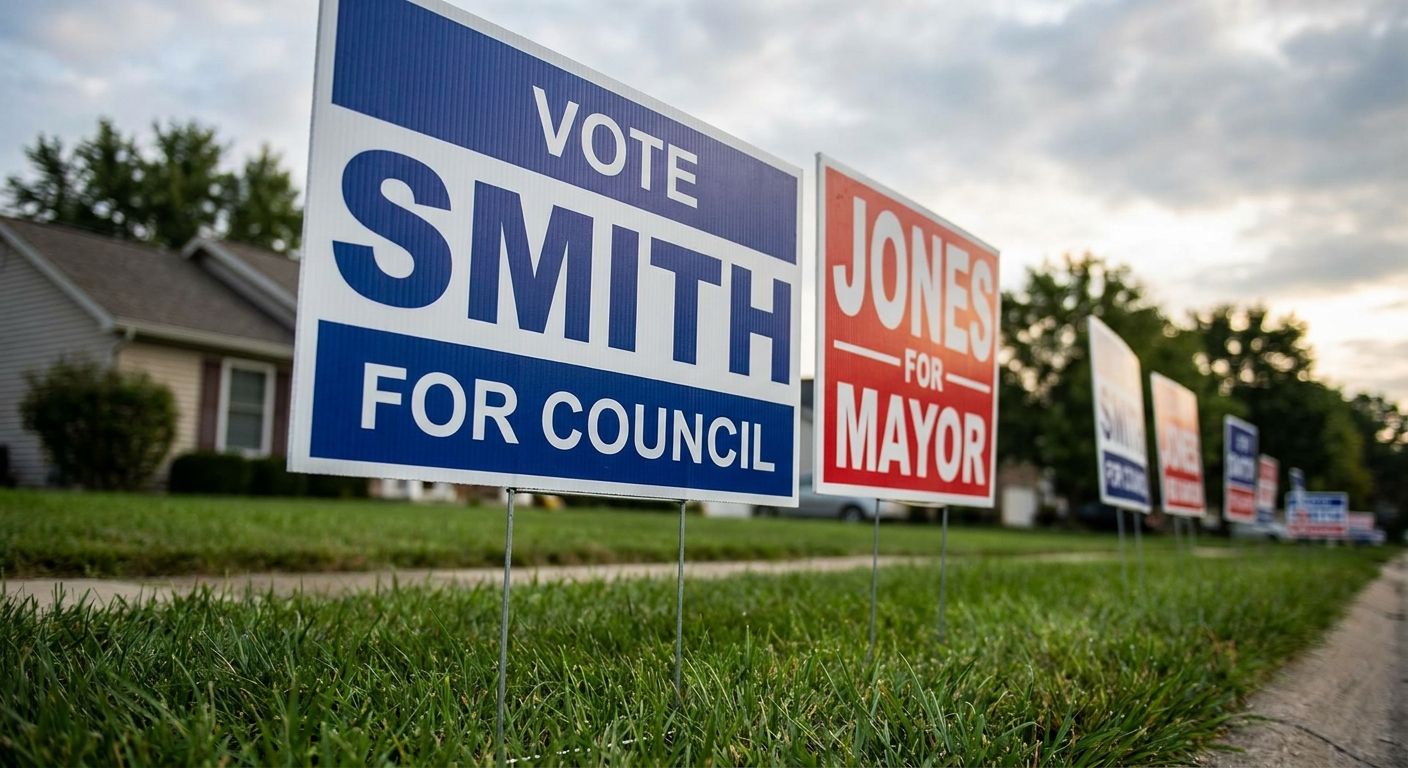
Election season turns lawn signs into a logistics problem: hundreds of yards need coverage before a deadline that doesn't move, and a flimsy sign that curls in the wind undoes weeks of canvassing. This guide breaks down what actually matters when you're ordering election lawn signs for a campaign running in the Toronto and GTA area in 2026.
- 18x24 4mm coroplast is the standard election lawn sign size for 2026 campaigns — buy it for general yard coverage.
- Double-sided printing adds visibility from both directions of traffic without a size upgrade.
- Rush turnaround (1Hr, Same Day, 24Hr) matters more than price for last-minute election lawn sign orders.
- Thin coroplast under 4mm and single-sided signs on corner lots are the two most common mistakes campaigns make.
Why this matters
A political campaign lives on a fixed calendar. Once a candidate is confirmed, the countdown to election day doesn't pause for design revisions or shipping delays. Election lawn signs are one of the few pieces of campaign material voters see every single day they drive to work, which makes turnaround and durability more important than almost anything else on the order form.
Get the size or material wrong and you're reprinting in week two of a campaign that only has six. Get the turnaround wrong and your signs arrive after the debate they were meant to promote.
Who this is for
This guide is built for campaign managers, candidates, riding associations and volunteer coordinators running municipal, provincial or federal races in the GTA in 2026 — people ordering anywhere from 25 to several thousand signs on a deadline they don't control. If you're managing a canvassing operation and need signs, staff business cards and volunteer badges printed on the same tight window, Print Fast runs same-day and rush jobs specifically for this kind of deadline pressure.
What to look for in election lawn signs
Coroplast thickness
Standard election lawn signs use 4mm corrugated plastic (coroplast) — light enough for wire H-stakes, rigid enough to survive a normal wind day. Campaigns planting signs on exposed corners or open fields should step up to 10mm coroplast; it costs more per sign but won't fold in half after one storm.
Sign size and readability
18"x24" is the workhorse size for residential lawns and reads clearly from a passing car. 24"x36" earns its keep on busier roads, medians and intersections where drivers only get a two-second glance. Match size to placement, not to budget — a 24"x36" sign in a low-traffic cul-de-sac is wasted material.
Single-sided vs. double-sided printing
Any sign planted near a corner, driveway or two-way street needs double-sided printing, full stop. A single-sided election sign facing the wrong direction is invisible to half the traffic that passes it, which defeats the entire point of yard sign coverage.
Turnaround speed
Campaigns rarely order signs six weeks out — candidate confirmations, ballot order and endorsement announcements all shift the timeline. Look for a printer offering 1Hr, Same Day and 24Hr rush tiers, not just a standard five-to-seven-day production run.
Bulk pricing and custom quotes
A 25-sign order and a 2,000-sign order shouldn't be priced the same way per unit. Because campaign budgets and volunteer counts vary block by block, a custom quote based on actual quantity and deadline beats a flat per-sign rate advertised for a different scale entirely.
Local pickup or delivery
Volunteers distributing signs across a riding don't have time to wait on shipping. Local delivery within the GTA turns a print order into signs in the ground the same afternoon, which matters more in week five of a campaign than in week one.
Need election lawn signs fast?
Same-day and 24Hr rush printing for GTA campaigns in 2026.
Top picks for campaign lawn signs
The standard yard sign — 18x24, 4mm coroplast
The hook: this is the sign every canvasser expects when they knock on a door and ask for a lawn. Single or double-sided, 4mm coroplast, wire H-stake compatible — it's the default for residential coverage across a riding. Verdict: Buy.
The corner-lot upgrade — 24x36, double-sided
The hook: bigger and readable from both directions, built for intersections and busier residential streets where a smaller sign gets lost. Double-sided printing on 4mm coroplast keeps weight manageable while covering both lanes of traffic. Verdict: Buy for high-visibility placements only — don't order this size across an entire riding, it's overkill for quiet streets.
The heavy-wind pick — 10mm coroplast
The hook: for open fields, waterfront ridings or exposed rural stretches where 4mm signs fold or tear within days. It costs more per unit and isn't necessary for a typical suburban lawn, so reserve it for the 10-15% of placements that actually take wind damage. Verdict: Consider for exposed sites, Skip for standard residential yards.
The debate-week rush order
The hook: candidate confirmations and endorsement announcements land late, and signs need to be in the ground within 24 hours, not five business days. A 1Hr or Same Day rush order covers the campaign moment that standard turnaround misses entirely. Verdict: Buy when the calendar forces your hand — it costs more than standard production but a sign that arrives after the news cycle is worth nothing.
The full canvassing kit
The hook: lawn signs get a candidate noticed on the street, but volunteers still need staff business cards and event ID for door-knocking teams and campaign office visitors. Pairing a lawn sign order with next-day business cards for organizers and ID card printing for events for volunteer check-ins at rallies keeps the whole ground game running off one print partner instead of three. Verdict: Buy if your campaign runs canvassing shifts or public events — it saves coordination time in a season where nobody has spare hours.
“If a lawn sign can't be read from a moving car at 40 km/h, it's not doing its job.”
What to avoid
- Under-4mm coroplast. It looks identical to standard stock in a photo and folds in half after the first windy week — a false economy on a campaign that runs 6-10 weeks.
- Single-sided signs on two-way streets. Half your intended audience never sees the candidate's name.
- Ordering size before placement. Buying one size for the entire riding wastes budget on quiet streets and under-serves busy intersections. Match size to traffic, not to a single blanket order.
For a closer look at how size and material choices play out on real properties, the lawn sign sizes and materials guide built for real estate agents covers the same coroplast and placement logic that applies to campaign signage.
Verdict comparison table
| Sign Type | Size | Material | Best For | Verdict |
|---|---|---|---|---|
| Standard yard sign | 18x24 | 4mm coroplast | Residential streets | Buy |
| Corner-lot sign | 24x36 | 4mm coroplast, double-sided | Intersections, busy roads | Buy for key spots |
| Heavy-wind sign | 18x24 or 24x36 | 10mm coroplast | Open fields, exposed lots | Consider |
| Rush order | Any | 4mm coroplast | Late candidate confirmations | Buy when deadline forces it |
FAQ
What size are standard election lawn signs?
18x24 inches is the standard election lawn sign size for residential coverage in 2026. Busier intersections and higher-traffic streets do better with 24x36 signs for visibility from further away.
How much do election lawn signs cost in 2026?
Cost depends on size, quantity, turnaround speed and single- vs double-sided printing, so campaigns should request a custom quote rather than rely on a flat rate. Bulk orders for full riding coverage price differently per unit than a 25-sign batch.
What material is used for political lawn signs?
4mm corrugated plastic, known as coroplast, is the industry standard for election lawn signs. Campaigns placing signs in exposed, high-wind locations often step up to 10mm coroplast for added rigidity.
Can election lawn signs be printed the same day?
Yes — same-day and 24Hr rush printing is available for election lawn signs when a candidate confirmation or endorsement lands close to a deployment deadline. Standard production runs longer, so rush tiers exist specifically for campaign timelines.
Are double-sided lawn signs worth the extra cost?
Yes for any sign near a corner, driveway or two-way street, since a single-sided sign is invisible to half the passing traffic. For deep-lawn placements facing one direction only, single-sided printing is sufficient.
Do election lawn signs come with wire stakes?
Wire H-stakes are the standard mounting hardware for 4mm coroplast election signs and should be confirmed as part of the order, not assumed. Heavier 10mm signs may need sturdier stakes to stay upright in wind.
How early can election lawn signs go up before an election?
Most municipalities set their own bylaw windows for when election signs can be placed and when they must come down after voting. Check the specific riding's municipal bylaw before planting signs, since timing rules vary by jurisdiction.
How many lawn signs does a local campaign need?
Sign counts scale with riding size and canvassing capacity rather than a fixed number, ranging from a few hundred for a tight ward race to several thousand for a wider provincial or federal riding. Volunteer coordinators typically size the order around confirmed yard commitments plus a buffer for high-traffic corner placements.
One last thing
Most campaigns order lawn signs and forget the rest of the ground operation until the week before an event, then scramble for ID badges and volunteer materials on the same deadline that's already tight for signage. Running lawn signs, volunteer ID and staff business cards through one rush order in 2026 means one delivery window instead of three separate deadlines to track during the busiest stretch of the campaign.