
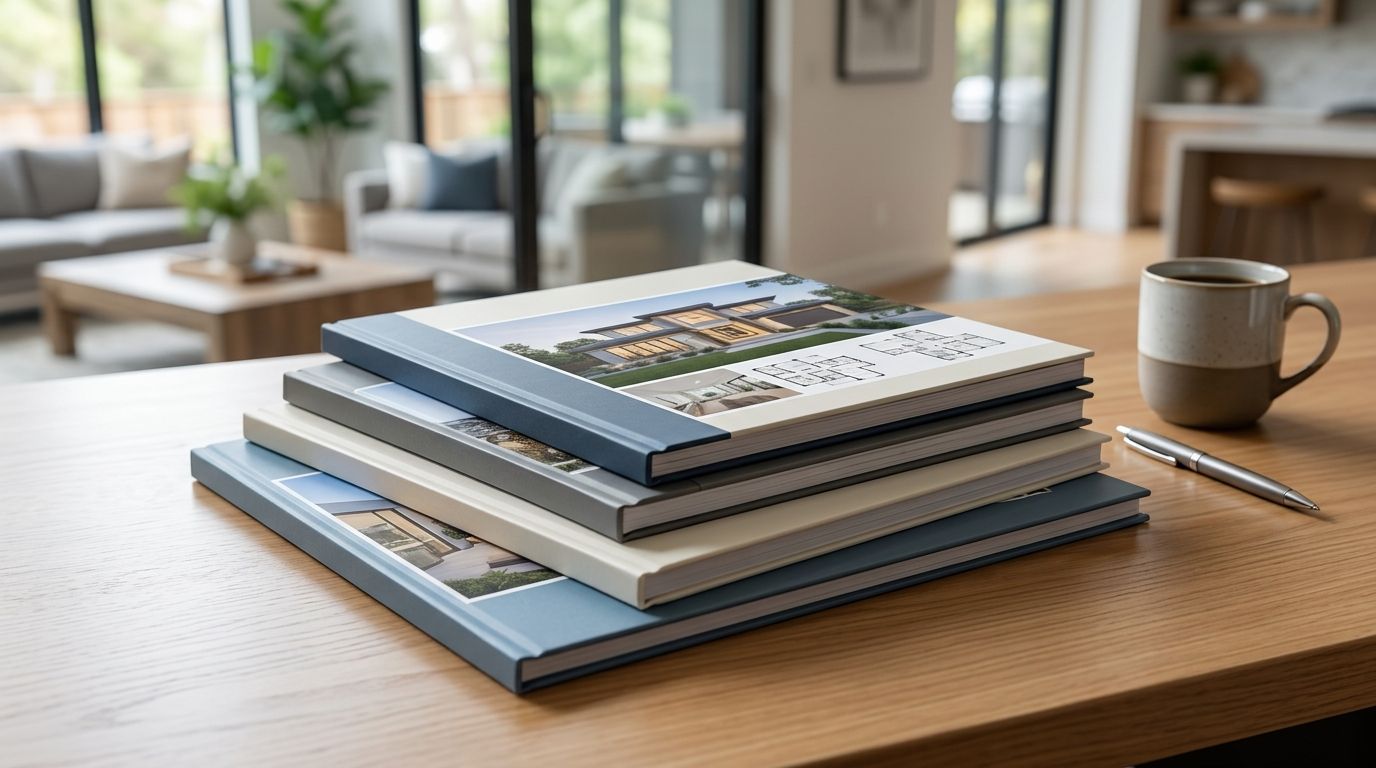
Real estate listing booklets are multi-page printed handouts that walk a buyer through a property—photos, floor plan, feature list, neighbourhood details and agent contact—handed out at showings and open houses with the goal of turning a walk-in into a call. Unlike a single flyer, a booklet gives you room to sell the story of a home, not just the address and price. Real estate agents also work against a fixed calendar: photos land Monday, the open house is Saturday, and the booklet has to be printed, folded and stacked before the first car pulls into the driveway.
- Saddle-stitched booklets of 8-16 pages work for most listings; go perfect-bound only past 24 pages.
- Booklets for real estate listings need same-day or 24Hr turnaround since open houses run on fixed weekend dates.
- Print Fast handles rush booklet orders in Toronto with 1Hr, Same Day and 24Hr options plus local delivery.
- Match paper stock to price point: 100lb gloss text for standard listings, heavier cover stock for luxury properties.
- Order 15-20% more booklets than expected foot traffic — running out mid-open-house costs you leads.
Why booklets for real estate listings matter for agents
A one-page flyer answers "what is this house." A booklet answers "why should I buy it," and that's the job during an open house when a buyer is standing in the kitchen deciding whether to make an offer this weekend or keep looking. Booklets give room for a full floor plan, a feature breakdown room by room, school and transit notes, and a clean call-to-action page with the agent's contact details.
The real constraint for agents isn't design — it's the calendar. Listings get photographed, staged and opened to the public inside a single week. A flyer program built for real estate open houses can go from file to lockbox in a day, but a booklet has more moving parts: page count, binding, stock. That means the print order has to move fast or the open house happens with nothing on the table.
In 2026 the buyer standing in that kitchen has already seen the listing on their phone. The booklet's job is to be the thing they still have when the phone tab is closed.
Define your page count and format first
Most single-property booklets run 8 to 16 pages. Anything past 24 pages starts feeling like a magazine and needs a different binding method entirely.
- Count your must-have sections: cover, floor plan, 3-5 photo spreads, feature list, neighbourhood page, back cover with contact
- Cap it at 12 pages for a standard listing
- Push to 16-20 pages only for luxury or acreage properties with multiple structures
- Confirm the page count is divisible by 4 before you send files — saddle stitching requires it
- Decide print vs. digital-first: a leave-behind PDF can supplement a printed run but shouldn't replace it at the open house
Pick paper stock and finish that match the listing
Stock choice signals price point before a buyer reads a word. A downtown condo and a detached estate home shouldn't use the same paper.
- 100lb gloss text for standard listings — bright photos, low cost per page
- 80lb matte text if the agent's brand leans minimal or the photography is moody
- 14pt or 16pt cover stock with a gloss or soft-touch laminate for the front and back cover
- Heavier 100lb+ cover stock throughout for luxury and estate listings
- Avoid uncoated stock for photo-heavy pages — colours print flat and dull
If you're unsure which weight reads right in hand, the same logic in the guide to choosing paper stock for brochure printing applies directly to booklet interiors.
Build the content skeleton before you touch design software
Skip this step and you'll be reformatting the booklet the night before the open house.
- Cover: hero photo, address, agent name and phone number
- Page 2-3: full floor plan, room dimensions
- Page 4-8: photo spread by room, 2-4 photos per spread
- Page 9-10: feature list — upgrades, appliances, lot size, taxes, condo fees if applicable
- Page 11-12: neighbourhood — schools, transit, walk score, nearby amenities
- Back cover: agent headshot, brokerage logo, contact info, QR code to the listing page
Once the skeleton is locked, a print partner with a fast turnaround stops being optional. A 12-page booklet built the night before a Saturday open house needs a 24Hr or Same Day print run, not a standard 5-7 business day queue. Print Fast runs booklet printing on 1Hr, Same Day and 24Hr windows with local Toronto and GTA delivery, which is the whole reason agents use it for listing work in 2026.
Choose the right binding for your page count
Binding decides both cost per unit and how the booklet feels in a buyer's hands.
| Option | Best for | Key limitation |
|---|---|---|
| Saddle-stitched booklet | 8-24 page single-property listings | Pages must be in multiples of 4 |
| Perfect-bound booklet | 28+ page luxury or multi-listing packages | Higher minimum page count, slower to produce |
| Folded flyer (bi-fold/tri-fold) | Quick single-page listings, tight budgets | No room for a full floor plan or feature list |
| Presentation folder with loose inserts | Seller listing presentations, closing packages | Each insert sheet prints separately |
| Digital PDF booklet | Email follow-up, pre-showing previews | No physical leave-behind at the open house |
Verdict: saddle-stitched wins for roughly 9 out of 10 single-listing booklets in 2026 — fastest to produce and cheapest per unit at open-house quantities. Buy.
Set your print quantity by expected foot traffic
Running short mid-open-house means buyers walk away with nothing to remember the listing by.
- Estimate 1.5 booklets per expected visitor, not 1-to-1 — couples and groups often each want a copy
- For a typical GTA weekend open house, 40-60 booklets covers most single-family listings
- Add 20 extra copies for the agent's own follow-up mailers and buyer packages
- Order in batches of 25 or 50 — most print runs price more efficiently at those breakpoints
- Keep 10-15 in the trunk for private showings the following week
Proof the file before it goes to print
A typo on a flyer is annoying. A wrong square footage or missing school district on a booklet tied to a seven-figure listing is a credibility problem.
- Check every dimension and tax figure against the MLS listing sheet
- Confirm the QR code links to the live listing page, not a draft
- Extend edge-to-edge images into the bleed area; Adobe’s print bleed guide explains how this prevents white gaps after trimming
- Have a second person read the copy — agents proofing their own work miss their own errors most often
- Print one physical proof before the full run if the timeline allows even a few hours
- Verify the phone number and email on the back cover match current contact details
Time your order to the listing calendar, not the print calendar
This is the step most agents get wrong. They design the booklet on Thursday and assume any printer can turn it around by Saturday morning.
- Confirm the turnaround window before you finalize photos — 1Hr, Same Day and 24Hr rush options exist for exactly this timeline
- Build in a buffer between print pickup and the open house for last-minute corrections
- Ask about local delivery in Toronto and the GTA so a courier trip doesn't eat your prep time
- Use live support to confirm file specs before submitting, not after a rejected proof
- Reserve a rush slot early in the week when the open house falls on a weekend
Need booklets before Saturday's open house?
Rush turnaround with local Toronto delivery and live support on file specs.
Pair the booklet with the rest of the listing package
A booklet rarely works alone. Pair it with a lawn sign for drive-by visibility, a door hanger run for the surrounding blocks, and a folder for the seller-facing side of the transaction. Each piece does a different job — the booklet is for the buyer standing inside the house, the sign and door hanger are for the people who never walked in.
“The booklet that works isn't the one with the most pages — it's the one still on the passenger seat when the buyer drives home.”
Common mistakes agents make with listing booklets
- Ordering standard turnaround for a weekend open house. A 5-7 business day print queue doesn't fit a listing photographed Tuesday and shown Saturday.
- Using the same paper stock at every price point. An estate listing on 80lb uncoated stock reads cheap; a small condo on 16pt laminated cover looks over-produced.
- Skipping the floor plan. Buyers ask for it constantly at showings — leaving it out means fielding the same question for four hours instead of handing over page 2.
- Under-ordering for high-traffic listings. Running out two hours into a four-hour open house means half your visitors leave with nothing.
- Forgetting the QR code and contact page. A booklet with no clear next step is a nice leave-behind and a wasted lead.
- Reusing last listing's file without a full field sweep. Template reuse is fine; stale square footage and the wrong address are not.
FAQ
What's the best page count for a real estate listing booklet?
8 to 16 pages covers most single-family listings in 2026 — enough room for a floor plan, photo spread, feature list and neighbourhood page without pushing into perfect-bound territory. Luxury or multi-structure properties can run 16-24 pages.
Is a booklet better than a single flyer for an open house?
A booklet works better for higher-priced or feature-heavy listings where buyers want a floor plan and a room-by-room breakdown. A single flyer is faster and cheaper for simpler listings or when the window before the open house is under 24 hours.
How fast can real estate booklets be printed?
Rush booklet printing in Toronto can move on a 1Hr, Same Day or 24Hr turnaround depending on page count and quantity. Standard multi-day turnaround is fine when the listing calendar gives you more lead time.
What paper stock works best for luxury listing booklets?
Heavier cover stock, 100lb or above, with a gloss or soft-touch laminate on the cover reads as premium. Interior pages on 100lb gloss text keep photos bright without the booklet feeling flimsy.
How many booklets should I print for one open house?
Plan for roughly 1.5 booklets per expected visitor, since couples and groups often each want a copy. A typical GTA single-family open house needs 40-60 copies plus 20 extras for follow-up mailers.
Should the booklet include a QR code?
Yes — a QR code linking to the live listing gives buyers a way to revisit photos after they leave. It is also the easiest tracking point for gauging whether the booklet is generating follow-up.
Can I use the same booklet design for multiple listings?
The layout template can be reused, but every field — square footage, taxes, features, address — needs updating per property. Shipping an old booklet with the wrong details is a common and avoidable error.
What binding works best for a short print run?
Saddle stitching is the fastest and most economical binding for single-listing booklets under 24 pages. Perfect binding only makes sense past that page count or for multi-property portfolio packages.
One last thing
Put the floor plan on page 2, not page 8. Agents who bury it lose the one page buyers flip back to, and in 2026 the floor plan is the single most requested item at a Toronto open house. Keep the booklet short enough that a visitor finishes it standing in the kitchen, then time the print order to the open house date rather than the design deadline.


