

NCR forms for auto repair shops are multi-part carbonless order forms that capture the repair estimate, the customer's signature and the final invoice in one write, so the shop, the customer and the insurance adjuster all walk away with a matching copy. A repair shop's paperwork moves faster than a retail counter — a service writer fills the form out standing at the parts window while a car sits on the lift, so the layout has to survive rushed handwriting, grease and a customer who wants an answer now, not after the shop management system finishes syncing.
- NCR forms for auto repair shops work best as pre-numbered 3-part carbonless sets covering customer, shop file and insurance.
- Sequential numbering on repair order pads closes the audit gap that trips up shops in 2026 insurance reviews.
- Print Fast prints rush NCR carbonless forms same day or in 24 hours for Toronto and GTA repair shops.
- Matte carbonless stock is mandatory — glossy paper won't transfer ink through a second or third ply.
Why NCR forms matter for auto repair shops
A repair order isn't a courtesy — it's the paper trail proving what the customer agreed to before a tech touched the car. Ontario's consumer protection rules put the burden on the shop to show a written estimate was given and approved, and a signed NCR form keeps that proof sitting at the counter instead of buried in a shop management system nobody can pull up mid-repair. Before ordering, request a custom NCR form quote with the ply count, form size, numbering and turnaround your shop needs.
Insurance adjusters, warranty claims and small-claims disputes over an unauthorized repair all come back to one question: what did the customer sign, and does the shop have a matching copy? A 2-part or 3-part carbonless form answers that in real time, without a printer, a tablet or a signature app that fails the moment the shop Wi-Fi drops. That's the gap NCR forms for auto repair shops are built to close in 2026, when most other shop paperwork has already gone digital.
How to set up NCR forms for your auto repair shop
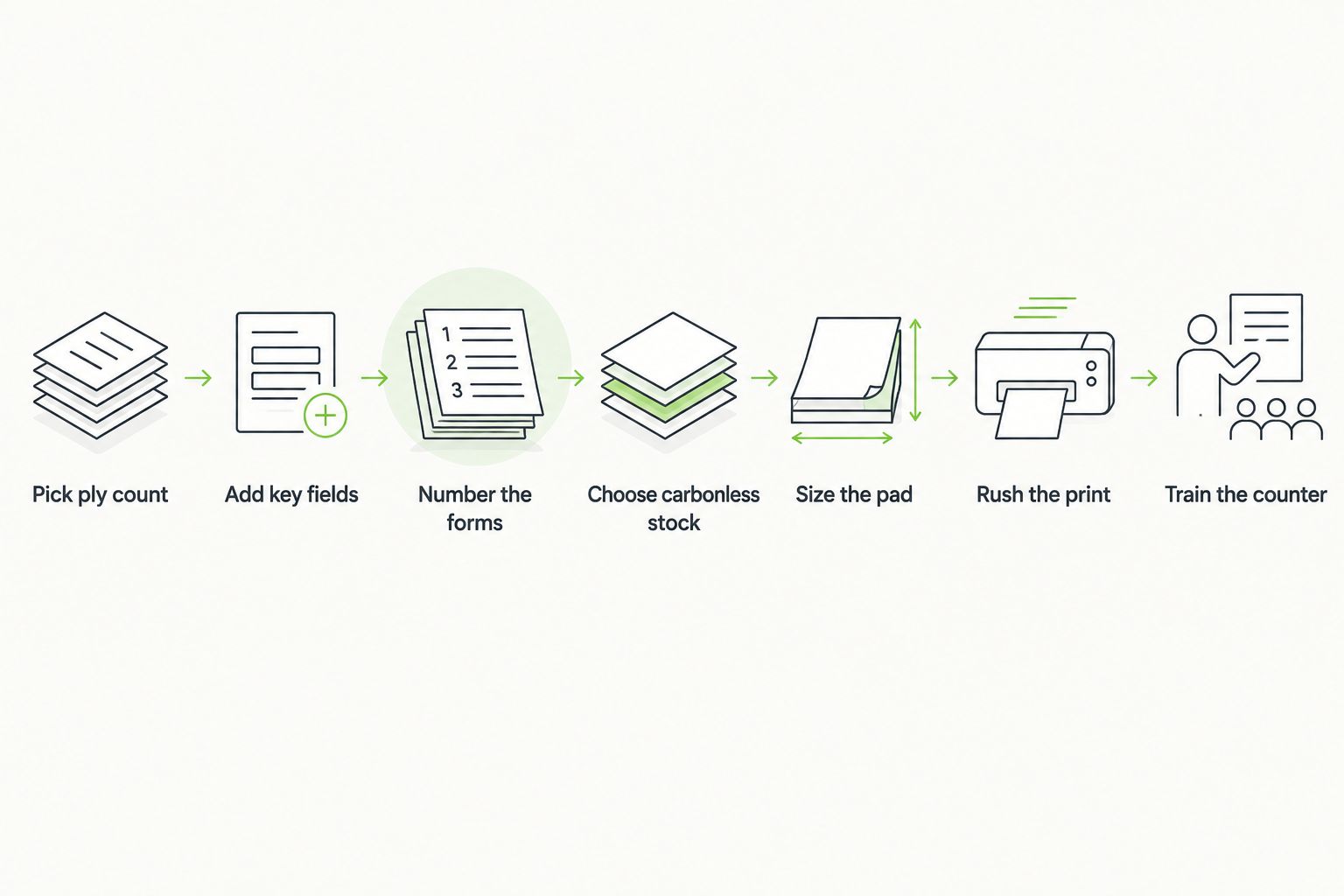
Pick a 2-part or 3-part set for your workflow
Start with how many people need a matching copy the moment the form is signed. A single-bay oil-change shop rarely needs more than two plies; a full-service shop running insurance claims needs three, and guessing wrong means photocopying a third copy by hand every time an adjuster asks for one.
- 2-part: customer copy plus shop file — enough for basic maintenance and inspections
- 3-part: adds a copy for the insurance adjuster or the parts department
- Match the ply count to your busiest job type, not your rarest one
- Count how many departments touch a repair order before it's closed
Add the fields your service writers actually use
Generic invoice templates from an office supply store don't have a VIN line or a mileage-in/mileage-out field, and that gap is exactly what causes warranty disputes six months later when nobody can prove the odometer reading at intake.
- VIN and licence plate
- Mileage in and mileage out
- Itemized parts and labor hours
- A customer authorization signature line
- A disclaimer line for storage fees or declined repairs

Number the forms before you order, not after
Sequential numbering is the one feature shop owners skip and regret. Without it, there's no way to prove a form wasn't voided or replaced after a dispute starts, and an insurance auditor will ask for the number sequence before anything else in 2026.
- Pre-printed sequential numbers on every set
- A void log at the front desk for skipped numbers
- One numbering series per location if the shop runs more than one bay
- A reorder trigger a few forms before the pad runs out
Choose carbonless stock that actually transfers
Carbonless paper — sometimes still called NCR, short for "no carbon required" — relies on a chemical coating, not pressure alone, to move ink through the plies. Coated or glossy stock blocks that reaction and leaves the second and third copy blank.
- Confirm matte carbonless stock, not laminated or coated paper
- Ask for a proper multi-ply structure if ordering 3-part sets
- Test a sample sheet with a ballpoint, not a felt pen, before a full run
- Avoid stapled pads if techs write with gloves on — glued tops tear cleaner
Size the pad for the counter, not the filing cabinet
A full letter-size form looks organized in a binder and useless at a parts counter with two customers waiting.
- Half-page (5.5 by 8.5 inches) for quick-service bays and mobile mechanics
- Full letter size for shops itemizing more than 8-10 line items per job
- Padded and glued at the top so forms tear out without ripping the carbon layer
- Chipboard backing if the form gets filled out on a clipboard
Get the print run turned around on your shop's schedule
This is where a shop stops improvising with a photocopier and gets a form that actually holds up under a signature and three plies of pressure. Print Fast turns rush NCR carbonless forms around Same Day or within 24Hr for shops that run out mid-week and can't wait on a standard print queue.
- Confirm the ply count and numbering sequence on the proof before it prints
- Ask about Rush or Same Day turnaround if the shop is down to its last pad
- Order in batches sized to a quarter or a season, not a single month
- Confirm whether mobile or on-site repair calls need a separate compact form layout
Roll the new forms into daily workflow
A new pad sitting in a drawer doesn't fix anything — service writers have to use it the same way every time, from the first day it lands on the counter.
- Walk every service writer through the fields in one shift, not a memo
- Post a one-page reference near the register showing where each copy goes
- File the shop copy the same day, not at week's end
- Pair the form with self-inking invoicing stamps for a paid/unpaid marker at a glance
Which NCR form setup fits your shop
| Option | Best for | Key limitation |
|---|---|---|
| 2-part carbonless | Quick-service and single-bay shops | No third copy for insurance or parts |
| 3-part carbonless | Full-service shops running insurance claims | Slower to fill by hand than 2-part |
| Pre-numbered continuous forms | High-volume shops needing an audit trail | Needs a compatible printer feed |
| Pocket-sized order books | Mobile mechanics and on-site service calls | Limited space for long parts lists |
For most GTA repair shops, a pre-numbered 3-part carbonless form is the right default in 2026 — it covers the customer, the shop file and the insurance copy without adding a second product to manage.
“A repair order without a VIN field, a signature line and a sequential number isn't documentation - it's a receipt.”
Common mistakes auto repair shops make with NCR forms
- Skipping the VIN and mileage fields — then losing a warranty dispute because there's no proof of the odometer reading at intake.
- Ordering 2-part forms for a shop that handles insurance claims — then scrambling to photocopy a third copy every time an adjuster asks.
- Choosing glossy or laminated stock that looks premium on the shelf but doesn't transfer ink past the first ply.
- Never numbering the forms, which makes it impossible to prove a form wasn't altered after a customer dispute.
- Letting the pad run out mid-week and filling in blank paper by hand until the next order arrives.
Get your shop's NCR forms printed
Rush ply counts, numbering and stock confirmed before it prints.
FAQ
What's the best NCR form setup for auto repair shops in 2026?
A pre-numbered 3-part carbonless form is the best default for most auto repair shops in 2026 - it covers the customer, the shop file and the insurance copy in one write. Single-bay quick-service shops can drop to a 2-part set if they rarely handle insurance claims.
Is a 3-part NCR form better than a 2-part form for insurance claims?
Yes - a 3-part form gives the adjuster a signed original instead of a photocopy, which insurance companies process faster. A 2-part form works fine for routine maintenance that never touches a claim.
How much does NCR carbonless printing cost for a repair shop?
Cost depends on ply count, form size, numbering and order quantity, so get a custom quote instead of guessing from a generic template price. Ordering in a larger batch usually lowers the per-set cost more than switching ply count does.
How fast can a repair shop get NCR forms printed?
Print Fast can turn around NCR carbonless forms Same Day or within 24Hr for shops in Toronto and the GTA. Standard turnaround takes longer, so shops running low mid-week should ask about rush options before ordering.
Do carbonless NCR forms need a special printer?
No - carbonless forms print on standard offset or digital print equipment; the paper itself carries the chemical coating that transfers the impression. What matters is confirming matte, uncoated carbonless stock, not the press it runs on.
Can auto repair shops order pre-numbered forms for auditing?
Yes, sequential numbering is a standard option on carbonless print orders and it's the easiest way to prove a form sequence wasn't tampered with. Ask for it at the proof stage, since adding it after printing means reordering the whole batch.
What size should an auto repair order form be?
Half-page forms (5.5 by 8.5 inches) work best for quick-service bays and mobile mechanics who fill them out standing up. Full letter-size forms suit shops itemizing more than 8-10 parts and labor lines per repair.
Is digital work order software better than paper NCR forms for a repair shop?
Digital systems work well for scheduling and inventory, but a signed paper NCR form remains the simplest proof of authorization when Wi-Fi drops or a customer disputes a charge later. Many shops in 2026 run both - digital for tracking, carbonless for the signed original.
One last thing
The forms that cause the fewest disputes in 2026 aren't the fanciest ones — they're the ones with a signature line big enough to actually sign and a numbering sequence nobody skips. If a shop is still photocopying a 2-part pad to fake a third copy for an insurance adjuster, that's the clearest sign it's time to reorder as a proper 3-part set instead of patching around the gap.


