
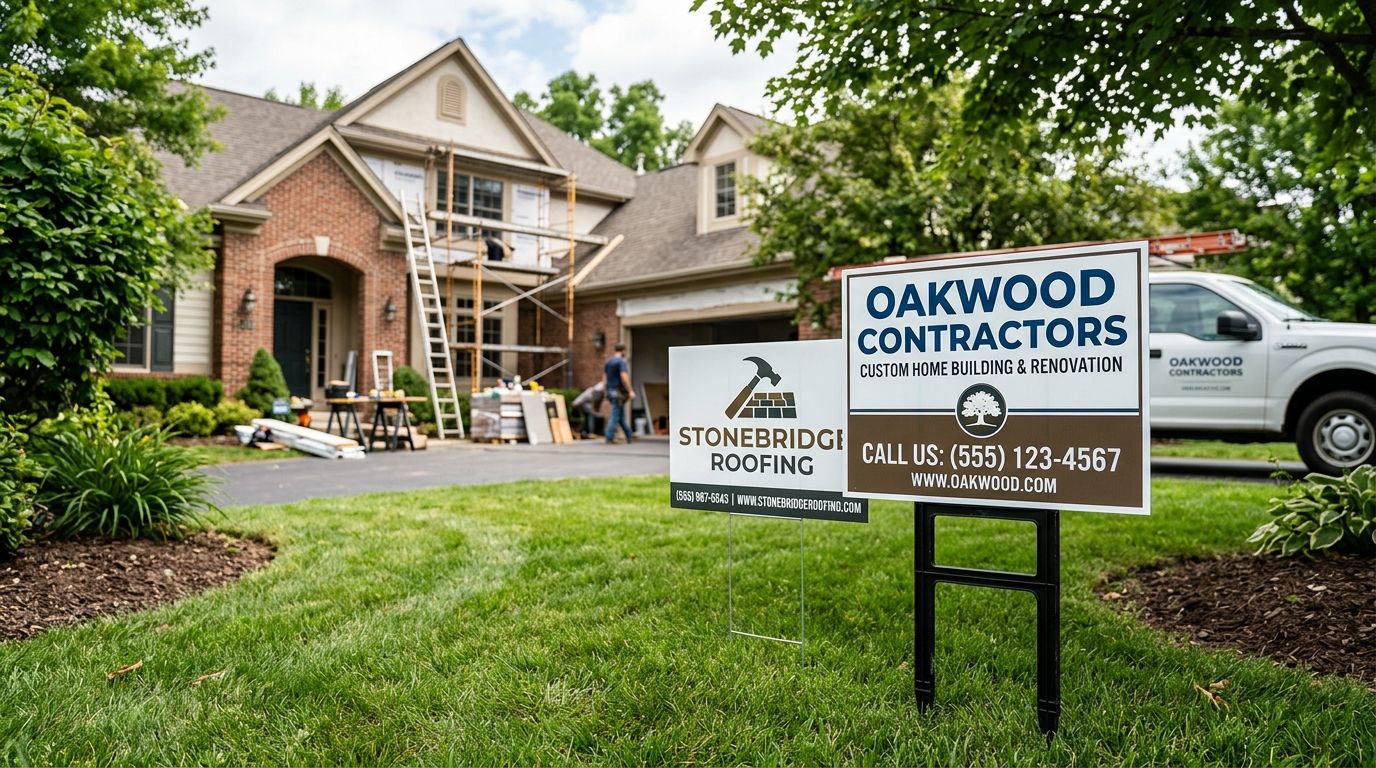
Contractor and construction lawn signs identify an active job site, generate calls from neighbours who see the work in progress, and turn every project into a moving billboard for the next bid. A homeowner picking a roofer or a landscaper rarely searches cold — they call the number on the sign planted next door. The difference between a real estate lawn sign and a contractor's is durability: yours sits through rain, frost, and months of foot traffic instead of a single weekend open house.
- Corrugated plastic lawn signs at 18x24 inches on wire H-stakes are the standard for construction job sites in 2026.
- Contractors get more calls when signs sit at eye level near the curb, not tucked against the house.
- Print Fast prints rush lawn signs same-day for active Toronto and GTA construction jobs.
- Aluminum signs survive multiple jobs; corrugated plastic is a lower-cost, single-project option.
Why lawn signs matter for contractors
A construction lawn sign works while your crew is on someone else's payroll clock. Roofers, landscapers, renovators, and general contractors all compete for the same pool of homeowners who compare three quotes before signing anything, and a sign on a finished or in-progress job is proof of work in a way a website photo never is.
Contractors also have a constraint real estate agents don't: your signs sit outside for weeks or months, not one weekend. That changes the material decision from day one — a sign designed for a Saturday open house will curl, fade, or blow away long before a kitchen renovation wraps in 2026. The category term here is simple: lawn signs built for construction need to survive weather, not just look good in a listing photo.
Update your sign size for the job type
Size decisions depend on how far away the sign needs to read and how long it needs to hold up.
- 18x24 inches — the standard for single-property jobs like roofing, siding, or a driveway repour.
- 24x18 inches horizontal — better for wide lots or corner properties where drivers pass at an angle.
- 12x18 inches — fine for smaller residential add-ons like fencing or eavestrough work.
- Double-sided printing — mandatory on any lot where traffic passes both directions.
- Bundle sizes — order the same size across every active job so your fleet of signs reads as one brand, not a patchwork.
Choose a material rated for the job duration
Material choice is the single biggest factor in whether a sign survives to the end of a project.
- Corrugated plastic (coroplast) — the standard for jobs under 8-10 weeks; lightweight, cheap to replace if stolen or damaged.
- Aluminum — holds up across multiple seasons and multiple job sites, better for contractors who reuse the same generic sign.
- UV-stable inks — ask for them on any sign staying outdoors past 60 days to stop fading.
- Wire H-stakes — the standard mounting hardware; confirm stake gauge before ordering if the site has hard or rocky soil.
- Grommets — add these if the sign will ever be zip-tied to a fence instead of staked.
Corrugated plastic lawn signs on wire H-stakes are the standard choice for contractors in 2026 — durable enough for a multi-week job site, cheap enough to lose a few to weather or theft without it costing much.
“Corrugated plastic lawn signs on wire H-stakes are the standard for contractors in 2026 — durable enough for a multi-week job site, cheap enough to lose a few without it costing much.”
Design for a five-second read
A driver passes a lawn sign in under five seconds. Everything on it has to work at that speed.
- Company name in the largest type on the sign — bigger than the phone number, not smaller.
- Phone number in a font at least 2 inches tall on an 18x24 sign so it reads from a moving car.
- One service line only — "Roofing & Siding" beats a paragraph of services every time.
- High-contrast colour pairing — dark text on white or yellow background outperforms pastel combinations.
- Logo placement in a corner, never centred over the phone number.
Place signs where they get seen
Where the sign sits matters as much as what's printed on it.
- Curb-side, not house-side — plant signs close to the road, angled toward oncoming traffic.
- One sign per visible lot line on corner properties so both approaches see it.
- Height above knee-level foot traffic — stake deep enough that mowing crews and dog walkers don't knock it flat.
- Rotate placement weekly on long jobs so the same neighbours don't tune it out.
- Remove signs within 48 hours of job completion — an old sign on a finished job reads as abandoned, not active.
Order in bulk once you're running multiple jobs
One sign per site works for a single crew. Once you're running three or four jobs at once, ordering piecemeal wastes time and breaks brand consistency.
- Standardize one template across every job site so crews grab a sign and go.
- Order in batches of 10-25 to keep the design and stock consistent for the season.
- Keep 2-3 spares per active crew for theft, wind damage, or a site that runs long.
- Pair signs with door hangers for the houses next to the job — see door hangers for local service businesses for a companion piece that reaches neighbours who never walk past the sign.
- Use the same phone number and colour scheme on invoicing paperwork so a homeowner who called off the sign recognizes the brand on the quote — NCR forms for contractors and invoicing covers the paper side of that consistency.
Once a crew is juggling more than two active sites, this is where a rush print partner earns its keep. Same-day and 24-hour turnaround matters when a job starts Monday and nobody ordered signage the week before — Print Fast runs rush lawn sign orders for Toronto and GTA contractors who need signs on-site before the crew shows up.
Measure what the sign is actually doing
A sign with no way to track results is a guess, not a marketing line item.
- Ask every new caller how they found you and log "yard sign" separately from referrals or online search.
- Track calls by neighbourhood if you run several jobs at once, to see which placements pull leads.
- Compare lead volume between corrugated and aluminum signs across a season if you use both.
- Note theft or damage rate per job type — high-traffic streets lose more signs than quiet cul-de-sacs.
Comparison: sign options for contractors
| Option | Best for | Turnaround | Key limitation |
|---|---|---|---|
| Corrugated plastic lawn sign | Single job, under 10 weeks outdoors | Same-day to 24hr with rush print | Curls or fades past one season |
| Aluminum lawn sign | Reusable, multi-job contractor signage | 24hr to a few days | Higher upfront cost per sign |
| Vinyl banner on a fence line | Larger sites, bigger visual footprint | 24hr to a few days | Needs mounting hardware, not stake-ready |
| Door hanger | Reaching the neighbours around a job, not just drive-by traffic | Same-day to 24hr | Requires door-to-door distribution, not passive |
| Feather flag | High-visibility on open lots or new-build sites | 24hr to a few days | Needs a base and clear space to fly properly |
Common mistakes contractors make with lawn signs
- Using the same sign for every job for years without checking legibility — faded ink and a bent stake read as "this company doesn't care."
- Skipping the phone number size test — a number that looks fine on a screen often shrinks to unreadable at driving speed once printed.
- Leaving signs up after the job wraps — this reads as abandoned work, not finished work, and costs referrals.
- Planting one sign per job and calling it done — corner lots and long driveways need two angles of visibility, not one.
- Ordering standard turnaround for a job that starts in three days — rush printing exists for exactly this gap.
Get lawn signs on-site fast
Same-day and 24hr rush printing for active Toronto and GTA job sites.
FAQ
What size lawn sign is best for a construction site?
18x24 inches is the standard size for a single-property construction job in 2026. Wider or corner lots often need two signs angled toward each direction of traffic.
How long do corrugated plastic lawn signs last outdoors?
Corrugated plastic lawn signs hold up well for jobs under 8-10 weeks. Past that, UV fading and edge curling become noticeable, so longer jobs do better on aluminum.
Are aluminum or plastic lawn signs better for contractors?
Corrugated plastic is cheaper and fine for a single job under three months; aluminum survives multiple seasons and multiple job sites, making it the better choice for contractors who reuse the same generic sign design.
How many lawn signs does a contractor need per job site?
One sign covers most single-lot residential jobs. Corner lots, wide driveways, and larger commercial sites need two signs placed at different angles so both directions of traffic see one.
Can I get lawn signs printed same day in Toronto?
Yes. Print Fast runs same-day and 24-hour rush printing for lawn signs, which matters when a job starts within days and signage wasn't ordered ahead of time.
Do lawn signs need a permit for construction sites in Ontario?
Some municipalities regulate sign size and placement on public boulevards near construction sites, so check local bylaws before staking a sign at the curb. Placement on the private property itself is generally unrestricted.
What information should a contractor's lawn sign include?
Company name in the largest type, a phone number at least 2 inches tall on an 18x24 sign, and one service line. Skip a full list of services — it won't read at driving speed.
How much do lawn signs cost for a construction company?
Cost depends on material, size, and order quantity — corrugated plastic runs cheaper than aluminum for the same dimensions, and bulk orders across several job sites bring the per-unit cost down. Get a custom quote for exact numbers on your job count.
One last thing
Most contractors treat the lawn sign as an afterthought stapled onto the job, but the sign that gets read is the one placed like it matters: curb-side, at an angle facing oncoming traffic, staked deep enough to survive a mow. Swap a faded sign the day it starts curling — a sign that looks tired in 2026 tells the street the work is tired too, even when the job inside is solid.


