
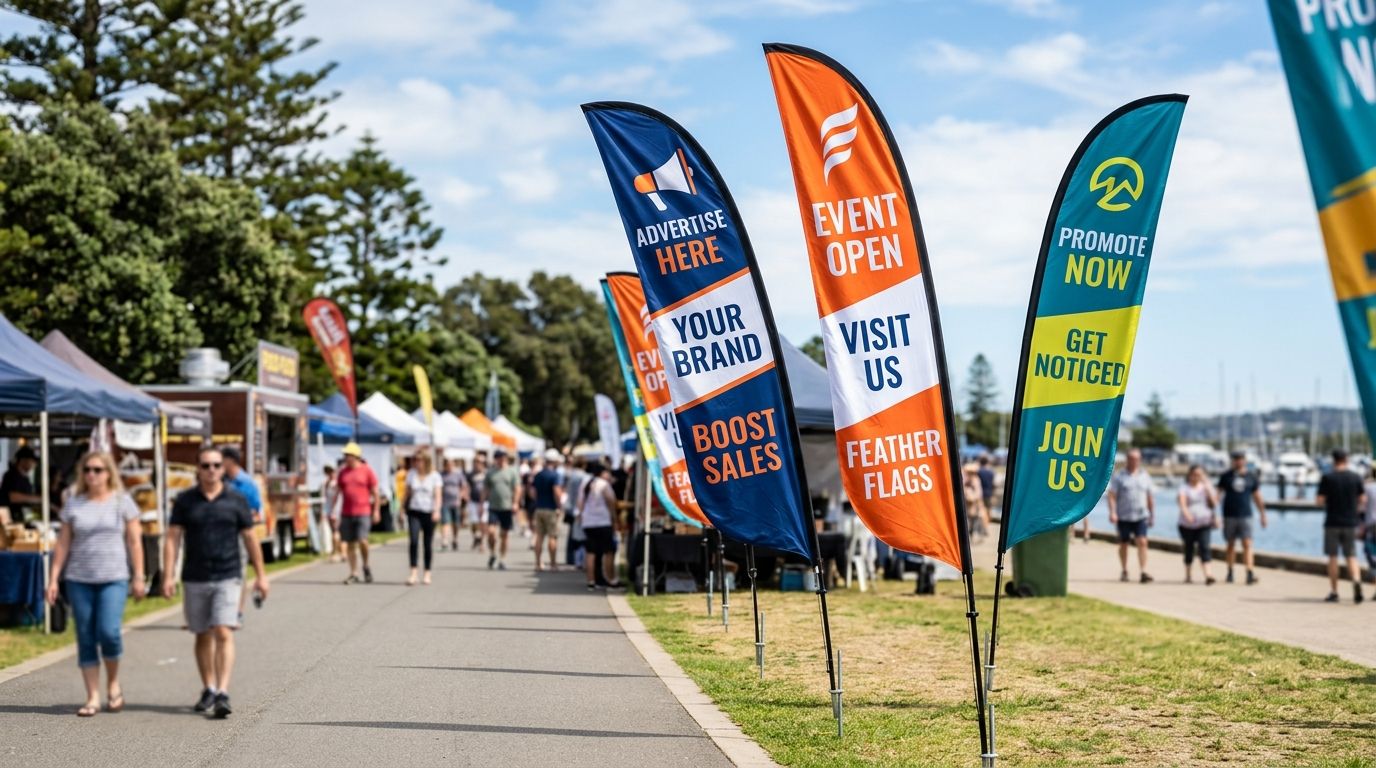
Feather flags for retail storefronts are tall, curved-top banners mounted on a single pole outside the entrance, built to catch a shopper's eye before they walk past a busy block. A storefront competing with five other signs on the same street wins attention because the flag moves — wind lift does a job a static sign never can, and that's the whole reason feather flag options outperform static signs at street level in 2026.
- Feather flags for retail storefronts run 8 to 15 feet tall and mount on cross, spike, or water-bag bases.
- Print Fast prints feather flags for Toronto and GTA storefronts with same-day and rush turnaround options.
- A-frame sidewalk signs and roll-up banner stands are the closest alternatives, each trading reach for portability.
- Skip fabric that isn't rated for outdoor wind exposure — a torn flag on a busy sidewalk reads worse than no flag at all.
Why feather flags matter for retail storefronts
A storefront on a pedestrian street isn't competing with billboards — it's competing with the store next door, the awning across the road, and the phone in every shopper's hand. A feather flag solves a narrower problem than most outdoor advertising: it grabs peripheral vision from thirty feet away and points a walking crowd toward one door.
That makes feather flags a fit for three specific storefront moments: a grand opening that needs foot traffic on day one, a seasonal sale that needs to look different from last month's window display, and a corner unit with weak sightlines from the main sidewalk. Static signage handles the message once a shopper is already at the door. Feather flags do the work of getting them there.
Measure your storefront frontage and clearance
Before ordering anything, walk the actual footprint where the flag will stand. A flag that looks right on a screen can hit an awning or block a doorway on the sidewalk.
- Sidewalk width and how much of it is public right-of-way
- Overhead obstructions — awnings, hanging signs, low wires
- Door swing and pedestrian entry flow at peak hours
- Wind exposure at corner lots versus mid-block units
- Existing signage already competing for the same sightline
Choose your base type for the corner you've got
The base decides whether the flag survives its first windy afternoon or ends up flat on the concrete. Match the base to the surface, not the flag size.
- Cross base — flat sidewalks, small footprint, easy to move indoors overnight
- Spike base — grass strips, planters, soft ground only
- Water-bag base — no digging allowed, holds steady on windy corners
- In-ground base — permanent placement outside a leased storefront
Pick your flag height and shape
Height and shape decide how far the flag reads before a shopper is close enough to see the store's actual signage. A feather (or swooper) shape reads as motion from a distance; a teardrop or rectangle reads as a static block of colour.
Before locking in a feather flag, compare it against an A-frame sidewalk sign for the same spot — the sign wins on close-range menu or price detail, while the flag wins on distance and motion. Standard heights sit at 8, 11, and 15 feet; taller reads further but needs a heavier base to stay upright.
Signs.com's 2026 size guide lists 4 print-area formats: small at 24.25 × 79.5 inches, medium at 25.5 × 105.5 inches, large at 29.5 × 139.5 inches, and extra-large at 27 × 191 inches. Its design guidance recommends 3-inch main text as a starting point, with estimated legibility from 30 to 100 feet.
Design for a three-second read
A shopper walking past gets about three seconds of attention before they've moved on. Design for that window, not for a brochure.
- One message per flag — never stack a sale, a hashtag, and a phone number on the same panel
- Logo or store name in the top third, where it's visible above other signage
- High-contrast colour pairing, not a gradient that fades at distance
- Five to seven words maximum on the main line
- Choose a double-sided feather flag so the message reads correctly from both walking directions
Rotate your message with the season or promotion
A flag left up past its promotion tells a walking crowd the store stopped paying attention. Treat the flag sleeve as replaceable, not the whole unit.
- Swap the printed sleeve, keep the pole and base in place
- Print a second sleeve at the same time as the first so there's no downtime between swaps
- Tie flag copy to whatever's actually in the window that week
- Budget one reprint per season at minimum for a storefront running promotions year-round
Place flags in a line for maximum pull
One flag gets noticed. Three flags in a line get remembered — the repetition reads as a destination, not a single sign.
- Space flags 6 to 8 feet apart along the frontage
- Alternate 8-foot and 11-foot heights for a visible wave effect
- Keep the sightline to the actual door clear of all three
- Never block an accessible curb ramp to make room for a flag line
Maintain and store the flags off-season
A feather flag that's faded or creased undoes the work it was printed to do. Storage habits decide how long a single print lasts.
- Roll the fabric, don't fold it — folds crease into permanent lines
- Hose off road salt and grime before storing through a Toronto winter
- Retire a flag once the colour visibly fades against a fresh print
- Keep a spare base at each site so redeployment doesn't wait on hardware
Comparing outdoor advertising options for a storefront
| Option | Best for | Key limitation |
|---|---|---|
| Feather flag | Corner lots and grand openings that need motion to pull foot traffic | Needs steady wind or a fan base to read as intended |
| A-frame sidewalk sign | Doorway impulse messaging and daily specials | Static — easy to steal or move indoors overnight |
| Roll-up banner stand | Under an awning or just inside the entrance | Needs a flat, low-wind surface — struggles outdoors on open sidewalks |
| Teardrop flag | Compact outdoor displays with a taut silhouette | Less printable width than a rectangle flag |
| Rectangle flag | Messages that need a wider, block-style layout | Less distinctive curved movement than a feather flag |
Verdict: for a Toronto or GTA storefront that needs to pull foot traffic off a busy sidewalk in 2026, a feather flag beats a static sign on distance and motion — but pair it with an A-frame or window sign for the close-range message.
Common mistakes retail storefronts make with feather flags
- Planting the flag where there's no wind — under an awning or against a wall kills the motion that makes the flag work
- Using a spike base on paved sidewalk — spike bases need soft ground; a cross or water-bag base is the fix
- Printing single-sided — a single-sided feather flag shows the reverse image through the fabric instead of presenting a separate correctly oriented panel
- Leaving a faded flag up past the promotion — it reads as neglect, not as a current sale
- Skipping the local sidewalk-signage check — confirm what's allowed on public right-of-way in Toronto and the GTA before placing a flag line
FAQ
Order feather flags from Print Fast: feather flags at PrintFast.ca — same-day and 24-hour turnaround in Toronto.
What is the best height for a feather flag outside a retail store?
Most retail storefronts do best with an 8 or 11 foot feather flag; 15 foot flags read further but need a heavier base to stay upright on windy corners.
How long do feather flags last outdoors?
Fabric life depends on wind, sun exposure, and storage habits more than the print itself. Rolling instead of folding, and storing off-season, extends how long a flag keeps its colour and shape.
Are feather flags better than A-frame sidewalk signs?
Feather flags win on distance and motion, pulling attention from further down the sidewalk. A-frame signs win on close-range detail like daily specials, so many storefronts run both.
Do feather flags need a permit in Toronto?
Placement on public sidewalk or right-of-way can be restricted depending on the location, so check local signage rules before setting up a flag line outside a storefront.
Can feather flags be double-sided?
Yes, and double-sided printing is worth the request for any storefront with two-way foot traffic, since single-sided flags show blank fabric to half the pedestrians walking past.
What base works best for a windy street corner?
A water-bag base holds steadiest on exposed corners without requiring any digging into the sidewalk, which makes it the standard choice for wind-heavy storefront locations.
How much does a feather flag cost in 2026?
Cost depends on the flag size, print method, and hardware chosen, so it's worth requesting a current quote directly rather than relying on a fixed number.
How often should a feather flag be replaced?
Replace the printed sleeve once the colour visibly fades against a fresh print, and keep a spare sleeve ready so a storefront never runs a flag line with worn fabric.
One last thing
Request a reverse-printed second panel, not just a single-sided print, if the flag sits anywhere with two-way foot traffic. Dye-sublimated polyester carries colour through the fabric, so a reverse panel reads correctly instead of mirrored — a detail most storefronts skip until they notice half their sidewalk traffic is walking past blank fabric.


