
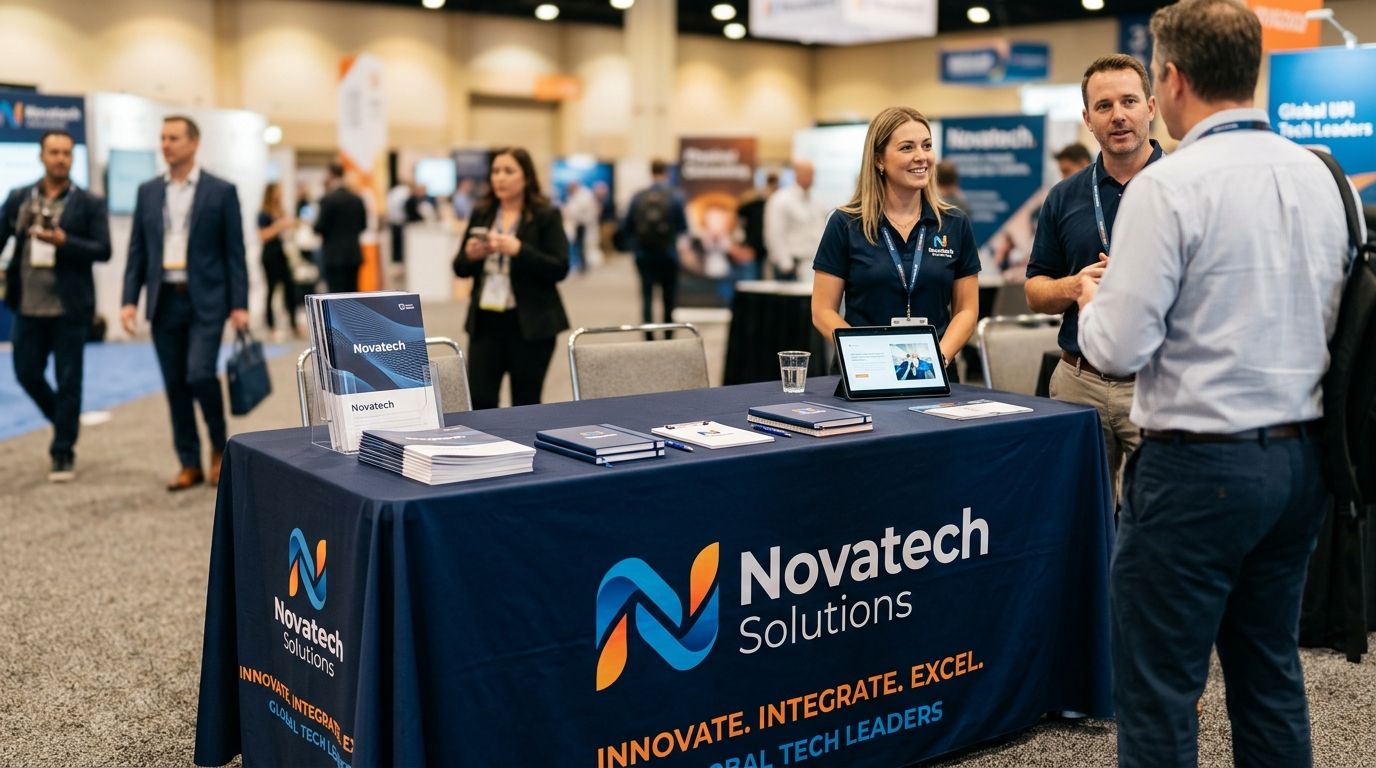
Custom tablecloths for trade show booths are printed table covers sized to fit standard 6-foot or 8-foot show tables, built to carry your logo and colours across the full front panel so your booth reads as branded the moment someone turns down the aisle. Toronto and GTA exhibitors booking a show in the next two to three weeks need a print partner that can turn a full-colour cover around before load-in, not a supplier quoting a three-week production window.
- Fitted stretch tablecloths give the cleanest, wrinkle-free look for trade show photos in 2026.
- Dye-sublimation printing puts ink into the fabric fibre, so it won't crack or peel over multiple shows.
- Standard folding tables run 6ft (72x30x29 in) or 8ft (96x30x29 in) — measure before you order custom tablecloths.
- Many convention centres require flame-retardant certified fabric; check the exhibitor kit before you pick a supplier.
- Print Fast offers Rush and Same Day turnaround for exhibitors ordering close to a show date.
Why this matters for trade show exhibitors
A table is the first flat surface an attendee's eye lands on at a booth, well before they look up at a banner stand or read a sign. A blank or wrinkled cloth undercuts everything else in the booth — the roll-up banners, the staff lanyards, the pitch itself.
Exhibitors also work under a hard deadline that most print categories don't have: the show date doesn't move. A tablecloth ordered too close to load-in with the wrong turnaround expectation is a booth that shows up bare. Print Fast builds custom tablecloths around that constraint, with Rush and Same Day options for GTA exhibitors who booked a booth later than they planned.
Measure your table before you order
Get the exact table dimensions from the show's exhibitor kit before choosing a cover — most convention centres supply tables, and sizes vary by venue.
- Standard 6-foot folding table: 72" x 30" x 29" high
- Standard 8-foot folding table: 96" x 30" x 29" high
- Confirm whether the venue's table height includes or excludes the apron
- Check if you're bringing your own table instead of using the venue's
- Note whether you need storage access from behind the table during the show
Choose fitted, draped, or a table runner
The style you pick decides how much of the table is covered and how easy it is to reach stock or supplies mid-show.
- Fitted stretch cover: pulls tight over the table and corners, no loose fabric to snag or wrinkle
- 3-sided open-back throw: covers front and both sides, leaves the back open for bins and storage
- 4-sided closed throw: covers all sides, hides everything stored underneath
- Table runner or topper: layers over a plain base cloth, cheaper to swap when a campaign changes
Verdict: a fitted stretch cover is the right call for booths built around photos and demos; a 3-sided throw wins when staff need to grab stock all day.
Pick a fabric that survives a full show day
Fabric choice decides whether the cover still looks pressed by hour six of a two-day show.
- Polyester poplin: standard economical option, resists wrinkles, holds colour well
- Stretch spandex: snug fit with almost no visible seams, higher cost than poplin
- Satin: reads more formal, better suited to evening events than a daytime show floor
- Flame-retardant certified fabric: many convention centres require it — confirm in the show's exhibitor kit before ordering
- Dark or mid-tone colours over white or pale shades, since scuffs and coffee rings show fast on light fabric
Design artwork that reads from the aisle
A cover only works if someone six feet away can read it while walking past at a normal pace.
- Keep the logo above the table's midline so boxes and giveaways don't cover it
- Use high contrast between logo and background colour
- Leave bleed on all wrap edges so nothing gets cut off at the fold
- Avoid body text under 24pt; it disappears at aisle distance
- Proof the full-colour file before sending it to print, not just a black-and-white draft
Decide full-colour dye-sub vs single-logo print
This is where the manual DIY route and a print shop's process actually diverge. A plain cloth with a heat-pressed or vinyl logo is cheaper up front but limited to one or two colours and a single logo placement. Full-colour dye-sublimation infuses ink directly into polyester fibres edge-to-edge, so gradients, photos, and multi-colour branding print cleanly and won't crack, peel, or fade the way an applied vinyl decal can after repeated folding and packing.
Print Fast runs custom tablecloths through dye-sublimation for full-bleed, edge-to-edge branding rather than a single applied logo — the difference matters most for exhibitors with a photo, gradient, or multi-colour background in their booth design.
Order with the show date driving turnaround, not the calendar
Work backward from load-in day, not from when you happen to remember to order.
- 1Hr and Same Day options exist for last-minute reorders inside Toronto
- 24Hr and Rush turnaround cover most exhibitors booking a week or less out
- Standard production windows suit exhibitors planning a show more than two weeks ahead
- Local Delivery in the GTA removes courier lead time from the schedule
- Live Support and Custom Quotes help when a design needs a fast revision before the print run
Pack and store it between shows
A cover that survives one show should survive a dozen if it's packed correctly.
- Fold along built-in seams, not new creases, to avoid permanent lines
- Store in a garment bag between shows, not loose in a box
- Steam spandex and poplin instead of ironing directly — high heat can scorch or melt polyester fibres
- Label the storage bag with the show name and date if you rotate between multiple campaigns
If you also sell at markets or craft fairs alongside trade shows, a table cover built for market vendors covers a similar need with a different table footprint.
Comparing table cover options for trade show booths
| Option | Best for | Key limitation |
|---|---|---|
| Fitted stretch tablecloth | Booths built around photos and product demos | Sized to one table dimension; won't fit odd or oversized tables |
| 3-sided open-back throw | Exhibitors who need mid-show access to stock or storage | Back panel is unbranded and visible from behind the booth |
| 4-sided closed throw | Booths storing boxes underneath that want zero visibility | Harder to reach stored items during the show |
| Table runner or topper | Multi-show exhibitors rotating campaigns without a full reprint | Needs a base cloth underneath; reads less premium alone |
Get a quote before your next show
Custom Quotes and Rush turnaround for GTA exhibitors on a show deadline.
Common mistakes trade show exhibitors make
- Ordering the wrong length. A cover cut for an 8ft table dragging on the floor around a 6ft table looks worse than no cover at all.
- Placing the logo too low. Giveaways, laptops, and brochures on the tabletop block anything printed near the bottom edge.
- Skipping flame-retardant certification. Some venues check fabric certification at load-in and can turn away a non-compliant cover on the spot.
- Choosing white or pale fabric for a two-day show. Scuffs, coffee rings, and marker smudges show within hours on light colours.
- Reusing last year's design without updating it. A booth number, campaign message, or product line change should update the cloth, not just the banner stand.
FAQ
What size tablecloth do I need for a trade show table?
Standard folding tables run 6ft (72x30x29 in) or 8ft (96x30x29 in). Check the show's exhibitor kit for the exact table size before ordering a custom tablecloth.
Is a fitted or draped tablecloth better for a trade show booth?
A fitted stretch tablecloth gives a cleaner, wrinkle-free look for photos and demos. A 3-sided draped throw works better when staff need to reach stock or storage during the show.
How fast can I get a custom tablecloth printed before a show?
Print Fast offers Rush and Same Day turnaround for exhibitors ordering close to a show date, plus Local Delivery across the GTA to remove courier lead time.
Does the fabric need to be flame-retardant certified?
Many convention centres require flame-retardant certified fabric for table covers and other booth materials. Confirm the requirement in the show's exhibitor kit before you order.
What's the difference between dye-sublimation and vinyl logo printing on a tablecloth?
Dye-sublimation infuses ink into the fabric fibre for full-colour, edge-to-edge designs that won't crack or peel. Vinyl or heat-pressed logos are cheaper but limited to one or two colours in a fixed placement.
Can I reuse a custom tablecloth for multiple shows?
Yes, if it's packed and stored correctly. Fold along built-in seams, steam instead of iron, and store in a garment bag between shows to avoid creasing or scorching the fabric.
Should I choose white or dark fabric for a trade show tablecloth?
Dark or mid-tone fabric hides scuffs, coffee rings, and marker smudges better than white or pale colours over a full show day.
What should go on the tablecloth versus the banner stand?
Keep the logo and core message on the tablecloth above the midline so it's visible even with items on the table. Save detailed copy for banner stands or signage positioned higher up.
One last thing
Spandex and poplin covers should never see a hot iron — high heat can scorch or melt the polyester fibre and leave a permanent shine mark. Steam instead, and the fitted shape holds without a single crease showing up in booth photos, which matters more in 2026 than most exhibitors think when they're packing the night before a show.


